Web3 is changing how value, identity, and ownership move online through systems built on blockchain technology. But the Web3 ecosystem is also noisy: thousands of tokens, fast-moving narratives, and constant on-chain activity. That's why AI blockchain integration is becoming a core part of modern Web3 products. It pairs machine intelligence that can analyze patterns at scale with blockchain infrastructure that can verify data, enforce rules, and settle transactions transparently.
This guide focuses on one specific question: how artificial intelligence and blockchain technology work together in real-world systems.
What "AI Blockchain Integration" Actually Means
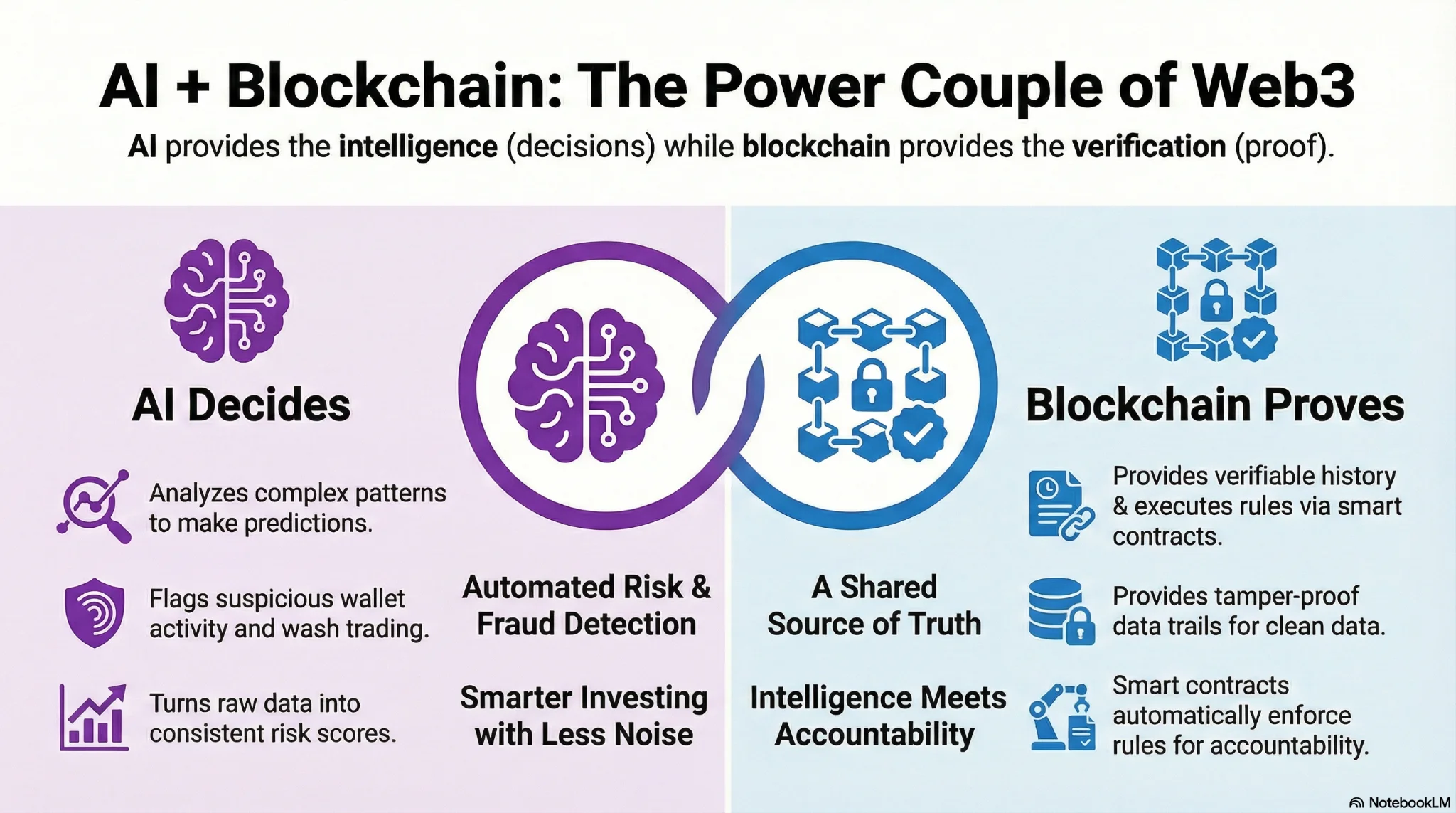
AI blockchain integration is the system design where:
- AI (machine learning models) produces outputs like risk scores, predictions, classifications, recommendations, and anomaly alerts.
- Blockchain provides verifiable data history, programmable execution (smart contracts), and transparent settlement.
A simple way to remember it:
- AI helps decide
- Blockchain helps prove and execute
This is the practical meaning of blockchain meets artificial intelligence, and the reason the market keeps moving toward AI blockchain synergy.
Why Blockchain Is a Strong Foundation for AI in Crypto
AI systems are only as good as the data and incentives around them. In crypto, data manipulation and selective storytelling are constant risks. Blockchain reduces that risk because it creates a shared source of truth.
1) Verifiable Data Trails
On-chain activity is timestamped and difficult to rewrite retroactively. That gives AI systems cleaner inputs for trend analysis, behavior patterns, liquidity events, and token flow signals.
2) Transparent Rules Through Smart Contracts
When actions like vesting, staking rewards, or allocations are handled by smart contracts, the rules are visible. That makes outcomes easier to audit, which is critical for investor trust.
These contracts operate based on predefined logic secured by a consensus mechanism, ensuring the network agrees on outcomes without central control.
3) Incentives That Can Reward Quality
Token incentives can reward high-quality contributions like useful datasets, correct labeling, validation, and monitoring. This is one path toward Decentralized AI, where quality is reinforced by an open incentive layer instead of a single gatekeeper.
Why AI Makes Blockchain Products More Useful
Blockchains are great at secure settlement and transparency, but they do not solve the human side of the problem:
- Too much information
- Too many low-quality projects
- Sophisticated scams
- Decisions that require context, not just data
AI helps make blockchain products usable at scale by adding:
1) Risk Scoring and Due Diligence Automation
AI can evaluate signals like token distribution, liquidity depth, unlock schedules, and overall tokenomics structure. That turns raw on-chain activity into decision-ready insights.
This is where AI blockchain integration becomes practical for investors. For example, at IPO Genie, our scoring approach is designed to help users compare early-stage opportunities more consistently by combining structured evaluation with verifiable market signals, rather than relying on narratives alone.
2) Fraud Detection and Anomaly Monitoring
AI models can flag suspicious wallet clustering, unusual contract interactions, wash trading patterns, and liquidity manipulation earlier than manual review.
3) Personalization Without Giving Up Custody
AI can tailor insights to a user's preferences or portfolio behavior while the user remains in control of funds via self-custody. This alignment of intelligence and ownership is a major advantage of Web3 technology, and we focus on user-first access, clarity, and transparency in the discovery workflow.
The Most Common Ways AI and Blockchain Work Together
Most real systems follow one of these architectures:
Architecture A: On-Chain Data, Off-Chain AI
- Blockchain generates the data (transactions, liquidity, governance activity)
- AI analyzes it off-chain for speed and cost
- Outputs are published back on-chain (scores, alerts, eligibility)
This is common because model computation can be expensive on-chain.
Architecture B: Off-Chain Data, On-Chain Verification
- AI uses off-chain sources (news, social signals, filings, research)
- Important outputs are anchored on-chain using hashes, attestations, or signed proofs
This protects against "result rewriting" after the fact.
Architecture C: Decentralized AI Networks
- Multiple parties contribute data or compute
- Validation is distributed
- Incentives align contributors through tokens
This is where Decentralized AI becomes more literal, but it still requires strong design to prevent spam and manipulation.
Architecture D: Smart Contracts Triggered by AI Signals
- AI produces a signal
- A smart contract enforces a rule based on that signal (limits, rebalancing, insurance triggers)
This is powerful, but it must be designed carefully because bad signals can trigger real financial actions.
What AI and Blockchain Technology Contribute
| Use Case | What AI Contributes | What Blockchain Contributes | Why It Matters |
|---|---|---|---|
| Deal scoring | Consistent scoring, pattern detection, risk flags | Verifiable on-chain metrics, transparent execution rules | Better decisions with less noise |
| Scam and fraud detection | Anomaly detection, clustering, behavior modeling | Immutable trails of transactions and contract interactions | Earlier warnings, reduced losses |
| Portfolio monitoring | Trend detection, volatility signals, personalized insights | Auditable activity, transparent holdings and flows | Faster reaction with clearer context |
| Tokenized data marketplaces | Data quality ranking, validation models | Provenance, permissioning, incentive payouts | Stronger data integrity and incentives |
| Reputation and identity | Scoring trust signals from behavior | Tamper-resistant reputation history | Better filtering of participants and projects |
| Insurance and risk pools | Pricing models, fraud detection | Automated payout rules via smart contracts | More predictable risk management |
This table reflects the most practical blockchain applications in AI today: decision support and trust reinforcement built on transparent rails.
The Impact of AI and Blockchain Use Cases in Web3
Here are the real-world applications that consistently produce value in AI in crypto:
1) Safer Investing Workflows
Crypto is a high-velocity market. AI improves filtering and risk visibility, while blockchain provides transparency around the underlying activity. This is the most direct expression of AI blockchain integration for everyday investors. For investors participating in early-stage token launches, understanding presale mechanics and risks is equally critical.
2) Better Market Integrity
Fake volume, manipulated liquidity, and wallet-based deception are common. AI identifies unusual patterns, and blockchain provides the evidence trail.
3) Automated Execution with Accountability
Smart contracts can enforce rules, while AI can inform decisions like timing, eligibility, allocation, or risk thresholds. The result is automation that is more auditable than Web2 platforms.
4) Decentralized AI as an Emerging Direction
As the ecosystem matures, more systems will distribute contributions across networks, using token incentives for data and validation. The challenge is quality control. The opportunity is open participation with provable accountability.
What to Look for Before Trusting Projects Claiming AI Blockchain Integration
If a project markets AI blockchain integration, these are the questions that separate real systems from buzzwords:
1) What Is Verifiable?
- Are key actions executed by smart contracts?
- Are important outputs anchored or auditable?
2) What Data Powers the Model?
- On-chain data only, or also off-chain?
- Are the data sources clearly stated and defensible?
Investors should also understand how to properly interpret token structures, especially when evaluating early-stage opportunities.
3) How Is Manipulation Prevented?
Look for practical controls like stakeholder-based penalties, rate limits, identity signals, validation layers, and transparent governance.
4) Does It Reduce Real User Friction?
A strong product makes users faster and safer, not just impressed by terminology.
The Future of AI and Blockchain
The future of AI and blockchain is not about replacing humans. It's about improving decision quality in open markets while preserving transparency and ownership.
Expect these trends to grow:
- More AI-driven analysis of on-chain behavior
- More verifiable outputs and audit trails
- More automation via smart contracts
- Gradual expansion of Decentralized AI networks as quality controls improve
This evolution fits naturally inside Web3 technology. Web3 provides the rails for ownership and verification, while AI provides the intelligence layer that helps users navigate complexity. For broader context, read our full guide on what Web3 is and how it's shaping the future of the internet.
Smarter Decisions You Can Verify
AI blockchain integration combines intelligence and verification. AI improves analysis, ranking, and detection. Blockchain improves trust, auditability, and execution. Together, they power safer, smarter experiences in Web3 technology, especially for investors who need clarity in a market that moves fast.
Join the IPO Genie presale to access AI-powered deal scoring built on transparent infrastructure.
Frequently Asked Questions
Q: How do AI and blockchain work together in simple terms?
AI finds patterns and produces decisions like scores or alerts. Blockchain stores verifiable activity and executes rules via smart contracts, making outcomes transparent and auditable.
Q: Is Decentralized AI required for AI blockchain integration?
No. Many systems use centralized AI with blockchain-based verification. Decentralized AI is a separate direction where training, validation, or governance is distributed.
Q: What are the most valuable blockchain applications in AI today?
Risk scoring, fraud detection, monitoring, reputation systems, tokenized data provenance, and smart-contract execution informed by AI signals.
Q: Why does this matter for investors?
Because it reduces noise, flags risks earlier, and improves consistency. In fast markets, better filtering and verifiable execution can be a major edge. This is especially relevant in early-stage offerings like crypto presales, where transparency and signal clarity matter most.
Disclaimer: This article is for educational purposes only and does not constitute investment advice. Early-stage investing carries significant risk. Always conduct thorough due diligence and consult professionals before making investment decisions.