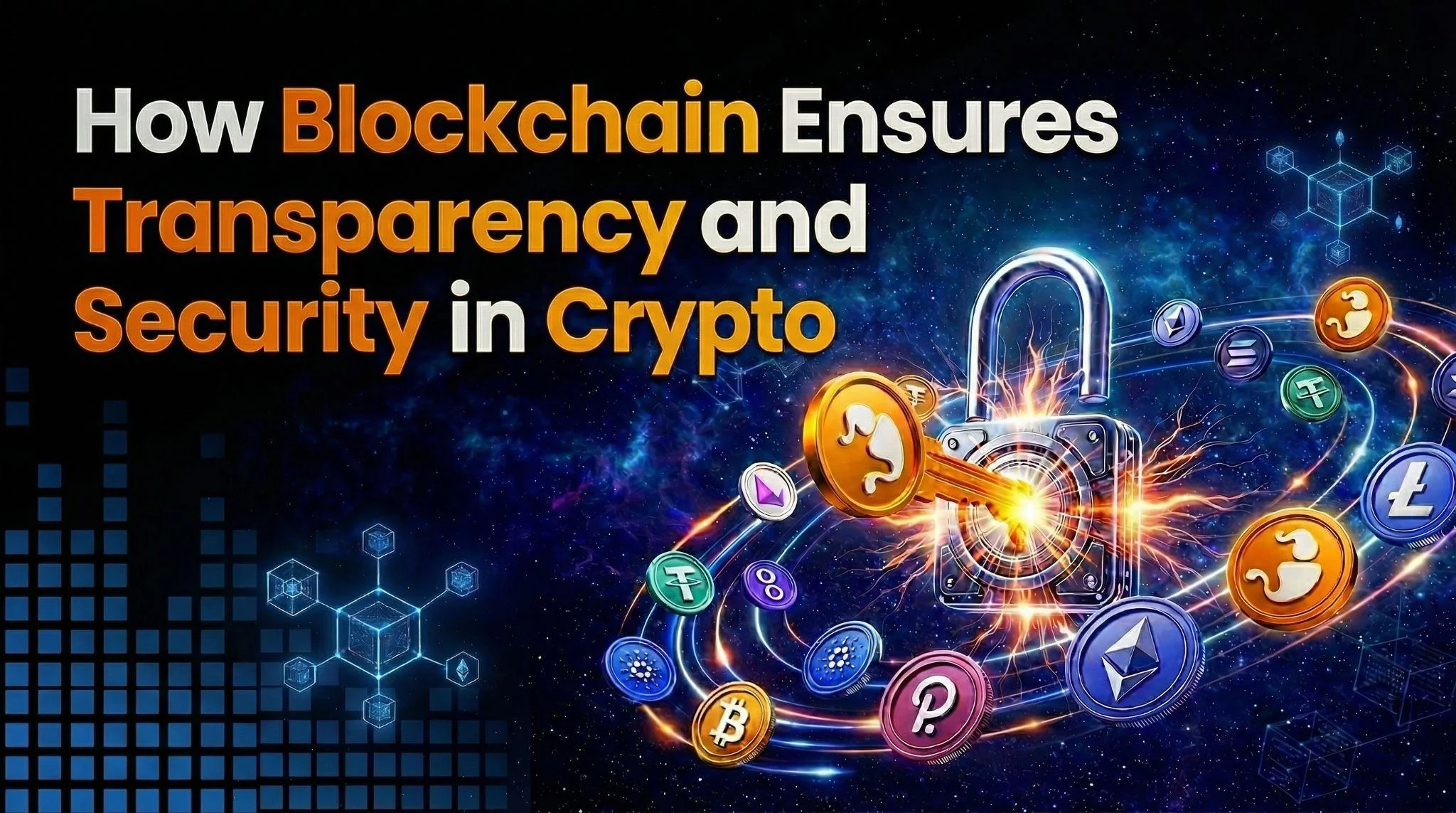
In crypto, trust is not built on a bank's promise or a company's internal database. It is built on blockchain transparency and security, where the network keeps a shared record that anyone can verify, and cryptography makes that record extremely difficult to manipulate.
If you want to learn crypto, this guide will show you exactly how transparency works, how blockchain enhances security, and what you can personally check on-chain before you trust a token or protocol.
If you want the full foundation first, read our beginner guide: What Is Blockchain and How Does It Work?
Why Transparency and Security Matter in Cryptocurrency
To understand why blockchain is such a big deal, it helps to connect the basics.
Cryptocurrency means a digital form of value that can be sent peer-to-peer using a blockchain ledger instead of a central authority. Simply, cryptocurrency works because the network agrees on a single version of the truth.
So when people ask how cryptocurrency works, the real answer is:
It works because the ledger is verifiable, the rules are enforced by the network, and transactions are authorized using cryptographic keys.
That's the core value behind transparency in blockchain technology and the reason security is built into the design, not added later.
Transparency in Blockchain Technology: What You Can Actually Verify
Blockchain transparency does not mean your personal identity is public. It means the data is verifiable.
Here's what transparency looks like in real life:
- Every transaction is recorded on a ledger shared across the network.
- Transactions are time-stamped and traceable, so you can follow movement from address to address.
- The same history is visible to everyone, which makes audits, tracking, and verification possible without trusting a private report.
This is one of the biggest benefits of blockchain transparency for investors: you can check what happened on-chain, not what someone claims happened.
Blockchain Transparency Security Features That Protect the Ledger
Blockchain security is not one feature. It's a set of security layers working together.
1) Cryptographic Hashing (Tamper Evidence)
Each block includes a cryptographic fingerprint called a hash, which is part of how blocks are structured and linked together. If someone changes a past record, the hash changes, and the network can detect the mismatch. This is what makes the ledger tamper-resistant.
2) Digital Signatures (Proof You Authorized a Transaction)
Instead of usernames and passwords, blockchain uses public and private keys.
- Your private key signs a transaction.
- The network verifies the signature using your public key.
This proves the transaction was authorized by the key holder without exposing the private key.
3) Consensus Mechanisms (Network Agreement)
A blockchain needs a way to decide which transactions are valid. That's the consensus.
- Proof of Work uses computation to secure the chain.
- Proof of Stake uses staked value and validator incentives to secure the chain.
Different methods, same goal: make rewriting history extremely expensive.
4) Distributed Nodes (No Single Point of Failure)
Because many computers store the ledger, there is no single database to compromise and quietly edit. An attacker would need to overpower the network, not hack one server.
Decentralization & Security in Blockchain: Why "No Middleman" Can Be Safer
Centralized systems fail in predictable ways: a single organization can be hacked, pressured, or corrupted. Blockchain reduces that risk by distributing control.
Decentralization strengthens security because:
- No single entity controls the ledger
- No single server holds the "real" database
- The system is validated by many independent participants
This does not mean all blockchains are equally secure. Large, widely-used networks tend to be harder to attack than small or poorly distributed ones. That's why it matters which chain a project uses and how active its validator or miner ecosystem is.
How Blockchain Ensures Transparency & Security in Crypto (Beginner Checklist)
This is the practical section most people miss. If you want to use blockchain transparency as an advantage, here is what to check before trusting a token, crypto presale, or protocol.
On-Chain Verification Checklist
- Confirm the official contract address from the project's official site and verified channels
- Use a block explorer to view transactions, holders, and contract interactions
- Check token supply and decimals to confirm the numbers match official tokenomics
- Review top holders and concentration to understand whale risk and distribution health
- Inspect liquidity status and whether liquidity is locked or controlled by a single wallet
- Check contract ownership permissions to see if admin functions can change fees, mint, pause, or blacklist
- Look for unusual transaction patterns like repeated minting, sudden large transfers, or coordinated dumps
- Verify audit references and confirm they apply to the same deployed contract and version
This is why blockchain is powerful for crypto beginners. This is especially important when evaluating early-stage token launches and presale opportunities where transparency can protect against common risks. You are not forced to trust marketing claims. You can verify the facts.
Quick Comparison of Transparency and Security Working Together
| Blockchain Concept | What It Does for Transparency | What It Does for Security | What Beginners Should Watch |
|---|---|---|---|
| Shared ledger (nodes) | Everyone can verify the same record | Reduces a single point of failure | Check activity and network strength |
| Hash-linked blocks | Makes history easy to audit | Makes tampering obvious and costly | "Immutable" does not prevent scams |
| Consensus (PoW/PoS) | Confirms what is valid | Prevents easy rewrites of history | Smaller chains can be easier to attack |
| Digital signatures | Transactions are verifiable | Proves authorization without passwords | Protect private keys from phishing |
| Smart contracts | Rules can be inspected publicly | Automates execution without intermediaries | Contract bugs and admin keys matter |
Real Examples of Blockchain Transparency and Security
1) Tracking Token Supply and Distribution
You can verify supply metrics, track large holders, monitor transfers in real time, and verify vesting schedules and lock-in periods. This makes tokenomics basics measurable instead of theoretical, especially when a project claims certain allocations or vesting behavior.
2) Verifying Contract Activity
You can see how often a contract is used, which functions are called, and how funds move through it. For investors, this helps separate real usage from hype.
3) Auditable Treasury and Reserves
When a protocol uses on-chain wallets for treasury, community members can monitor balances and movements. That visibility is a major benefit in Web3, where transparency can be continuous, not quarterly.
The Tradeoffs: What Transparency Does Not Protect You From
Blockchain improves system-level trust, but it does not remove all risk.
- Your wallet activity can be traced even if your name is not attached
- Transactions are usually irreversible, so mistakes do not come with chargebacks
- Smart contracts can have vulnerabilities even if the underlying blockchain is secure
- Scams can still exist because scammers can deploy contracts, too
For crypto beginners, the best mindset is: blockchain makes verification possible, but you still need strong personal security and careful due diligence.
Verify, Don't Blindly Trust
The real promise of blockchain transparency security is simple: it replaces "trust me" with "verify it." Transparency gives you a visible audit trail. Security makes that trail hard to forge. And when you combine both, you get a foundation where cryptocurrency can operate without relying on a single gatekeeper.
Join the IPO Genie presale now

Frequently Asked Questions
Q: Is blockchain fully anonymous?
Most public blockchains are better described as pseudonymous. Addresses are public, and activity can be traced through transactions and patterns.
Q: Can blockchain be hacked?
No system is perfect, but strong public networks are highly resistant to ledger manipulation because rewriting history requires overwhelming the network. More common risks include phishing, stolen keys, fake contracts, and smart contract vulnerabilities.
Q: How does cryptocurrency work in one sentence?
A transaction is signed with a private key, broadcast to the network, verified by nodes, confirmed by consensus, and permanently recorded on the blockchain.
Q: What is the simplest definition of transparency in blockchain technology?
It means the transaction record is publicly verifiable, so you can confirm what happened without trusting a private database.
Disclaimer: This content is for educational and informational purposes only and does not constitute financial, investment, or legal advice. Crypto assets carry risk, including the potential loss of capital.