DAOs (Decentralized Autonomous Organizations) are blockchain-based organizations that coordinate decisions, money, and execution using transparent rules instead of a traditional management structure. In simple terms, a decentralized autonomous organization is a community that proposes ideas, votes on them, and then carries out the result through on-chain processes. That's why DAOs matter in Web3 networks: they let internet-native communities govern shared networks without relying on a single company or central admin.
Simply DAOs Explained
To understand DAOs without the jargon, think of a DAO as a digital co-op:
- Members collaborate around a shared mission (build, fund, maintain, invest, coordinate).
- Rules are written into smart contracts or formal governance processes.
- Decisions are made through proposals and voting.
- A treasury is managed transparently, with actions logged on-chain.
A DAO is not "no humans." It's a system where humans operate inside a rule-set that's easier to audit. Instead of trusting a leadership team to follow the rules, the DAO's structure makes the rules visible, enforceable, and harder to change quietly.
Why DAOs Exist & Why Web3 Needed Them
Web3 gave communities new tools: tokens, smart contracts, and on-chain ownership. But communities still needed a way to:
- make decisions fairly across thousands of stakeholders,
- manage funds without a single person controlling the bank account,
- reward contributors globally,
- and keep governance transparent.
DAOs emerged as the governance layer for Web3 networks. They make it possible to fund development, coordinate contributors, and steer a protocol's direction through on-chain governance rather than private meetings and internal approvals.
How DAOs Work
Most DAOs follow a recognizable "proposal lifecycle." If you learn this flow, you can quickly evaluate how any DAO crypto community operates.
- Idea and discussion: The community discusses a change, budget, partnership, or policy in a public forum.
- Draft proposal: A contributor writes a structured proposal: goal, cost, timeline, and success metrics.
- Voting process: Members vote on-chain or through a governance system that can later trigger on-chain execution. These executions rely on the underlying consensus mechanism to validate and secure each decision across the network.
- Quorum and threshold: The proposal must hit the required participation (quorum) and approval percentage.
- Execution: Once approved, the DAO executes: funding a grant, changing protocol parameters, onboarding a team, or moving treasury assets.
- Reporting and accountability: Strong DAOs publish updates, track outcomes, and measure results.
This is the core mechanism behind how DAOs work. It's not only about voting — it's about transparent decision-making plus real execution.
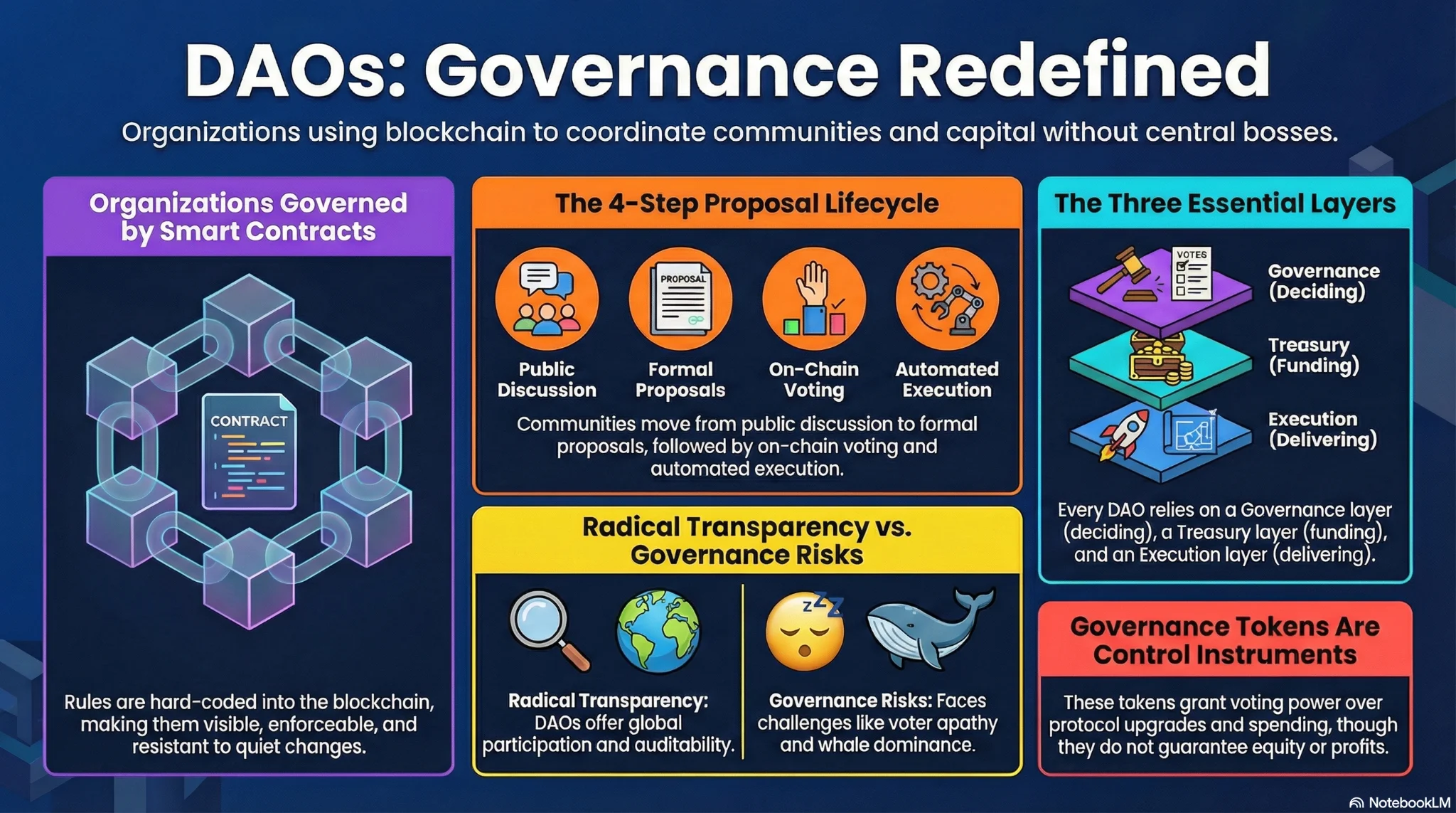
The 3 Layers Every DAO Has (Fast Evaluation Framework)
A useful way to analyze a DAO is to break it into three layers:
1) Governance Layer (Decision-Making)
- Who can propose?
- Who can vote?
- Are votes token-based, delegated, or reputation-based?
- What prevents vote manipulation?
2) Treasury Layer (Treasury Management)
- Who controls funds?
- Are there timelocks, multi-sigs, or spending limits?
- Is spending transparent and easy to audit?
3) Execution Layer (Getting Work Done)
- Who delivers after a vote passes?
- Are there working groups or core contributors?
- Are results tracked and reported?
A DAO can look decentralized on paper and still fail if it cannot execute, or if treasury safeguards are weak.
DAO Governance Token — What It Is & What It Isn't
A DAO governance token typically gives holders the right to influence decisions such as:
- protocol upgrades,
- treasury spending,
- incentives and grants,
- governance rules and parameters.
What it does not automatically mean:
- equity ownership,
- guaranteed revenue rights,
- guaranteed profits.
Some projects add fee-sharing or buyback mechanisms, but governance tokens should be evaluated first as control instruments. As an investor, always separate "governance power" from "economic rights."
DAO Governance Models (The Main Approaches)
Different DAOs adopt different governance models based on their goals, security needs, and community size. Here are the most common:
Token-Weighted Voting
Voting power is proportional to token holdings. This is common because it's simple and aligns governance influence with stakeholder interest in the network. The trade-off is whale concentration.
Delegated Governance
Token holders delegate their voting power to representatives who vote consistently and publicly. This boosts participation and improves decision quality when delegates take the role seriously.
Council or Multi-Sig Governance
A small group executes decisions, often with community oversight. This is common early on when speed and security matter most, but it relies on trusted signers.
Reputation-Based Governance
Voting power is earned through contribution, not purchased. This can align influence with effort, but it's harder to measure and can be gamed if metrics are weak.
Hybrid Models
Many mature DAOs combine systems: token voting for major changes, delegation for scalability, and councils for execution with safeguards like timelocks.
| DAO Governance Model | How Voting Power Works | Best For | Key Risk |
|---|---|---|---|
| Token-weighted voting | Votes proportional to tokens held | Large open communities | Whale control, bribery |
| Delegated governance | Votes delegated to trusted reps | Scaling participation | Delegate capture |
| Council / multi-sig | Small group executes under constraints | Speed and security early on | Centralization and trust |
| Reputation-based | Influence earned via contribution | Contributor-led ecosystems | Hard scoring, gaming |
| Hybrid governance | Mix of models | Most mature DAOs | Complexity, unclear authority |
Benefits of DAOs & What They Do Better Than Traditional Orgs
Here are the most practical benefits of DAOs that matter to builders, users, and investors:
1) Transparency by Default
Proposals, voting results, and treasury movements are visible. This creates a stronger audit trail than most traditional organizations.
2) Global Participation and Ownership
People can join from anywhere, contribute, and earn rewards without traditional payroll or geography limits.
3) Programmable Coordination
Smart contracts can automate treasury actions, incentive distribution, and protocol upgrades after governance approval.
4) Stronger Alignment Through Shared Incentives
In many systems, stakeholders who care about long-term success can influence direction — not just founders or executives.
5) Faster Experimentation
DAOs can fund initiatives and spin up working groups quickly, especially compared to slow corporate approval structures.
The Real Risks of DAOs & What to Watch Before You Trust One
A clear view of DAOs includes the downsides. Here are the major risks investors should understand:
- Voter apathy: If most people do not vote, governance power concentrates.
- Whale dominance: Token-weighted systems can drift toward pay-to-govern.
- Governance attacks: Vote buying, manipulation, and bribery of crypto assets can distort outcomes.
- Slow decisions: Large DAOs can move slowly during urgent moments.
- Execution gaps: Passing proposals is easy. Shipping outcomes is harder.
- Legal uncertainty: Regulations vary and can evolve quickly by jurisdiction.
Strong DAOs design around these risks using delegation, quorum rules, timelocks, multi-sig controls, transparent reporting, and clear accountability.
Why DAOs Are a Core Web3 Building Block
DAOs and Web3 are tightly linked because Web3 networks need a way to govern themselves. In many ecosystems, DAOs function as:
- the policy layer that decides upgrades,
- the treasury layer that funds growth and grants,
- and the coordination layer that organizes contributors.
That's why DAOs sit alongside DeFi (decentralized finance), NFTs, and tokenized systems as one of the most important Web3 primitives. If Web3 is about user-owned networks, DAOs are often how those networks make collective decisions.
How DAOs Are Changing Governance
DAOs are changing governance in ways traditional structures struggle to match:
Open Participation
Depending on the rules, anyone can propose, discuss, and vote. That's a major shift from closed boards and private approvals.
Transparent Capital Allocation
Treasury spending can be tracked in real time. Communities can see what was funded, why, and what outcomes followed.
New Incentive Design
DAOs can reward contributors with tokens tied to network growth, aligning incentives between builders and stakeholders.
For investors, this matters because governance quality shapes product direction, treasury discipline, and long-term resilience.
Understanding the Role of DAOs in the Web3 Ecosystem
From an investor perspective, a DAO is not just a community feature. It's an operating system for how a project behaves under pressure. When markets turn, when a treasury shrinks, or when a controversial decision appears, governance design decides whether the project responds with discipline or chaos.
This governance structure becomes especially important in early-stage token launches where treasury control and voting concentration can affect long-term outcomes.
That's why at IPO Genie, we treat DAO governance as a serious evaluation signal when reviewing Web3 opportunities. We look at:
- voting power concentration, token distribution, and overall tokenomics structure,
- delegation health and delegate transparency,
- quorum thresholds and proposal standards,
- treasury protection (multi-sig controls, timelocks, spending limits),
- and execution history: did the DAO deliver outcomes or only pass votes?
This approach helps separate "governance in branding" from governance that actually protects stakeholders. For readers exploring structured early-stage access models, here is a step-by-step breakdown of how participation works.
How to Evaluate a DAO At a Glance
Before participating in or investing around a DAO, ask:
- Is voting power concentrated? Check distribution and whale influence.
- Is participation healthy? Look at turnout and delegate activity.
- Are proposals high quality? Clear scope, budget, timeline, and success metrics.
- How is the treasury protected? Multi-sig, timelocks, caps, and transparency.
- Can the DAO execute? Track record of shipping, not just voting.
- Is accountability real? Updates, reporting, and post-proposal follow-through.
This checklist is a fast way to judge whether a DAO is built for long-term governance or short-term hype. The same structured framework applies when analyzing private market or pre-IPO opportunities.
Key Takeaways: DAOs Explained
- DAOs (Decentralized Autonomous Organizations) are on-chain governance systems for coordinating people, decisions, and treasuries.
- How DAOs work is built around proposals, voting, quorum rules, and execution.
- The benefits of DAOs include transparency, global participation, and programmable coordination.
- The biggest risks include voter apathy, whale dominance, governance attacks, and weak execution.
- DAO governance models vary, and most mature DAOs use hybrid systems with delegation and safeguards.
- DAOs and Web3 connect deeply because DAOs are a primary way Web3 networks govern themselves.
Join the IPO Genie presale to access AI-powered deal scoring that evaluates governance quality alongside fundamentals.
Frequently Asked Questions
Q: What are DAOs (Decentralized Autonomous Organizations)?
DAOs are blockchain-based organizations where decisions are made through proposals and voting, and actions like treasury spending or upgrades can be executed through on-chain systems.
Q: How do DAOs work?
DAOs work through a proposal lifecycle: community discussion, a formal proposal, voting with quorum and thresholds, and then execution through smart contracts or approved signers.
Q: What is a DAO governance token?
A DAO governance token is a token that gives voting power or delegation rights in a DAO. It does not automatically represent equity or guaranteed profits.
Q: What are the benefits of DAOs?
Benefits include transparent governance, global participation, programmable coordination, and community-aligned incentives.
Q: What are the risks of DAO crypto governance?
Risks include whale domination, voter apathy, governance manipulation, slow decision-making, execution gaps, and evolving legal treatment. These risks become even more important during early fundraising phases like crypto presales.
Disclaimer: This content is for educational and informational purposes only and does not constitute financial, investment, or legal advice. Cryptocurrency involves significant risk, including possible loss of capital. Always do your own research and consult qualified professionals before making investment decisions.