Early-stage markets follow a harsh statistical pattern: 65-80% of startups fail, 70% of tech ventures collapse, and 97% of crowdfunded companies never reach a positive outcome.
Crypto presales mirror this distribution. While a small minority delivers meaningful upside, most stagnate due to weak fundamentals, poor execution capacity, or structurally misaligned token economics.
This is why sophisticated investors rely on AI presale scoring systems rather than intuition - and why reading tokenomics for red flags is a critical skill. In the IPO Genie model, this discipline is driven by the AI Engine, Opportunity Ranking system, and automated red-flag detection. Each deal is screened using AI filters that evaluate risk structure, economic viability, traction signals, and Identity Wallet verification before scoring.
This article explains what makes a crypto deal strong-signal and how scoring determines a stronger presale candidate.
Why Is AI Deal Scoring Model Necessary for strong-signal presale Selection?
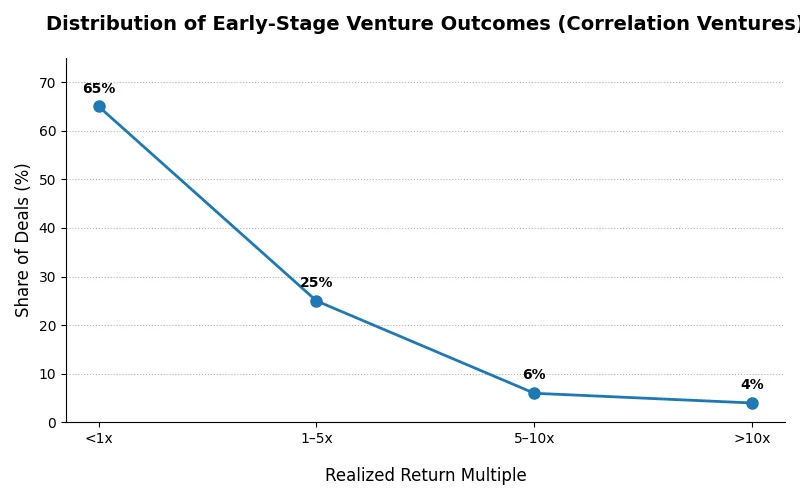
The core statistical challenge in early-stage investing is simple: outcomes are power-law distributed. Most deals produce limited or negative returns, while a tiny percentile generates the majority of long-term performance. In this environment, the purpose of a scoring model is not prediction; it is crypto investment scoring functioning as risk-adjusted filtration for identifying strong-signal presale opportunities.
Structured scoring helps investors:
- Distinguish evidence from narrative
- Evaluate deals consistently
- Identify structural weaknesses early
- Rank opportunities objectively
- Apply investment filters based on transparent criteria
A model grounded in data, not emotion, is essential for navigating an ecosystem where risk vs reward varies dramatically from project to project. Within IPO Genie, this takes the form of an AI Workflow that automatically ingests fundamental signals, cross-checks founder identities through Identity Wallet, assigns an Access Score, and routes opportunities through the Dealflow Database for deeper analysis. This automation reduces human error and ensures scoring consistency across all presales.
The Five-Pillar Framework: AI Presale Scoring and the Deal Evaluation Model
In IPO Genie, these pillars sit on top of the AI Engine's composite scoring logic, where every signal is weighted, normalized, and processed to generate a unified Opportunity Ranking visible to users in the dashboard. The evaluation engine consists of five independent but interlocking components:
- Pillar 1: Team Score
- Pillar 2: Fundamentals Score
- Pillar 3: Traction Score
- Pillar 4: Momentum Score
- Pillar 5: Risk Score
These pillars represent the complete evaluation criteria used to determine whether a presale qualifies as a high potential presale in a structured deal scoring model.
How AI Uses Deal Evaluation Metrics to Distinguish High Potential From Noise
An AI-driven scoring engine processes a combination of fundamental signals, technical indicators, and behavioral patterns. IPO Genie automates this entire workflow. Each incoming deal is routed through the Input Signals Pipeline, a multi-stage AI workflow that parses fundamentals, sentiment, liquidity flows, and risk variables. The system applies algorithmic filters, red-flag automation, and weighted scoring rules to transform raw data into an actionable Access Score.
- Fundamental signals capture structural strengths (market, team, product).
- Technical signals analyze token unlocks, liquidity depth, chain activity, and supply flows.
- Behavioral signals evaluate sentiment velocity, community activity, and founder responsiveness.
- Risk filters detect governance issues, regulatory exposure, and allocation imbalances.
By quantifying these inputs, the model classifies deals not by hype but by probabilistic advantage, improving selection quality across the portfolio through a disciplined crypto investment scoring methodology.
What is a Deal Evaluation Metric?
Deal evaluation metrics are the measurable inputs used to assess the quality, risk, and long-term viability of an early-stage opportunity. These metrics include structural fundamentals (market size, product defensibility), adoption indicators (user activity, transaction patterns), sentiment signals (narrative velocity, engagement depth), and compliance factors (unlock transparency, regulatory posture). In institutional scoring systems, these metrics form the quantitative foundation that distinguishes genuine potential from narrative-driven noise.
In IPO Genie's scoring architecture, these metrics form the structured input layer used by the AI Engine to calculate composite scores, validate founders' identities through the Identity Wallet, and rank opportunities in the Dealflow Database.
Pillar 1: Team Score - What Metrics Define a Strong Early-Stage Deal?
A high Team Score reflects leadership credibility, operational maturity, and governance quality. Dataset-level studies show that founding team background is one of the most consistent predictors of outcome quality. Execution history, prior experience in relevant markets, and evidence of delivering under resource constraints are particularly important.
IPO Genie incorporates these signals directly into its Team Score algorithm, using automated due diligence checks, identity verification processes, and cross-industry credential mapping to ensure every team passes baseline credibility filters before advancing.
A strong team typically demonstrates:
- Transparent identity
- Coherent ownership structure
- Domain expertise
- Consistency between statements and milestones
In contrast, anonymous leadership, unclear cap tables, and inconsistent claims are statistically correlated with higher failure probability.
For beginner investors: a strong Team Score means the people running the project have real experience and can actually deliver what they promise.
Pillar 2: Fundamentals Score - What Makes a Crypto Deal High Potential in Terms of Market, Product, and Economics?
Fundamentals Score assesses the structural foundation of the opportunity: market demand, problem relevance, product defensibility, and economic logic. 42% of failed ventures cite "no market need" as the primary reason, underscoring the indispensability of market validation.
A strong fundamentals profile includes:
- A substantial market
- Quantifiable problem severity
- A product that cannot be easily replicated
IPO Genie evaluates the Fundamentals Score using a blend of AI signal weighting, problem-solution mapping, and tokenomics validation models embedded in its automated due diligence layer. This ensures fundamentals are scored consistently regardless of sector or hype cycles.
Defensible technology - audited smart contracts, proprietary datasets, validated R&D - improves durability. Economic fundamentals also make sense: clear value creation, rational tokenomics, and alignment between incentives and long-term viability. A presale lacking economic clarity or operating in a non-problem market almost always fails this pillar.
For beginner investors: strong fundamentals mean the project solves a real problem in a real market, not just a concept that sounds exciting.
Pillar 3: Traction Score - How Does Scoring Define a Good Presale Through Real Adoption Signals?
Traction Score measures actual usage and adoption behavior. Research consistently finds that dynamic traction (growth velocity, retention, user activation) is more predictive of success than any static attribute.
strong-signal presales show measurable usage:
- Active testing of prototypes
- Early on-chain transaction patterns
- Repeat user engagement
- Organic discovery that reflects genuine market curiosity rather than paid amplification
IPO Genie tracks these signals in real time through the AI Engine's traction analytics module, which analyzes velocity, retention curves, wallet behavior, and usage consistency before assigning a Traction Score.
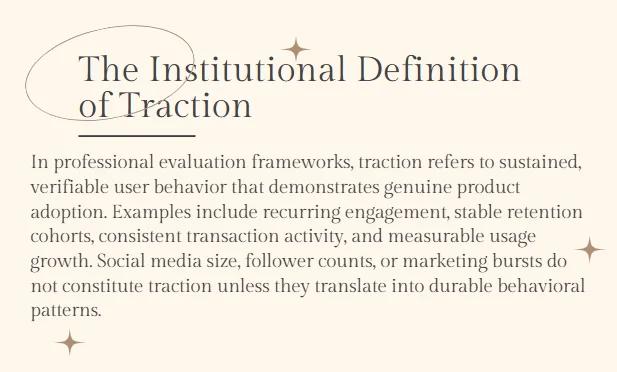
For analytical readers: high traction is defined as measurable, recurring usage behavior with verifiable retention curves, whereas weak traction refers to inconsistent, one-time activity patterns that do not sustain over multiple cycles.
For beginner investors: high traction simply means real users are actually interacting with the product, not just talking about it.
Pillar 4: Momentum Score - Performance Factors and Sentiment Signals Behind strong-signal deals
Momentum Score evaluates timing, macro alignment, sentiment velocity, and behavioral indicators. Many sectors - AI, tokenization, gaming, and RWAs - move through rapid attention cycles. Projects launched into expanding narratives benefit from higher visibility, easier distribution, and favorable liquidity flows.
IPO Genie's Momentum Score integrates sentiment velocity, narrative alignment, and discovery acceleration into a unified behavioral index. The AI Workflow continuously updates these signals, giving users a live view of momentum through the Opportunity Ranking dashboard.
Momentum also captures social and behavioral acceleration: patterns in community growth, founder responsiveness, media interest, and narrative reinforcement. These signals help assess whether the project is gaining strategic energy or losing relevance.
For high-risk opportunity seekers: the most relevant behavioral indicator is velocity - rapid increases in sentiment, participation, or deal discovery within short time intervals often signal accelerated opportunity windows, though they also carry elevated volatility.
For beginner investors: strong momentum means attention, interest, and participation are growing in measurable ways.
Pillar 5: Risk Score - Investment Filters and Structural Red Flags That Determine Survivability
The Risk Score serves as the final fail-safe. It identifies structural vulnerabilities that can undermine all other strengths, including regulatory opacity, governance issues, hidden token unlock schedules, or excessive insider allocation.
High-net-worth investors typically anchor their decisions around downside protection, which is why Risk Score also evaluates:
- Treasury transparency
- Unlock schedules
- Liquidation pathways
- Feasibility of exits under stressed market conditions
For this cohort, a deal is only high potential if the structural design prevents value erosion through hidden emissions, opaque treasury movements, or illiquid redemption mechanics. When these elements are cleanly disclosed and logically constructed, confidence increases materially.
A project with unresolved legal exposure, opaque fund flows, or unverifiable leadership cannot qualify as high potential, regardless of its other merits. For a practical checklist, see our guide on how to spot token red flags.
For beginner investors: a clean Risk Score means there are no hidden dangers that could cause the project to collapse later.
Strong-Signal vs Weak Deals: AI Presale Scoring Comparison
| Factor | Strong-Signal Deal | Weak Deal |
|---|---|---|
| Team Score | Transparent, experienced, execution-proven | Anonymous or inexperienced founders |
| Fundamentals Score | Large market, real pain point, defensible product, rational tokenomics | Small niche, unclear demand, non-defensible product |
| Traction Score | Real usage, strong retention, consistent growth | No real users, synthetic engagement |
| Momentum Score | Strong narrative alignment, rising sentiment | Misaligned macro timing |
| Risk Score | Clean structure, compliance-ready | Severe governance or regulatory flags |
IPO Genie transforms this comparison into a live scoring interface where each pillar contributes directly to the AI-generated Access Score, helping users immediately see whether a deal is strong-signal, mid-signal, or filtered out by red-flag automation. These scored deals are then surfaced through the IPO Genie Marketplace, where users can explore the highest-ranked research candidates.
End-to-End Deal Scoring Flow
Below is the simplified evaluation sequence used to classify opportunities:
- Collect structural and behavioral data
- Quantify signals across the five pillars
- Apply risk filters and remove structurally weak candidates
- Rank surviving opportunities based on composite scoring
- Select stronger-signal candidates for deeper analysis
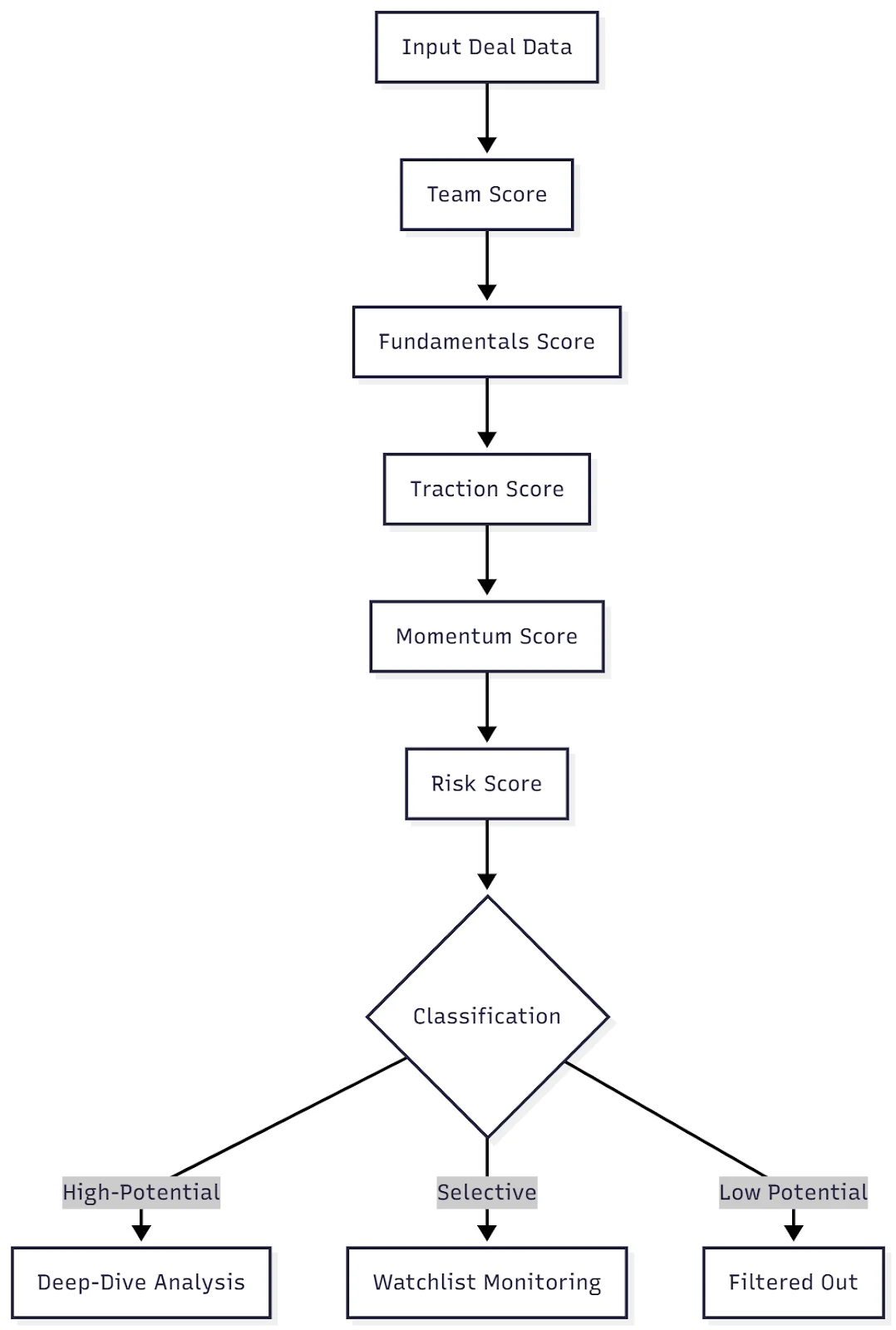
IPO Genie's version of this workflow is fully automated. Deals enter through the Opportunity Intake Pipeline, pass through Identity Wallet verification, and are evaluated across fundamentals, traction, and risk through the AI Engine. The system then outputs a composite score along with an Opportunity Ranking visible to users.
AI Scoring Framework (IPO Genie) vs Manual Human Framework
| Category | AI Scoring (IPO Genie) | Manual Human Scoring |
|---|---|---|
| Data Processing | Real-time processing of thousands of input signals; integrates on-chain, sentiment, tokenomics, liquidity & governance data; continuously updates Access Scores | Limited data intake; slow research; high risk of missing or outdated signals |
| Accuracy & Bias | Standardized scoring logic; zero emotional bias; algorithmic filters catch anomalies instantly | Subjective, inconsistent judgments; emotional bias; misses subtle risks |
| Due Diligence | Identity Wallet verification; automated checks on unlocks, treasury, governance; red-flag automation | Manual verification prone to errors; unlocks often misunderstood; oversight risk high |
| Scoring Logic | Weighted composite scoring across all pillars; dynamic AI recalibration; unified Opportunity Ranking | Checklist-based scoring; inaccurate across multiple deals; no standardized weighting |
| Speed & Scale | Scores hundreds of deals per minute; auto-generates Access Scores & risk flags; scalable workflows | Analysts can score only a few deals/day; slow, unscalable workflow |
| Investor Experience | Clear Access Score, real-time updates, transparent scoring logic, surfaced strong-signal deals | Static notes/spreadsheets; hard to compare deals; low transparency & delayed insights |
Frequently Asked Questions
What Makes A Crypto Deal High Potential In This Scoring Model?
A crypto deal is ranked high potential when it demonstrates a strong Team Score, Fundamentals Score, Traction Score, Momentum Score, and a clean Risk Score. These deal evaluation metrics signal real demand, defensible structure, and survivability under early-stage volatility.
How Does Scoring Describe A Good Presale In An AI Presale Scoring System?
A good presale shows verifiable adoption, rational economics, transparent unlocks, and aligned timing. AI presale scoring interprets these inputs to classify whether the opportunity fits the investment ranking system for strong-signal presale outcomes using a disciplined AI deal scoring model.
What Metrics Define A Strong Early-Stage Deal Using This Investment Ranking System?
Strong early-stage deals show measurable user behavior, a real market need, defensible technology, favorable sentiment momentum, and low structural risk. These signals support higher Traction, Fundamentals, and Momentum Scores within a structured crypto investment scoring framework.
How Does The Risk Score Manage Risk Vs Reward In Presale Evaluation?
The Risk Score evaluates legal clarity, treasury transparency, unlock schedules, and governance quality. By surfacing structural vulnerabilities early, it ensures the risk vs reward balance remains favorable before a deal is classified as strong-signal presale signal.
Conclusion
A structured scoring system does not predict winners; it filters noise, identifies weaknesses early, and focuses on the subset of opportunities that exhibit quantifiable strength. In a domain where risk vs reward is asymmetric and most deals fail, a disciplined evaluation framework grounded in Team Score, Fundamentals Score, Traction Score, Momentum Score, and Risk Score materially improves decision quality.
strong-signal deals are rarely accidents. They are the result of identifiable patterns: strong teams, clear fundamentals, measurable traction, credible momentum, and clean risk structure. For deeper insights into what VCs look for, read what VCs know about token utility that retail doesn't. A scoring system makes these patterns visible.
Within IPO Genie, this entire methodology becomes investor-ready through the AI Engine, Dealflow Database, Identity Wallet verification, Access Score model, and automated due diligence layer - ensuring every strong-signal presale is surfaced through data rather than intuition.

Ready to evaluate smarter? Join the IPO Genie presale and access AI-powered deal scoring for yourself.