If you want to understand how presales, seed rounds, and pre-IPOs differ, how they work, and where they sit in early-stage fundraising across crypto and equity, you're in the right place.
These aren't just different names for the same process. Each represents a distinct stage of fundraising with its own rules, participants, and purpose. Whether you're researching crypto projects, Web3 protocols, or traditional tech startups, understanding these differences matters - especially if you're new to pre-IPO investing.
This guide breaks down exactly what each funding round means, where it fits in the lifecycle, and how crypto and equity fundraising diverge in meaningful ways.
What Is a Presale?
A presale happens when a crypto project offers tokens to early supporters before the public launch. Think of it as the "friends and family" round of the token world.
Projects typically run presales to:
- Build initial liquidity before listing on exchanges
- Generate buzz and community support
- Reward early believers with discounted token prices
- Fund development costs during the final stages
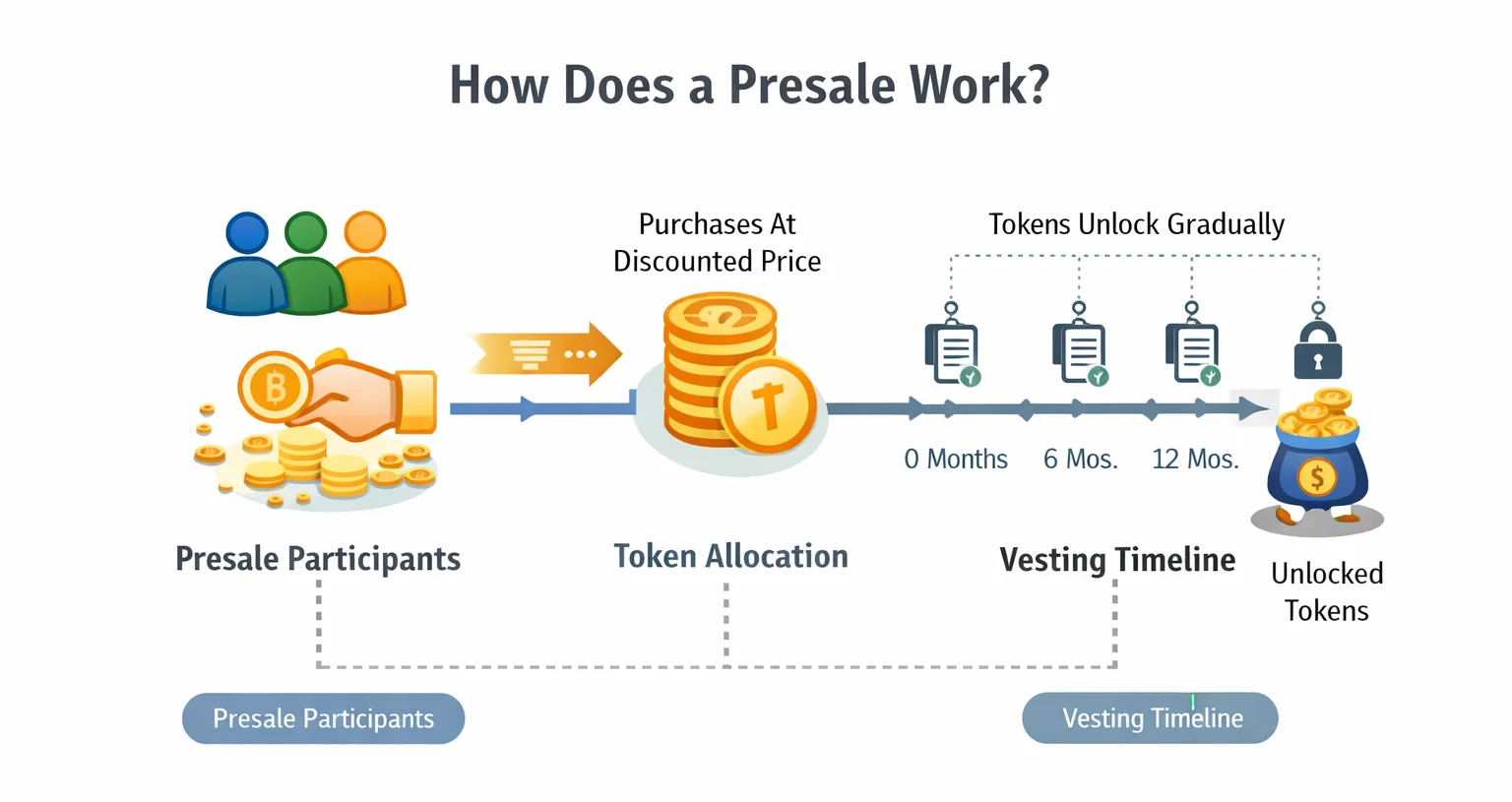
The structure is straightforward. Early participants buy tokens at a set price, usually lower than what the public will pay later. In return, they're betting on the project's success - but they're also taking on significant risk because most tokens come with vesting schedules and no guarantees.
According to educational resources from Ethereum.org, token presales often include smart contract-based vesting mechanisms to prevent immediate dumps when tokens unlock. This protects both the project and later investors from sudden price crashes.
Learn More: What Is a Crypto Presale and How Does It Work?
Who Participates in Presales?
Presales typically attract:
- Early crypto enthusiasts who follow projects closely
- Strategic partners who add value beyond capital
- Community members who want governance rights
- Sometimes venture funds specializing in crypto
Access varies wildly. Some presales are invite-only. Others require completing tasks like joining Discord servers or holding specific tokens. The key difference from traditional fundraising? Presales often target individuals, not just institutions.
What Is a Seed Round?
Seed rounds are the earliest formal fundraising stage for traditional startups. This is where founders exchange equity - actual ownership stakes - for the capital they need to build their product and find product-market fit.
According to Carta's startup funding research, seed funding comes when a company is ready for institutional fundraising, typically when they have an actual product to demo, even if they still need further development to create a user-ready minimum viable product.
Most seed rounds share these characteristics:
- Funding amounts typically range from $500K to $5M (median around $3.5M in 2024)
- Investors receive preferred stock or SAFEs (Simple Agreements for Future Equity)
- Valuations sit between $2M and $15M
- The money funds 12-24 months of runway
The Players in Seed Rounds
Seed investors include:
- Angel investors (wealthy individuals backing early ideas)
- Seed-stage VC firms like Sequoia's Scout program
- Accelerators such as Y Combinator or Techstars
- Sometimes strategic corporate investors
The Harvard Business Review notes that seed investors bet on teams as much as ideas. The product might pivot completely, but strong founders adapt.
What Does Pre-IPO Actually Mean?
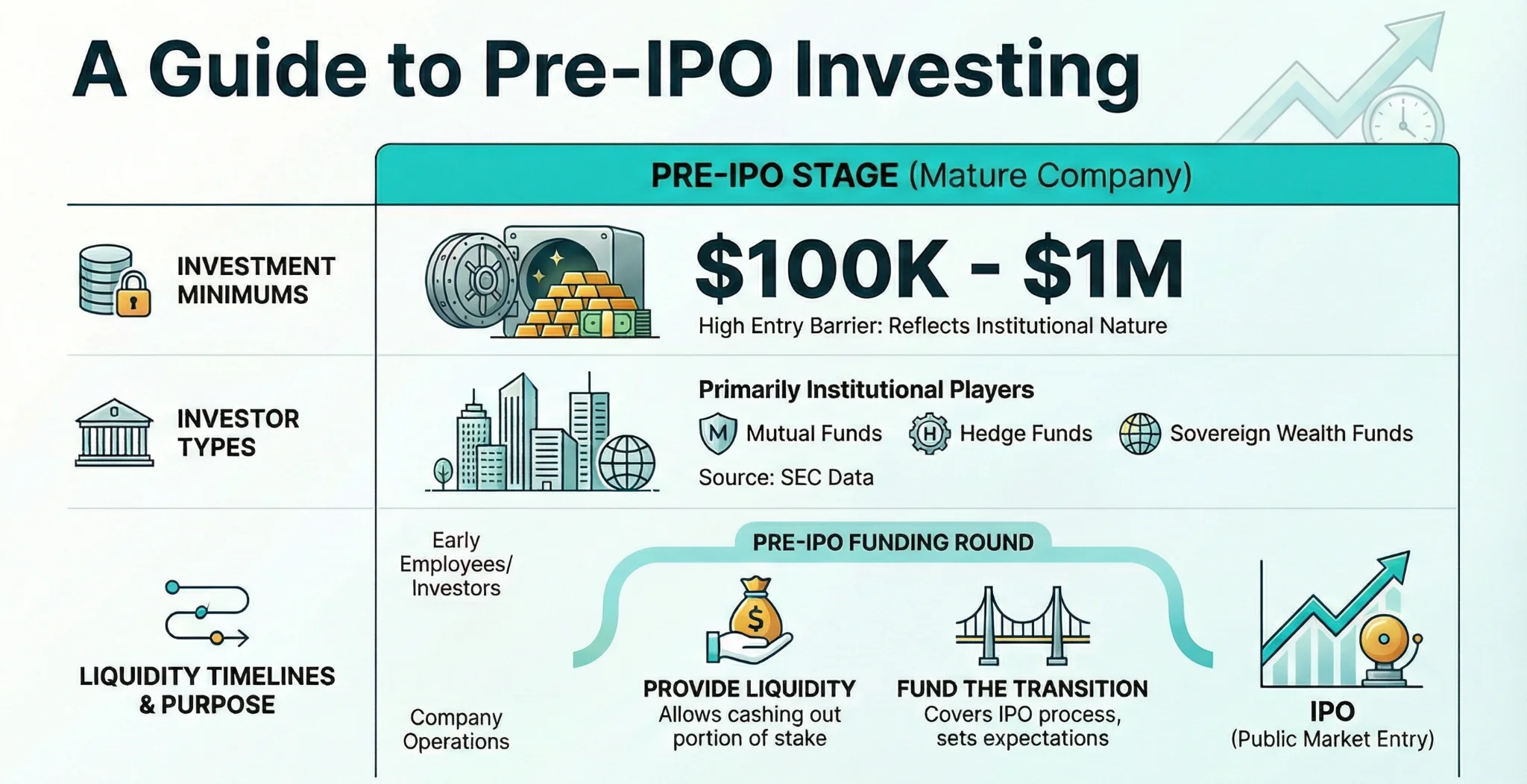
Pre-IPO rounds happen when a company is months or quarters away from going public. At this stage, the business is mature, profitable (or close), and preparing for life as a publicly traded entity.
These late-stage rounds serve specific purposes:
- Provide liquidity to early employees and investors who want to cash out partially
- Bring in investors who want exposure before the IPO "pop"
- Fund the expensive process of going public
- Set valuation expectations for the public markets
According to SEC educational resources, pre-IPO investors often include institutional players like mutual funds, hedge funds, and sovereign wealth funds. Minimum investments frequently start at $100K to $1M.
Why Pre-IPO Rounds Get Complicated
Pre-IPO investing carries unique considerations. The company is more proven, so risk feels lower. But you're also paying a premium valuation. Plus, there's usually a lockup period - often 180 days after IPO - where you can't sell shares.
The real complexity? Information asymmetry. Pre-IPO investors get access to detailed financials and management, but retail investors don't. This creates an uneven playing field that regulators watch carefully.
Where Each Round Fits in the Fundraising Lifecycle
Let's map this out chronologically:
Traditional Equity Path
- Seed Round → Build the product
- Series A-C → Scale the business
- Pre-IPO → Prepare for public markets
- IPO → Retail gets access
Crypto Project Path
- Presale/Private Sale → Build the protocol
- Public Sale → Community distribution
- Token Launch → Exchange listing
- Governance → Community-driven evolution
Notice the fundamental difference? Traditional companies gradually professionalize their investor base. Crypto projects often flip the script, starting somewhat institutional and moving toward community ownership.
Crypto vs Equity: The Core Differences
This is where things get interesting. The mechanics of raising money differ substantially between tokens and shares.
Ownership vs Utility
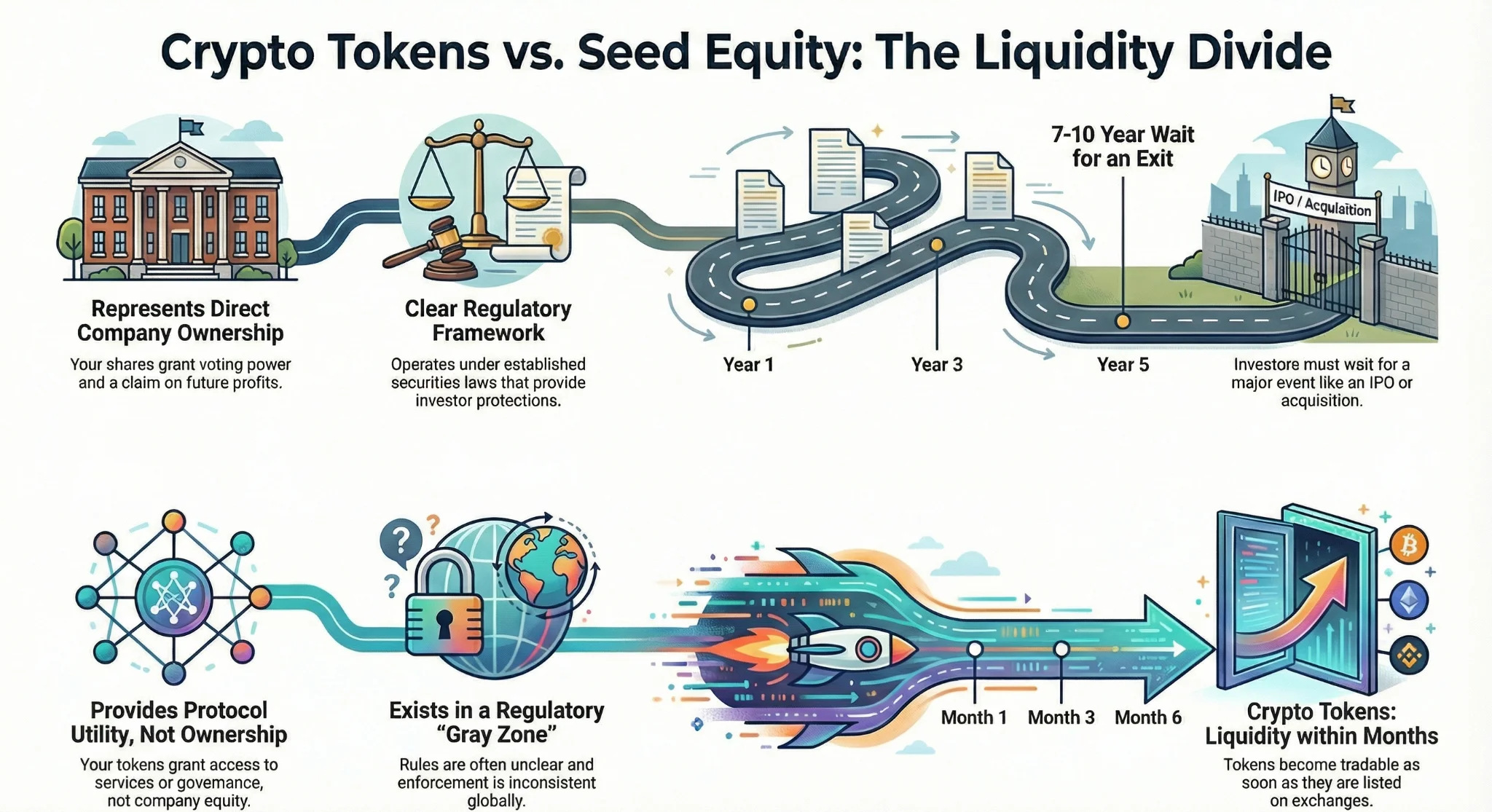
When you buy equity in a seed round, you own a piece of the company. Your shares represent actual ownership rights, voting power, and claim on future profits.
Tokens work differently. Most don't represent company ownership at all. Instead, they provide utility within a protocol, governance rights, access to services, or incentive mechanisms. As explained in Coinbase's analysis of governance tokens, token holders participate in protocol governance rather than traditional corporate ownership.
Regulatory Frameworks
This might be the biggest divergence. Equity fundraising operates under securities law that's been refined over decades. The SEC provides clear rules about who can invest (accredited vs non-accredited), disclosure requirements, and investor protections.
Crypto exists in regulatory gray zones. Some tokens are clearly securities. Others claim utility status. Many projects structure presales carefully to avoid securities classifications, but enforcement remains inconsistent globally.
Liquidity Timelines
Traditional equity investors wait years for liquidity. Seed investors might wait 7-10 years for an exit through IPO or acquisition.
Token holders often see liquidity within months. Once tokens list on exchanges, they're tradeable immediately (after vesting). This creates different incentive structures and risk profiles.
Vesting, Allocation, and Valuation: How It All Works
Allocation Structures
Seed rounds typically allocate 10-20% of company equity. Founders might give up 15% in exchange for $2M at a $10M post-money valuation. Future rounds dilute everyone proportionally unless they have anti-dilution protections.
Presales allocate from the total token supply, which gets divided roughly as:
- 30-50% for community/public sale
- 20-30% for team and advisors
- 15-25% for presale/private investors
- 10-20% for treasury/ecosystem development
Research from TokenMinds on token allocation emphasizes that projects with heavy insider allocations often face significant community pushback. When team and investor allocations exceed 40-50% of total supply, community members typically express concerns about centralized control.
Check out IPO Genie's tokenomics for an example of balanced token allocation.
Vesting Schedules
Vesting prevents everyone from selling immediately and crashing the market.
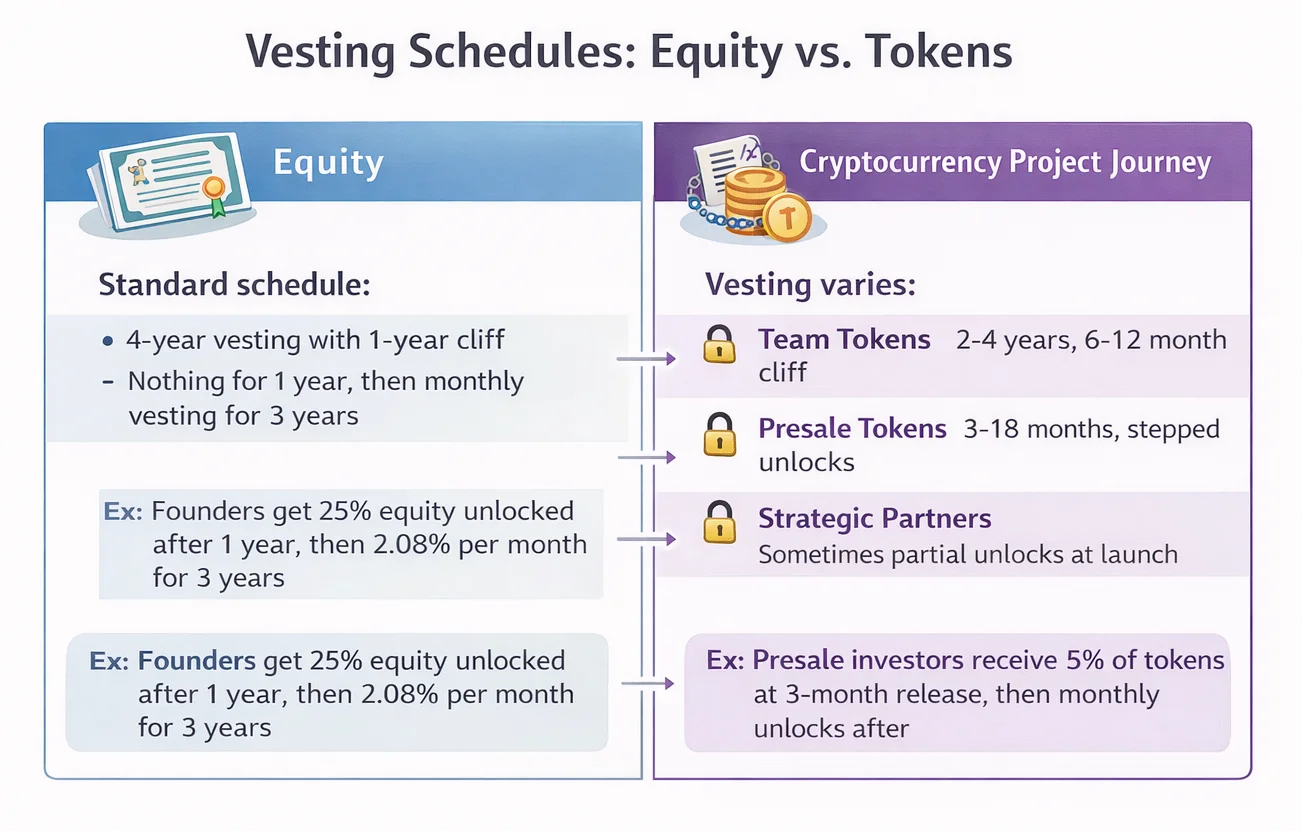
For equity, standard vesting runs 4 years with a 1-year cliff. You get nothing for 12 months, then 25% unlocks, followed by monthly vesting for the remaining 36 months.
Token vesting varies dramatically:
- Team tokens: often 2-4 years with 6-12 month cliffs
- Presale tokens: 3-18 months with various unlock schedules
- Strategic partners: sometimes partial unlocks at launch
Projects publish these schedules to show they're aligned long-term. Smart contract platforms like Ethereum make vesting programmatically enforceable through code.
Valuation Methods
Seed-stage equity valuations use methods like:
- Comparable company analysis (what similar startups raised at)
- Venture capital method (working backward from exit scenarios)
- Scorecard valuation (adjusting average valuations based on factors)
Token valuations borrow from both traditional finance and create new metrics:
- Fully Diluted Valuation (FDV): token price × total supply
- Market Cap: token price × circulating supply
- Price-to-Sales for revenue-generating protocols
- Total Value Locked (TVL) for DeFi projects
Investopedia's guide to startup valuation explains traditional methods thoroughly, but they acknowledge crypto adds complexity because tokens aren't equity claims.
Who Each Round Is Actually For
Let's be direct about who these fundraising stages serve.
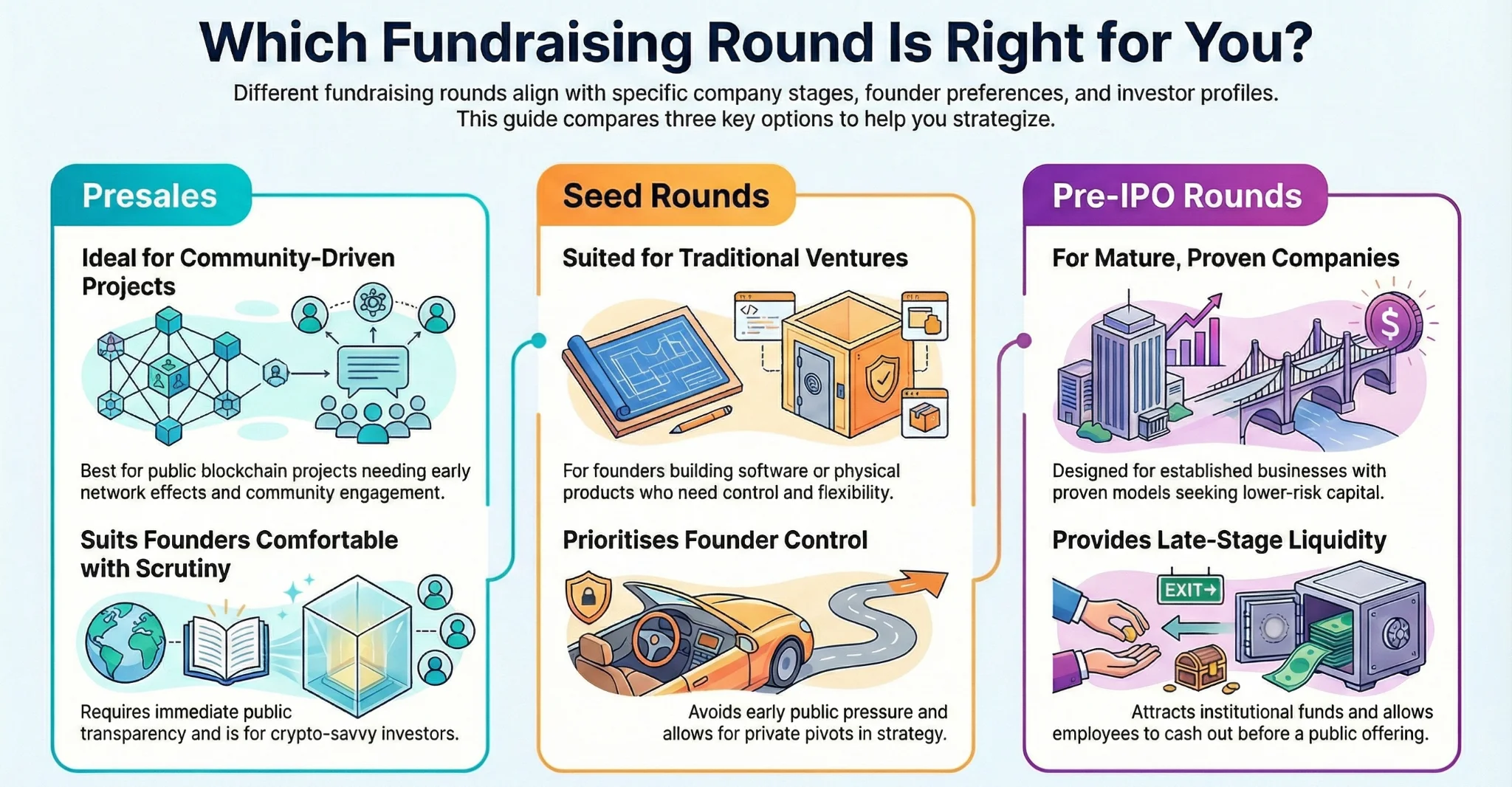
Presales Suit:
- Web3 projects needing community engagement from day one
- Teams building on public blockchains requiring network effects
- Founders comfortable with immediate public scrutiny
- Investors who understand crypto-specific risks
Seed Rounds Suit:
- Founders building traditional software or physical products
- Teams prioritizing control and avoiding public pressure early
- Investors seeking equity ownership and governance rights
- Companies needing flexibility to pivot privately
Pre-IPO Rounds Suit:
- Mature companies with proven business models
- Late-stage investors seeking lower risk profiles
- Employees wanting partial liquidity before IPO
- Institutional funds needing specific allocations
None is inherently "better." They serve different purposes at different stages with different risk-return profiles.
The Compliance and Disclosure Gap
Here's something that doesn't get discussed enough: the information asymmetry between these funding methods.
Seed-stage equity investors typically receive:
- Detailed financial projections
- Cap table showing all stakeholders
- Board observation rights or seats
- Regular updates through investor relations
SEC regulations mandate specific disclosures for equity investors, especially as companies mature toward IPO. Pre-IPO investors receive extensive financial audits and risk factors.
Presale token buyers often receive:
- A whitepaper explaining the protocol
- Tokenomics breakdown
- Team and advisor backgrounds
- Roadmap and development milestones
The difference? Token buyers frequently invest based on public information alone, without the detailed due diligence documents equity investors access. Some projects provide more transparency, but it's not standardized.
This matters for risk assessment. Equity investors can demand information. Token buyers must research independently, often with less data.
Frequently Asked Questions
Q: Can a company do both equity and token raises?
Absolutely. Many crypto companies raise equity seed rounds to fund operations, then launch tokens for protocol governance. The equity funds the company; the token powers the protocol. They're separate but related.
Q: Why do some presales require accreditation while others don't?
Regulatory positioning. Projects aiming to avoid securities classifications often restrict presales to accredited investors or structure sales carefully around utility. Others use SAFTs (Simple Agreements for Future Tokens) that mirror SAFEs but for tokens.
Q: Which has better returns: seed equity or presales?
This is impossible to answer generally. Both carry extreme risk. Most seed-stage startups fail. Most token presales underperform. The few winners in each category generate enormous returns, but survivor bias makes averages meaningless.
Q: How do lock-up periods compare?
Equity seed investors typically can't sell until exit events (IPO or acquisition), often 5-10 years later. Pre-IPO investors face 180-day lockups post-IPO. Token presale participants might wait 3-18 months but then have immediate market liquidity.
Q: How does IPO Genie fit into this landscape?
IPO Genie bridges both worlds - offering access to crypto presale opportunities alongside traditional pre-IPO deals, all scored by AI to help investors make informed decisions. Join the presale now.
Final Thoughts on Early-Stage Fundraising
The landscape of raising capital has fragmented dramatically over the past decade. Traditional venture capital continues funding incredible companies. Simultaneously, token presales have created entirely new models for community-driven projects. Understanding how to evaluate pre-IPO opportunities can help you navigate both worlds.
Neither replaces the other. They coexist, serving different needs.
If you're researching investment opportunities, understand what you're actually buying. Equity represents company ownership. Tokens represent protocol utility. Pre-IPO shares come with specific liquidity expectations. Each carries distinct legal, financial, and timing considerations.
For founders, choosing between these paths depends on your product, timeline, and community needs. Building a consumer app? Seed rounds probably make sense. Creating a decentralized protocol? Maybe presales align better with community ownership goals.
The key takeaway: these aren't just different words for raising money. They're fundamentally different structures designed for different purposes at different stages.
Disclaimer: This article is for educational purposes only and does not constitute investment advice. Early-stage investing carries significant risk in both traditional and crypto markets. Always conduct thorough research and consult professionals before making investment decisions.