A token's price is not only driven by hype, listings, or community size. It is heavily influenced by when tokens become sellable and who gets access to liquidity first. That is why the crypto vesting period and lock-ups matter so much. Vesting controls how tokens are released over time. Lock-ins control when tokens can be moved or sold at all.
In this guide, we explain vesting schedules, lock-in periods in crypto, and the real meaning behind token unlocks. You will also learn how to read a vesting schedule like an investor, spot red flags, and understand why disciplined token release design supports healthier markets.
Definition of Vesting & Lock-in Crypto
Before we go deeper, here are the terms in plain English:
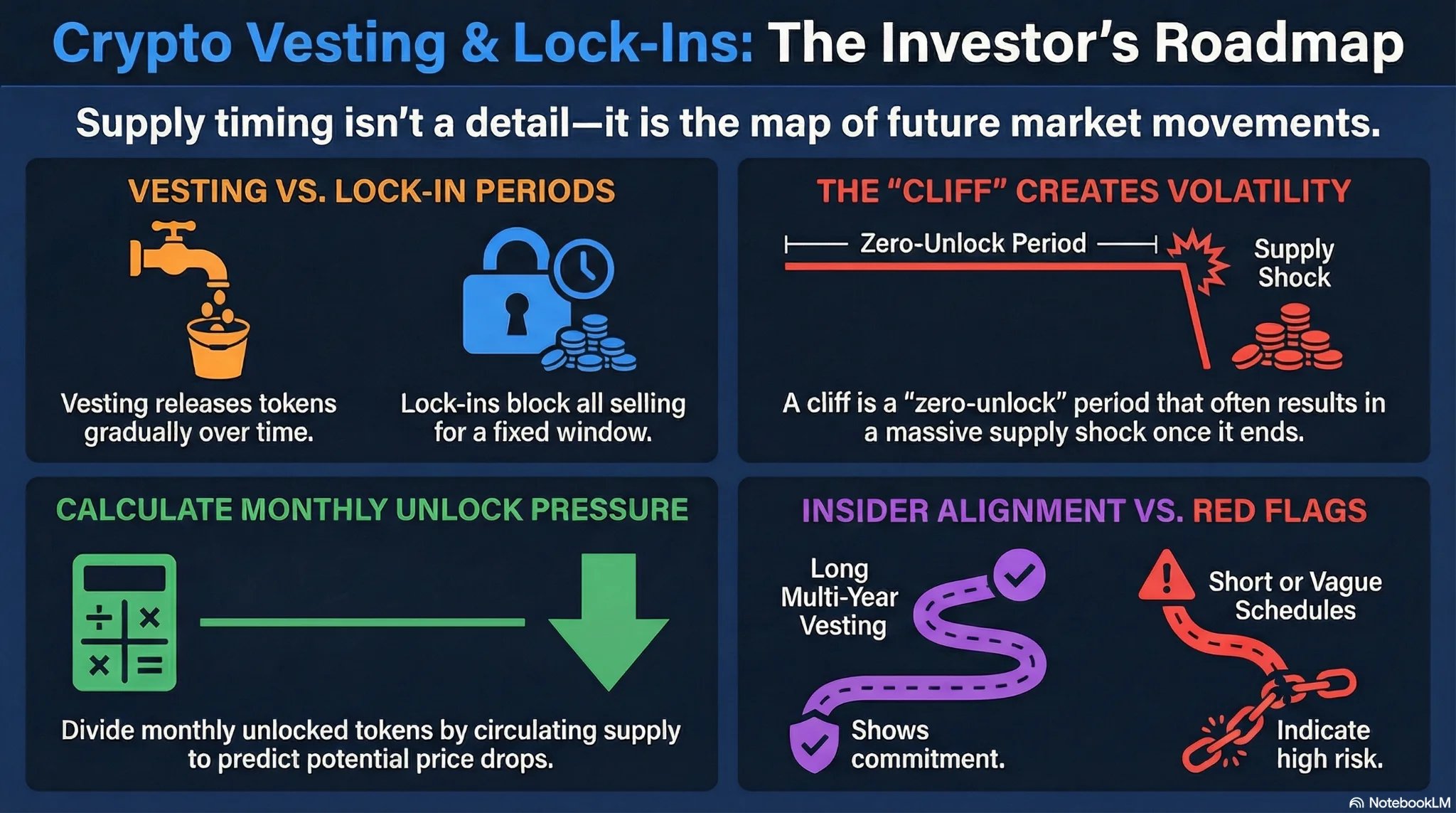
- Crypto vesting period: A timeframe where tokens are released gradually to a wallet over weeks, months, or years.
- Lock-in period (token lock-up): A period where tokens cannot be transferred or sold.
- Cliff: A rule that says "nothing unlocks until a specific date."
- Token unlock: A scheduled moment when tokens become liquid.
If you have ever asked, "what is a token lock-in period?" the answer is simple: it is the window where your tokens may exist in your wallet, but you cannot exit.
Vesting vs Lock-In Periods: What's the Difference?
These terms get mixed up, but they are not the same.
- Lock-in periods in crypto stop tokens from being sold or transferred for a fixed time.
- Understanding token vesting means understanding how tokens are released gradually over time.
Many projects use both: a lock-in first, then a vesting schedule.
Token Vesting vs Lock-Ins Compared
| Feature | Vesting (vesting schedule) | Lock-in (lock-in periods) |
|---|---|---|
| Purpose | Releases tokens gradually over time | Blocks selling or transfers for a set period |
| Common use | Team, advisors, strategic rounds, ecosystem rewards | Presales, staking, team lock-ups, liquidity locks |
| Structure | Often cliff + monthly releases | Fixed window, sometimes followed by vesting |
| Investor risk | Dilution and sell pressure at unlock dates | Liquidity risk and delayed exit options |
Vesting Schedules Explained: The Most Common Models
A vesting schedule document usually answers three questions: who gets tokens, how many, and when they unlock.
1) Cliff Vesting
Nothing unlocks until a set date. After that, tokens unlock in chunks or begin releasing monthly.
Example: 12-month cliff, then vesting starts.
2) Linear Vesting
Tokens unlock evenly over time, often monthly.
Example: 24 months linear means roughly 1/24 unlocks per month.
3) Milestone Vesting
Tokens unlock based on product or ecosystem milestones. This can be good when milestones are verifiable, but risky when definitions are vague.
4) Lump-Sum Unlocks
A large percentage unlocks at once. This is where supply shocks happen most often.
Where You See Crypto Investment Lock-Ins
When people say crypto investment lock-in, they may mean one of these:
1) Presale Lock-Ins
Some crypto presale tokens are liquid at launch. Others impose a lock-in, then release tokens via vesting. Always confirm whether presale allocations and early-stage token launches become sellable on day one.
2) Team and Advisor Lock-Ups
This is the alignment signal. If insiders are free to sell early, the community becomes exit liquidity.
In our tokenomics education, we explain why many projects use vesting to prevent sudden crashes and keep teams committed.
3) Staking Lock Periods
Locked staking increases yield but reduces flexibility. It is a liquidity tradeoff.
4) Liquidity Provider (LP) Lock-Ups
Projects may lock liquidity to reduce fears of liquidity removal. If liquidity is not locked or is controlled by a small number of wallets, risk increases.
Benefits of Vesting Periods
The benefits of vesting periods are not theoretical. They directly affect market stability and investor trust.
- Reduces sudden sell pressure by spreading unlocks over time
- Aligns incentives so insiders win only if the project grows
- Makes dilution predictable, which improves decision-making
- Builds transparency, which helps serious investors take the project seriously
Want a framework to evaluate whether vesting is actually healthy? Use our investor checklist in Tokenomics Red Flags: How to Spot Bad Crypto Projects.
How to Read a Crypto Vesting Period Like an Investor
This is the section most retail investors skip, and it is where avoidable losses happen.
Step 1: Check What Unlocks at TGE (Launch)
Ask: What percentage becomes liquid immediately?
A "small market cap" can be misleading if a huge supply unlock is coming later. This is why pros compare circulating supply to fully diluted market cap, not just price charts.
Step 2: Identify the Cliff
If the cliff ends and a large chunk unlocks, expect volatility.
Step 3: Calculate Monthly Unlock Pressure
A simple way to evaluate sell pressure is:
Monthly unlock % = (monthly unlocked tokens ÷ circulating supply) × 100
If the unlock is large relative to the circulating supply, the price can struggle even if the project is building.
Step 4: Compare Insider Vesting to Long-Term Standards
A key red flag is short vesting for insiders. Many strong projects aim for multi-year vesting with meaningful cliffs.
Step 5: Look for Clarity & Verification
If the schedule is vague, missing, or constantly changing, treat that as a risk.
For a deeper process, read How to Read Tokenomics Like a VC.
Practical Example: A Simple Vesting Schedule
Imagine a team allocation with:
- 12-month cliff
- Then 24-month linear vesting
- Total team tokens: 5,000,000
After month 12, vesting starts. If it unlocks evenly over 24 months:
Monthly unlock = 5,000,000 ÷ 24 = 208,333 tokens per month
Now compare that to the circulating supply to understand pressure.
Key Takeaways
- The crypto vesting period tells you when the supply becomes sellable.
- Lock-in periods in crypto tell you when you can exit.
- Big cliffs and vague schedules increase risk.
- The best investors track unlocks the same way they track fundamentals. The same discipline applies when evaluating early-stage private and pre-IPO opportunities where timing, access, and allocation design matter.
- If you can't find the schedule, that is a red flag.
Supply Timing Is Not a Detail — It's the Map
If you want to invest smarter, treat vesting schedules like a roadmap of future liquidity. The market reacts to unlocks, often before they happen. Track them, understand them, and you will avoid becoming exit liquidity.
Join the IPO Genie presale now

Frequently Asked Questions
Q: What are vesting and lock-in periods in crypto tokens?
Vesting releases tokens gradually over time. A lock-in blocks selling or transferring for a set period. Many projects use both.
Q: Why do token prices drop after launch?
Often, because new supply becomes liquid through unlocks. If demand does not grow faster than the sellable supply, the price can weaken.
Q: Where can I find token vesting explained clearly?
Start with the project's tokenomics page and whitepaper, then validate with on-chain data or reputable token unlock trackers when possible.
Q: How long do typical vesting periods last?
Team and advisor vesting commonly ranges from 12 to 48 months with a cliff of 3 to 12 months. Shorter schedules for insiders are a red flag.
Q: What is the difference between a cliff and a lock-in?
A cliff is the initial zero-unlock phase within a vesting schedule. A lock-in is a broader restriction that prevents tokens from being sold or transferred, regardless of vesting.
Disclaimer: This content is for educational and informational purposes only and does not constitute financial, investment, or legal advice. Cryptocurrency involves significant risk, including possible loss of capital. Always do your own research and consult qualified professionals before making investment decisions.