Tokenized platforms are reshaping how real-world assets like equity, real estate, and funds are accessed by turning them into digital tokens on blockchain. Unlike open crypto transfers, regulated tokenized investing requires verified identities and strict compliance controls.
KYC/AML architecture connects verified identities, wallet permissions, and transaction-monitoring systems so platforms can control access and detect financial-crime risks. As institutional investors enter digital assets, compliance has become a core architectural requirement rather than an optional layer.
KYC/AML systems directly impact investor access, legal enforceability, and institutional trust. Platforms offering regulated financial products commonly require KYC, AML, and sanctions controls to meet applicable legal and institutional requirements
This article explains how identity systems, AML monitoring, wallet verification, smart-contract enforcement, jurisdictional rules, and institutional compliance infrastructure work together in tokenized finance.
What Is KYC?
KYC, or Know Your Customer, is the process of identifying customers, verifying their identity, understanding relevant ownership and risk factors, and keeping that information current. It allows banks, brokerages, fintech companies, and tokenized platforms to manage risk and satisfy statutory obligations before granting access to financial products.
A comprehensive customer due diligence (CDD) framework typically encompasses:
- Customer identity verification and proof of address
- Beneficial ownership identification
- Purpose and intended nature of the business relationship
- Risk classification and customer profiling
- Source of funds and source of wealth verification
- Ongoing monitoring and periodic information refresh
Institutional KYC is usually more complex than retail account setup. Instead of verifying a single individual, platforms must verify corporate entities, directors, authorized signers, and ultimate beneficial owners (UBOs). This is critical in tokenized private-market investing, where legal structures often span multiple jurisdictions and shell entities.
What Is AML?
Anti-Money Laundering (AML) refers to the laws, regulations, and technical procedures financial institutions use to prevent, detect, and report illicit financial activity.
Money laundering is traditionally analyzed through three stages:
- Placement: Introducing illicit funds into the financial system.
- Layering: Distinguishing the origin of funds through complex layers of financial transactions.
- Integration: Returning laundered funds to the economy as legitimate business capital.
Note: This three-stage model is a traditional analytical framework; actual digital asset laundering activity does not always follow a fixed sequence.
Common compliance controls within an AML framework include:
- Sanctions screening
- Politically Exposed Person (PEP) screening
- Adverse-media (negative news) screening
- Source-of-funds and source-of-wealth checks
- Transaction monitoring and suspicious activity reporting
KYC and customer due diligence form part of the broader AML/CFT (Countering the Financing of Terrorism) framework. Identity and risk checks begin during onboarding, while ongoing monitoring and periodic reviews continue throughout the entire customer relationship.
What Is KYC/AML Architecture?
KYC/AML architecture is the system that tokenized platforms use to verify users, monitor transactions, and ensure compliance. It combines identity verification, blockchain analytics, and reporting tools.
The system includes identity checks, risk analysis, wallet verification, AML monitoring, and audit reporting layers. It enables continuous monitoring of blockchain activity to meet regulatory requirements in tokenized financial systems.
Layer | Purpose |
Customer & Entity Verification | Verifies individuals, corporate entities, and ultimate beneficial owners (UBOs). |
Screening & Risk Classification | Performs sanctions, PEP, adverse media, jurisdiction, and product risk scoring. |
Wallet-Control Verification | Confirms that an approved customer controls the target wallet address. |
Blockchain-Risk Analytics | Assesses wallet exposure, transaction history, and risk indicators. |
Authorization & Transfer Controls | Enforces smart-contract rules to permit, reject, freeze, or escalate transactions. |
Case Management | Enables compliance teams to investigate alerts, request information, and document decisions. |
Regulatory Reporting | Generates suspicious activity reports (SARs/STRs) and audit trails for regulators. |
Data Governance | Manages data retention, access control, field-level encryption, and privacy workflows. |
Representative Infrastructure Providers: Vendor tools (e.g., Sumsub, Persona, TRM Labs, Chainalysis, Elliptic) operate across these functional layers to supply verification data, risk intelligence, and automated screening feeds.
Tokenization & Legal Ownership Clarification
Tokenization means converting ownership rights into blockchain-based digital tokens. These tokens can represent ownership in assets such as private equity, real estate, venture funds, bonds, or revenue-sharing structures. Tokenized platforms may use blockchain to record or facilitate transfers, while legal ownership may still depend on an issuer register, transfer agent, custodian, fund administrator, or SPV records.
- Why Tokenized Assets Trigger Regulatory Obligations
Many tokenized assets represent real financial rights. Because of this, they fall under established securities and financial laws. According to the SEC staff's Framework for “Investment Contract” Analysis of Digital Assets, an offer or sale of digital assets is evaluated based on economic reality and facts and circumstances. Furthermore, regulators have reaffirmed that tokenization does not alter underlying securities laws or legal ownership duties (SEC Tokenized Securities Statement).
- Pseudonymity vs. Off-Chain Records
Unchecked anonymity creates compliance exposure under AML/CFT laws. However, eliminating anonymous participation does not mean publishing identity data publicly on-chain. Regulated systems can preserve pseudonymous public addresses on-chain while linking those addresses to verified identities within controlled off-chain compliance records.
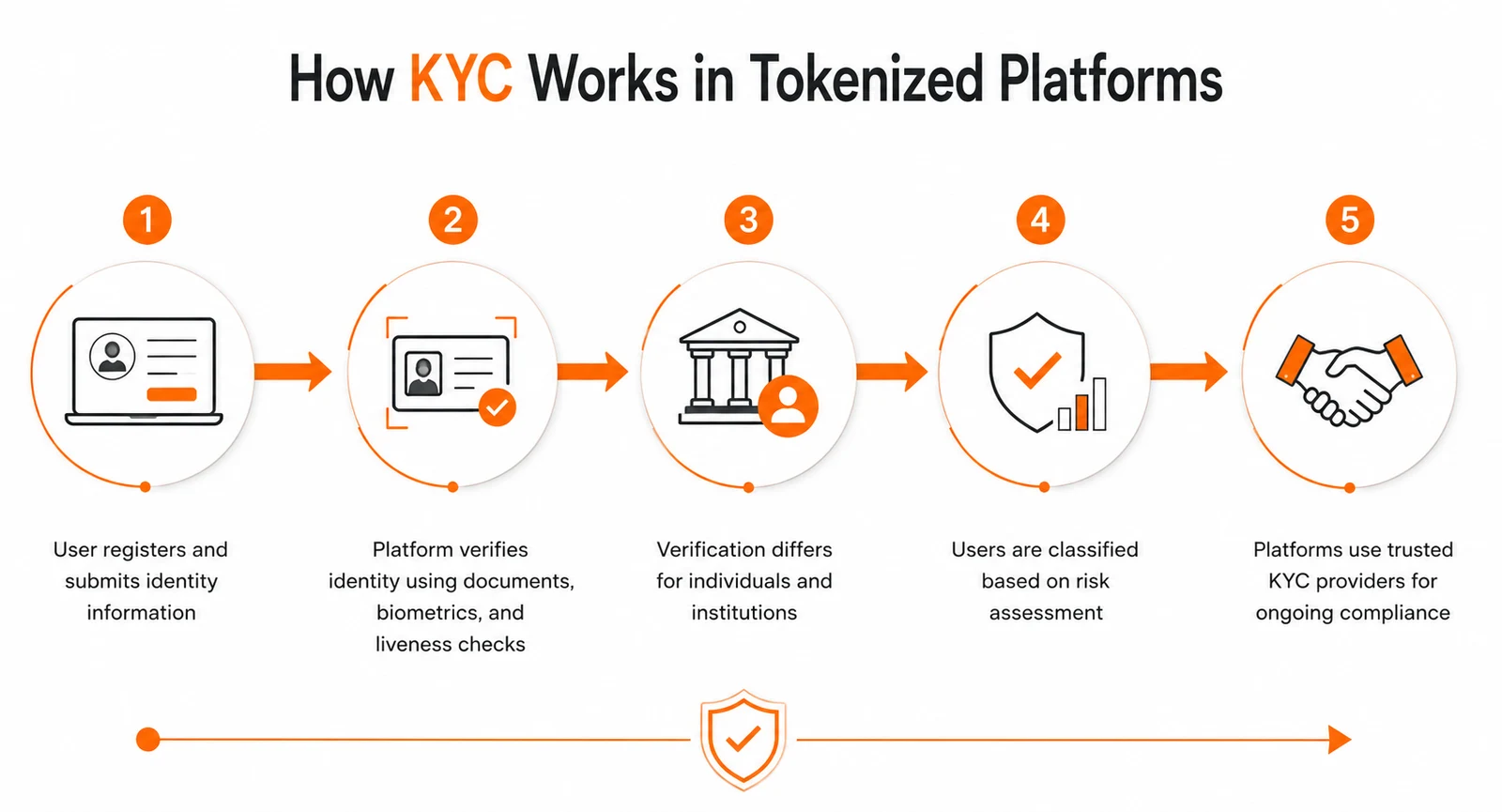
How KYC Works in Tokenized Platforms
User Registration and Identity Verification
KYC in tokenized platforms usually starts when a user creates an account and submits personal information. Most platforms use digital systems that collect identity data through online forms and document-upload interfaces. Users may need to upload a passport, national identity card, or proof of address before accessing investment features.
Identity Verification Systems
After document submission, the platform performs identity checks using verification software or third-party providers. Many systems use OCR (Optical Character Recognition) to scan identity documents and extract information automatically. Platforms may also use facial recognition, selfie matching, liveness detection, and biometric verification to confirm the user’s identity.
Individual vs Institutional Verification
Retail verification usually focuses on one individual. Institutional verification is more complex. Platforms may need to verify companies, directors, shareholders, and Ultimate Beneficial Owners (UBOs) before granting access. This is especially important in tokenized private-market investing where ownership structures can involve multiple companies or investment vehicles.
Risk-Based User Classification
Most regulated platforms also classify users based on risk. Compliance teams may review geographic exposure, sanctions lists, transaction behavior, and high-risk categories before approving accounts.
Third-Party KYC Providers
Many tokenized platforms use third-party KYC providers such as Sumsub, Persona, Trulioo, Onfido, and Jumio for document verification, biometric checks, and compliance monitoring.
What Is Wallet Verification and How It Links to Blockchain
Wallet verification confirms that an approved customer controls a specific wallet address or has authority to transact through it. A cryptographic signature proves control of a private key at a given moment; separate evidence or documentation may be needed to establish legal or beneficial ownership of the assets within that wallet.
Robust wallet-verification systems require strict challenge-response parameters to prevent message replay attacks. Standard cryptographic controls include:
- One-time nonces and timestamp expiration
- Domain separation and chain ID binding
- Customer ID and exact wallet address binding
- Multi-signature and smart-contract wallet verification rules
- Periodic re-verification upon key rotation or account changes
Verification methods include signed EIP-712 typed-data challenges, test transactions (micro-deposits), custodian attestations, and verified API connections. On-chain credentials or whitelist contracts confirm investor eligibility without publicly exposing personal identity or sensitive compliance details.
How AML Works in Blockchain Platforms
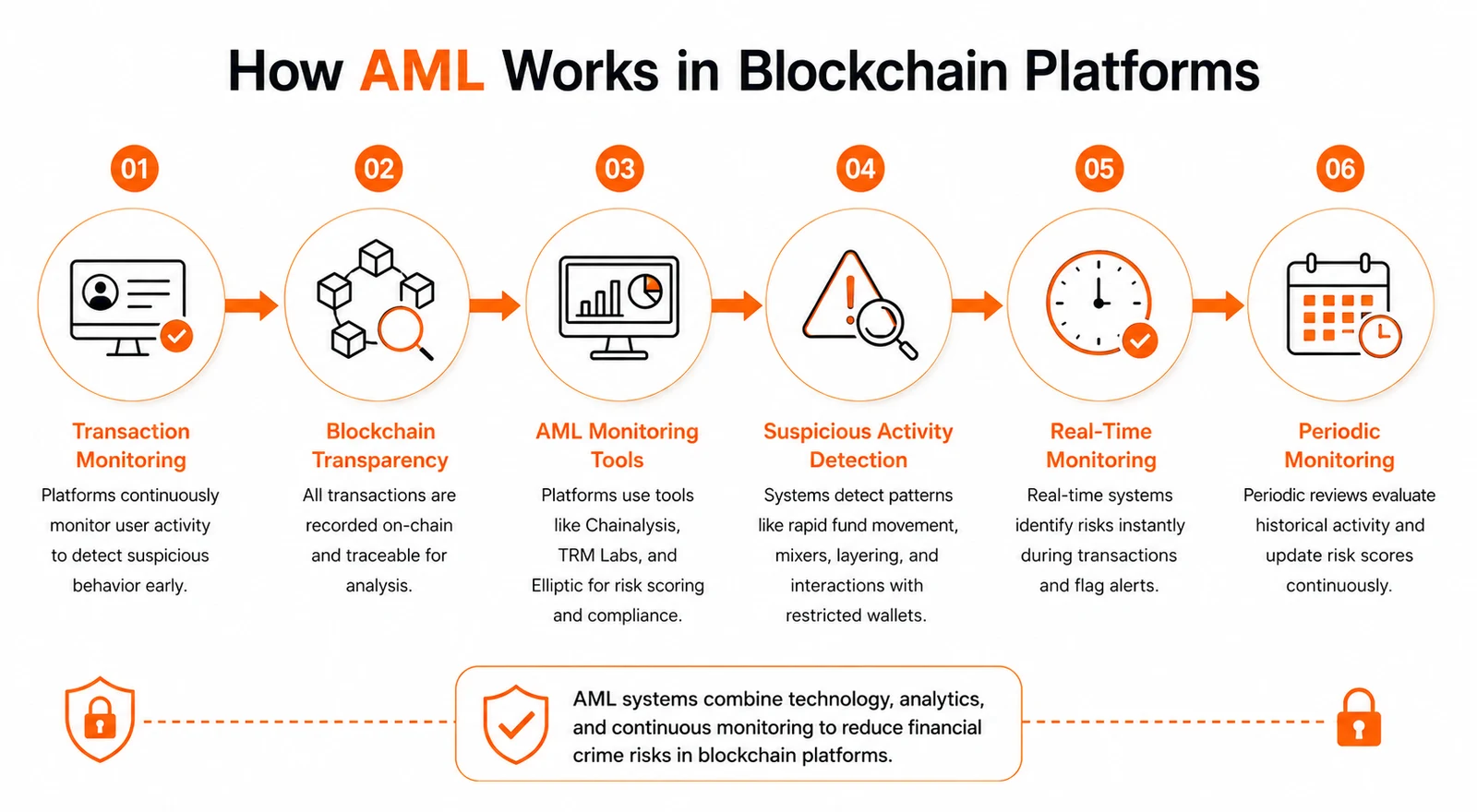
Anti-Money Laundering (AML) in blockchain platforms focuses on identifying and reducing financial crime risks.
Transaction Monitoring
Transaction monitoring refers to the ongoing review of user activity after onboarding. Platforms track how funds move over time, not just at entry. The goal is to detect suspicious behavior early and detect abnormal patterns for review.
Blockchain Transparency and Traceability
On-chain activity is transparent at the address level, but linking addresses to real entities remains probabilistic and incomplete. Visibility can be obscured by privacy protocols, off-chain exchange internal ledgers, custodial pooling, cross-chain bridges, chain hopping, and misattributed cluster labels.
AML Monitoring Tools Used by Platforms
Institutions utilize specialized analytics engines (e.g., Chainalysis, TRM Labs, Elliptic) to evaluate exposure to high-risk entities. However, automated risk scores are heuristic indicators that can yield false positives or outdated labels. Risk indicators should support human case review and documented compliance decisions rather than operate as unquestioned proof of criminal activity.
Suspicious Activity Detection
AML systems detect behaviors like rapid movement of funds, interaction with restricted wallets, use of mixers, layering patterns, and unusual transaction structures. These signals often indicate attempts to hide the origin of funds.
Real-Time vs Periodic Monitoring
Modern AML systems use both continuous and periodic monitoring. Real-time systems detect risks instantly during transactions. Periodic reviews analyze historical activity. Together, they create ongoing risk scoring that updates as user behavior changes.
The FATF Travel Rule
For covered transfers between Virtual Asset Service Providers (VASPs) and financial institutions, regulatory frameworks require compliance with the FATF Travel Rule. Under this rule, participating entities must collect and securely transmit originator and beneficiary information alongside asset transfers.
Travel Rule architecture requires:
- Counterparty VASP Identification: Verifying the regulatory status and public keys of the counterparty VASP.
- Secure Data Transmission: Exchanging PII through encrypted, interoperable messaging protocols (e.g., IVMS101 schemas).
- Unhosted-Wallet Policies: Applying risk-based screening and proof-of-control checks when transacting with self-custodial wallets.
- Transfer Escalation: Holding or rejecting transfers when required originator/beneficiary compliance payload is missing or flagged.
Technical Architecture Models in Tokenized Platforms
Technical architecture models in tokenized platforms define how compliance, identity, and token transfers are structured.
Fully Off-Chain Compliance Models
These models work by keeping all identity verification off-chain. KYC and AML checks are handled in centralized databases. The blockchain only records ownership and transactions. Compliance decisions happen outside the chain, so enforcement depends on external systems rather than smart contracts.
Hybrid Compliance Models
Hybrid models work by combining off-chain identity verification with on-chain enforcement. Users complete KYC off-chain, and their status is then linked to wallet permissions. Smart contracts enforce rules like transfer restrictions and approved wallet access. This is the most widely used model in institutional tokenization because it balances privacy and control.
On-Chain Eligibility or Credential Models
Rather than storing personal identity data on public ledgers, institutional models record only non-sensitive eligibility attestations, status tokens, zero-knowledge proofs, or cryptographic hashes on-chain. Personally identifiable information (PII) remains strictly off-chain in encrypted storage.
API-Based Compliance Infrastructure
Real-time API links connect token platforms, custodians, and external compliance providers. These feeds deliver updated risk scores, sanction updates, and onboarding status directly to off-chain authorization services.
Smart-Contract Compliance Controls
Smart contracts enforce rules supplied by trusted compliance systems. Their effectiveness depends entirely on the accuracy and governance of external inputs. Token standards such as ERC-3643 and foundational libraries like OpenZeppelin Contracts provide programmatic building blocks such as role-based access control (RBAC), pausable tokens, allowlist registries, and upgradeability hooks, allowing issuers to programmatically restrict transfers based on off-chain authorization.
KYC/AML Rules Across Different Jurisdictions
KYC and AML rules differ across countries because each jurisdiction has its own financial regulation system, securities laws, and privacy protections. These differences shape how digital assets are monitored and who is allowed to invest.
- United States: Regulatory oversight is fragmented by activity. The SEC oversees securities registration, exemptions (e.g., Regulation D, Reg S, Reg A+), accredited investor definitions, and transfer agent rules (SEC Digital Asset Framework). FinCEN enforces Bank Secrecy Act (BSA) obligations, Money Services Business (MSB) registration, and AML/SAR reporting (FinCEN Guidance). OFAC administers economic sanctions compliance, while state banking and money-transmitter laws apply locally.
- European Union: The Markets in Crypto-Assets (MiCA) Regulation harmonizes rules for crypto-asset service providers (CASPs) and utility/asset-referenced tokens (ESMA MiCA Framework). Tokenized financial instruments qualifying as MiFID II securities fall under traditional financial instruments legislation rather than MiCA. Financial crime requirements are driven by EU AML Directives and the Transfer of Funds Regulation.
- Singapore & Hong Kong: Both jurisdictions utilize activity-specific licensing regimes. The Monetary Authority of Singapore (MAS) regulates digital payment tokens and capital markets activities under the Payment Services Act and Securities and Futures Act. The Hong Kong Securities and Futures Commission (SFC) licenses virtual asset trading platforms (VATPs) and enforces strict capital, onboarding, and custody mandates.
- Offshore Jurisdictions: Compliance requirements in offshore financial centers vary significantly; top-tier international offshore centers maintain stringent international AML/CFT and beneficial-ownership reporting standards aligned with FATF standards.
Global frameworks show partial convergence around FATF AML/CFT principles, while product classification, licensing, and local enforcement continue to differ materially.
Data Privacy & GDPR Nuances
Handling sensitive PII requires robust privacy-by-design architecture:
- Storage Separation: Identity records and wallet databases are kept strictly segregated, joined only by pseudonymous internal identifiers.
- Data Encryption: Field-level encryption at rest and TLS encryption in transit restrict access to authorized compliance personnel.
- Data Minimization: Platforms collect only data necessary for legal compliance, applying strict retention schedules and disposal workflows.
- GDPR Nuance: Publishing personal data on immutable ledgers creates tension with GDPR principles such as data minimization and the right to erasure. Institutional designs keep personal data off-chain and record only limited attestations or status hashes on-chain. Note: Cryptographic hashes can still qualify as personal data under EU law if they can be linked back to an individual.
Institutional-Grade Infrastructure & Reconciliation
Institutional investors require strong compliance infrastructure before participating in tokenized markets. This includes pension funds, venture funds, asset managers, and banks, all of which operate under strict regulatory and risk control standards.
Institutional-grade compliance infrastructure requires:
- Case Management & Exception Handling: Operations workflows to handle false positives, sanctions matches, elevated risk reviews, and suspicious activity escalation.
- Credential Lifecycle Management: Support for credential expiration, periodic re-verification, wallet rotation, and immediate on-chain access revocation (e.g., if sanctions status changes or a wallet is compromised).
- Independent Security Assurance: Verification via SOC 2 Type II reports, ISO/IEC 27001 certifications, penetration testing, and independent AML audit reviews (noting that security certifications attest to operational controls, not legal compliance).
- Record Reconciliation: Clear legal and technical frameworks specifying whether the legal register of record is maintained by the transfer agent, fund administrator, or custodian, along with automated reconciliation routines to resolve discrepancies between on-chain balances and legal cap tables.
Institutional adoption depends on strong compliance infrastructure. Systems must provide legal clarity, maintain investor trust, and support growth as usage increases over time.
Bottom Line
KYC/AML architecture is the foundation of regulated tokenized finance. It connects identity verification, AML monitoring, wallet controls, smart-contract enforcement, and audit systems into one compliance framework.
Jurisdictional differences directly shape how these systems are designed and operated across markets. Institutional adoption depends on scalable, transparent, and enforceable compliance infrastructure that meets regulatory standards.
As tokenization expands, future systems will rely more on privacy-preserving identity models, automated blockchain enforcement, and interoperable compliance standards to support secure and regulated digital asset markets.
Disclaimer: This article is for educational purposes only and is not financial, legal, investment, or tax advice. Tokenized and private-market assets carry risks, including loss, limited liquidity, custody issues, and regulatory changes. Review all documents and seek professional advice before investing.