
The two Parity Wallet exploits collectively cost the industry over $330 million: $30 million stolen in July 2017 and roughly $300 million permanently frozen in November 2017. Neither loss was caused by stolen private keys. The attacker did not need to steal a private key; instead, the incidents exploited weaknesses in the wallet’s contract logic and access controls.
The first exploit involved a delegatecall flaw in an uninitialized library contract that allowed an attacker to claim ownership, while the second occurred when a user inadvertently triggered initWallet on the shared library and subsequently self-destructed it, freezing funds across hundreds of dependent wallets. That distinction is the entire argument for this article.
Traditionally, digital-asset custody focused primarily on protecting private keys. A paper wallet in a drawer, maybe a hardware wallet in a vault. Today, modern custody solutions rely on smart contracts to enforce business rules, manage user roles, and ensure the safety of billions of dollars in funds.
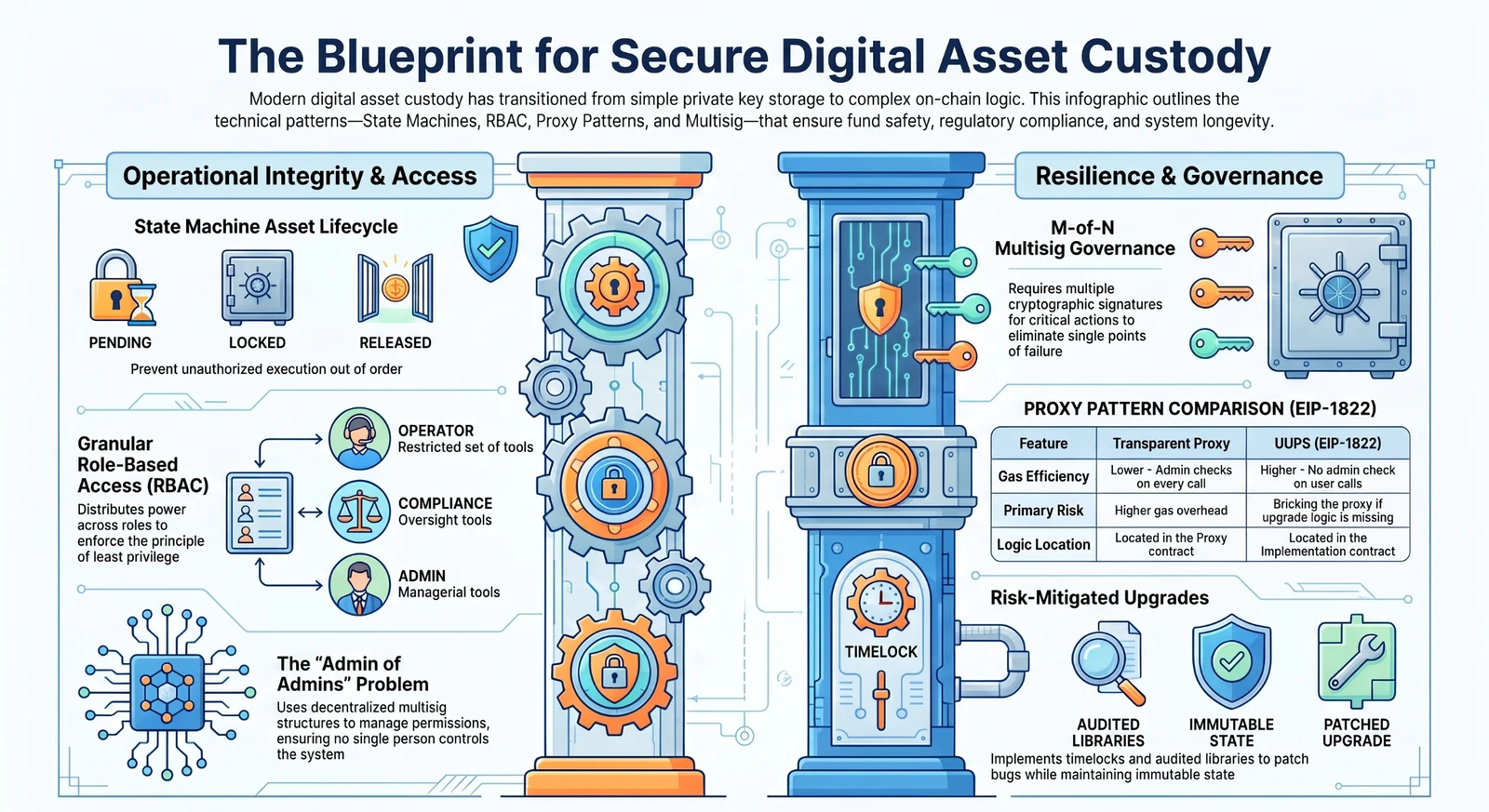
For developers, building a secure custody architecture requires a deep understanding of state machines, access control, and upgradeability. These patterns provide the framework for managing assets while allowing for the flexibility needed in a rapidly changing regulatory environment.
In December 2025, the U.S. Securities and Exchange Commission (SEC) addressed digital asset custody in its updated Custody Rule Modernization Model Framework (SEC Release No. IA-6800, Dec 19, 2025). However, the commission also recognizes the role of secure technology in safeguarding assets.
Modern custody has shifted from a physical vault to a technical stack built on hardware security modules (HSMs) and smart contracts, a programmable layer ensuring assets move strictly by rules no single person can override. This article explores the architectural backbone of that stack: modeling asset lifecycles with state machines, enforcing granular role-based permissions, and managing long-term system integrity through secure proxy upgrades.
The State Machine Pattern in Asset Lifecycle
At the heart of any custody contract is a state machine. This pattern allows a contract to transition through different stages, such as PENDING, ACTIVE, LOCKED, or RECOVERING. By explicitly defining these stages, developers can restrict certain functions to only be callable when the contract is in the correct state. This prevents critical actions, like large withdrawals, from occurring during a security audit or a recovery period.
In Solidity, the state machine is typically implemented using an enum and function modifiers, as detailed in the Solidity Patterns documentation. An enum provides a human-readable way to represent the current state, while modifiers act as the gatekeepers for function execution. For example, a withdrawal function might be wrapped in an atStage(Stages.Active) modifier, so if the contract is Locked, due to suspicious activity or a pending upgrade, the withdrawal reverts automatically.
Circuit breakers rely on this same state machine pattern; for instance, an EmergencySettle state can freeze standard transfers during a breach and route assets strictly to pre-approved cold storage, offering control a plain multisig can't match on its own. Beyond emergencies, explicitly modeling "unhappy paths" lets rejected or canceled multi-approval requests transition cleanly out of pending status, preventing transactions from getting stuck in permanent limbo.
- Intent: Partition contract behavior into distinct stages to prevent unauthorized state transitions and ensure logical consistency.
- Transition Logic: Stages can be transitioned manually by an admin, conditionally through contract logic, or automatically after a time window evaluated against block timestamps (rather than relying on precise block timestamps, which can vary slightly depending on block builders).
- Risk Mitigation: Properly implemented state machines prevent out-of-order execution, which is a common vector for smart contract exploits where an attacker tries to call a function before the contract is ready.
- Auditability: A state machine makes it easy for auditors to visualize the entire lifecycle of an asset and verify that every possible transition is secure.
Access Control and Role-Based Permissions
Custody contracts must distinguish between different user types; a simple owner variable isn't enough for institutional security. Instead, developers use Role-Based Access Control (RBAC) to distribute power: an OPERATOR triggers routine transactions, while an ADMIN changes system configuration.
The industry standard is OpenZeppelin's AccessControl, which offers granular permissions beyond the basic Ownable pattern. Developers can define custom identifiers like OPERATOR_ROLE, COMPLIANCE_ROLE, MINTER_ROLE, or BURNER_ROLE. However, AccessControl doesn't create a role hierarchy automatically; developers must explicitly configure role administration using _setRoleAdmin.
For instance, a CUSTODIAN_ROLE might initiate transfers while a COMPLIANCE_ROLE attests to them, supporting institutional separation of duties and providing an on-chain, auditable record. Enforcing least privilege limits damage if an operator key is stolen. Additionally, managing the "Admin of Admin" structure, where every role has its own governing admin role, allows departments to manage permissions decentrally, often paired with a multisig to prevent unilateral control.
Proxy Patterns and Upgradeability
Because smart contracts are immutable by default, developers use proxy patterns to fix bugs or add new features. In a custody system, upgradeability is a double-edged sword. While it allows for security patches, it also introduces a single point of failure: the upgrade admin. If the admin's key is compromised, the entire custody logic can be replaced with malicious code.
There are two primary upgrade patterns used today: the Transparent Proxy and the UUPS (Universal Upgradeable Proxy Standard). The choice between them often comes down to a tradeoff between gas efficiency, security, and developer complexity. Both patterns use delegatecall to execute logic from a separate contract while maintaining the state in the proxy contract's storage.
The Transparent Proxy pattern is the classic approach. It uses a ProxyAdmin contract to manage upgrades. The proxy itself has a fallback function that checks if the caller is the admin. If it is, it handles admin tasks; if not, it delegates the call to the logic contract. That setup avoids function selector clashes, where an admin function and a user function share the same 4-byte identifier. The tradeoff is that the check runs on every transaction, which adds gas cost for users.
Feature | Transparent Proxy | Universal Upgradeable Proxy Standard (UUPS) |
Upgrade Logic Location | Located in the Proxy contract (managed by ProxyAdmin). | Located in the Implementation contract. |
Gas Efficiency | Higher gas cost on user calls due to admin checks on fallback. | Lower execution gas cost per call for standard transactions. |
Architectural Trade-Offs | Higher proxy complexity, but lower risk of permanently losing upgrade capability. | Simpler proxy contract, but requires careful auditing to ensure upgrade logic isn't omitted in new implementations. |
Storage Standard | EIP-1967 | EIP-1967 |
Modern guidelines often favor UUPS over Transparent Proxies for one main reason: gas efficiency. Transparent proxies check caller permissions on every single transaction, adding overhead, whereas UUPS puts the upgrade logic directly inside the implementation contract.
The catch? If you accidentally deploy a new UUPS implementation that omits the upgrade function, you permanently lock yourself out. The proxy can never be upgraded again. For a custody system, avoiding that scenario requires rigorous CI/CD checks and automated deployment testing.
Finally, watch out for storage collisions. An upgraded implementation must strictly preserve the existing storage layout, meaning new state variables can only be appended at the end. Shift variable orders, and the proxy will corrupt its own state data. Tools like OpenZeppelin's Upgrades plugin are non-negotiable for catching layout mismatches before they hit mainnet.
Multisig Logic and Multisignature Schemes
No single individual should have total control over a custody contract. Multisig logic ensures that critical actions require the approval of multiple parties. This is often implemented at the owner level of a contract, where the owner is not an EOA (Externally Owned Account) but another smart contract like a Gnosis Safe account.
Advanced custody contracts may also include built-in multisig logic for specific functions. For example, a withdrawal exceeding a certain threshold might require three out of five signatures from a COMPLIANCE_ROLE. This M-of-N pattern is a fundamental building block of secure custody. While a multisig is not automatically trustless custody, it still relies on the selected signers and overall governance process; it drastically reduces reliance on any single private key.
In a professional setting, this multisig logic is often integrated with off-chain workflows. A transaction might be initiated in a web dashboard, which then triggers a series of push notifications to the mobile devices of the authorized signers. Each signer provides a cryptographic signature using their own private key. Only once the required number of signatures is collected is the transaction broadcast to the blockchain.
You get the speed of off-chain coordination with the security of on-chain enforcement, since the smart contract only checks that signatures are valid and meet the threshold. That combination is what makes the system hard to compromise, whether the threat is an outside hacker or someone on the inside.
- EIP-712 Typed Signatures: Encodes structured data so signers review human-readable payloads before signing.
- Chain ID & Address Binding: Embeds block.chainid and contract addresses into the domain separator to prevent cross-chain and cross-contract signature replay attacks.
- Unique Nonces & Deduplication: Tracks sequential or bitmapped nonces to ensure payloads execute only once, with strict address ordering to prevent duplicate signature submission exploits.
- Threshold Management: Allows threshold updates only through high-security admin workflows that themselves require elevated approval.
- Signature Expiry: Includes deadline timestamps so outdated requests cannot be executed after context changes.
- Signer Rotation & Reentrancy Guards: Supports adding/removing signers dynamically while wrapping execution entry points with reentrancy protection (e.g., OpenZeppelin ReentrancyGuard).
- Event Logging: Emits detailed events for all state changes and signatures to maintain an immutable audit trail.
Security Controls Beyond the Core Patterns
Beyond state machines, roles, and proxy logic, an institutional-grade smart contract custody platform requires several additional defense-in-depth security controls:
- Withdrawal Limits & Rate Limits: Cap the aggregate value of assets that can leave the system within a rolling window (e.g., daily limits) to mitigate automated draining in an exploit scenario.
- Allowlisted Destinations: Restrict outbound transfers strictly to pre-approved destination addresses verified by compliance governance.
- Timelocked Upgrades: Enforce mandatory delays (e.g., 48 to 72 hours) between proposing contract updates or role modifications and executing them, giving monitoring systems time to audit pending changes.
- Emergency Pause & Recovery: Integrate pausable state mechanics allowing automated monitoring bots or security roles to freeze operations instantly during anomalous activity.
- Governance & Operational Separation: Separate day-to-day operational accounts from high-privilege administrative keys that govern upgrades or emergency parameters.
Comparison of Custody Architecture Patterns
The following table summarizes the key architectural patterns discussed and their primary use cases in asset custody.
Pattern | Primary Purpose | Key Benefit | Technical Considerations |
State Machine | Lifecycle Management | Prevents out-of-order execution | Evaluate timestamp constraints over wide windows rather than precise block timestamps. |
RBAC | Permission Management | Granular distribution of power | Requires manual configuration of role admin hierarchies (_setRoleAdmin). |
Transparent Proxy | Logic Updates & Bug Fixes | Separates admin and user logic | Introduces additional per-call gas overhead. |
UUPS Proxy | Logic Updates & Bug Fixes | Gas-efficient user execution | Risk of bricking upgrades if new implementation omits upgrade function. |
Multisig | Governance / Access | Eliminates single point of failure | Requires off-chain coordination, unique nonces, and EIP-712 replay protection. |
Technical Takeaways for Developers
When designing a custody contract, the goal is to minimize the trust required in any single entity. Developers should follow these practical guidelines:
- Use Industry Standards: Never roll your own access control or proxy logic. Use audited libraries like OpenZeppelin.
- Separate Concerns: Keep the custody logic separate from the upgrade logic. This makes the contract easier to audit and reduces the risk of side effects.
- Initialize Proxies Atomically: In upgradeable contracts, the initialize function replaces the constructor. Initialize the proxy instance atomically during deployment, disable initializers on the logic implementation contract (using _disableInitializers() in the constructor), and prevent reinitialization to eliminate hijacking risks as warned by OWASP.
- Implement Timelocks: Any critical change, such as an upgrade or a role change, should be subject to a timelock. This gives the community or other admins time to react if a malicious change is proposed.
Practical Takeaways for the Audience
For institutional developers, the architecture is the security feature. State machines enforce the business logic, RBAC distributes power, proxy patterns keep the system maintainable, and multisig governance removes any single point of failure. As regulation catches up with the technology, the custodians with clean, auditable contract architecture will be the ones that don't end up as a case study.
Developers must stay informed about emerging standards like EIP-1967 for storage slots and the latest security recommendations from organizations like OWASP to ensure their systems remain secure in the face of evolving threats.
Related Articles:
Consensus, Custody & Cryptographic Architecture: A Technical Reference
Token Vesting Mechanics: Cliff, Linear and Milestone-Based Smart Contract Implementations
Smart Contract Audit Methodology: Static Analysis, Formal Verification and Coverage Gaps