
A May 2026 study tracked 9 Ethereum-based RWA tokens across 54 monthly observations and found that a larger on-chain asset value did not reliably produce stronger liquidity. In its baseline analysis, Treasury and private-credit tokens recorded significantly lower turnover than gold-backed tokens.
Some products also showed near-zero turnover in several months despite holding meaningful asset value. The research is a recent preprint, so its findings remain preliminary, but the warning is clear: issuing an asset on-chain does not create an active secondary market.
That gap is what effective secondary liquidity pool design must solve. A token can settle in seconds while its holder still struggles to find a buyer. In a thin, permissioned market, one moderate transaction can pull a standard constant-product pool away from net asset value, drain its stablecoin reserves, and leave liquidity providers holding one-sided inventory.
Can an automated market maker provide a dependable exit when there are too few traders to restore fair pricing?
It can, but AMM mechanics for RWA cannot simply copy a liquid crypto pair. Illiquid tokenized assets require an external price anchor, reserve-aware redemption, controlled participation, dynamic fees and a curve designed around the asset’s valuation cycle.
Automated Market Maker (AMM) is a type of decentralized exchange protocol that allows digital assets to be traded automatically without traditional buyers and sellers. |
Why AMM Mechanics for RWA Need a Different Curve
A constant-product market maker follows:
x×y=k
Here,
x = RWA token reserve
y = settlement-asset reserve
k = invariant
Suppose a pool starts with 100,000 RWA tokens and 100,000 USDC. The opening marginal price is $1. A buyer then adds 10,000 USDC. Ignoring fees, the pool releases about 9,091 tokens, so the buyer pays an average execution price near $1.10.
After the trade, the reserve stands at 90,909 RWA tokens and 110,000 USDC. That lifts the next marginal quote to roughly $1.21.
Simply, a trade equal to 10% of the initial cash reserve creates about 10% average execution slippage and moves the next quoted price by 21%.
Arbitrage may close that gap in liquid crypto markets. An RWA token may have no parallel venue, a once-daily NAV, and a whitelist that excludes most arbitrageurs, so the imbalance can persist.
Uniswap v3 improves capital efficiency by letting liquidity providers concentrate funds within selected price ranges. However, its design also states that liquidity becomes inactive when the price leaves the range. At that point, the position consists entirely of one asset.
That outcome is especially risky for low-volume RWA pools. The provider may end up holding the asset investors are trying to sell while the pool loses the stablecoin reserve needed to support exits.
Before selecting a curve, issuers should
- measure the bid-ask spread,
- depth near NAV,
- turnover, zero-trade days,
- active traders,
- holder concentration,
- and redemption time.
The Amihud illiquidity coefficient can also show how strongly small trades move the price.
Two May 2026 preprints found that outstanding RWA value did not reliably predict observed liquidity and that large on-chain value can coexist with low turnover and concentrated ownership.
( 1. Tokenized but Illiquid? Evidence from Real-World Asset Markets
2. Beyond TVL: An Explainable Risk Scoring Framework for Tokenized Real-World Assets)
These are early, non-peer-reviewed findings, but they support a practical lesson:
Tokenization and liquidity are different outcomes.
Bonding Curves and Better Price Anchors
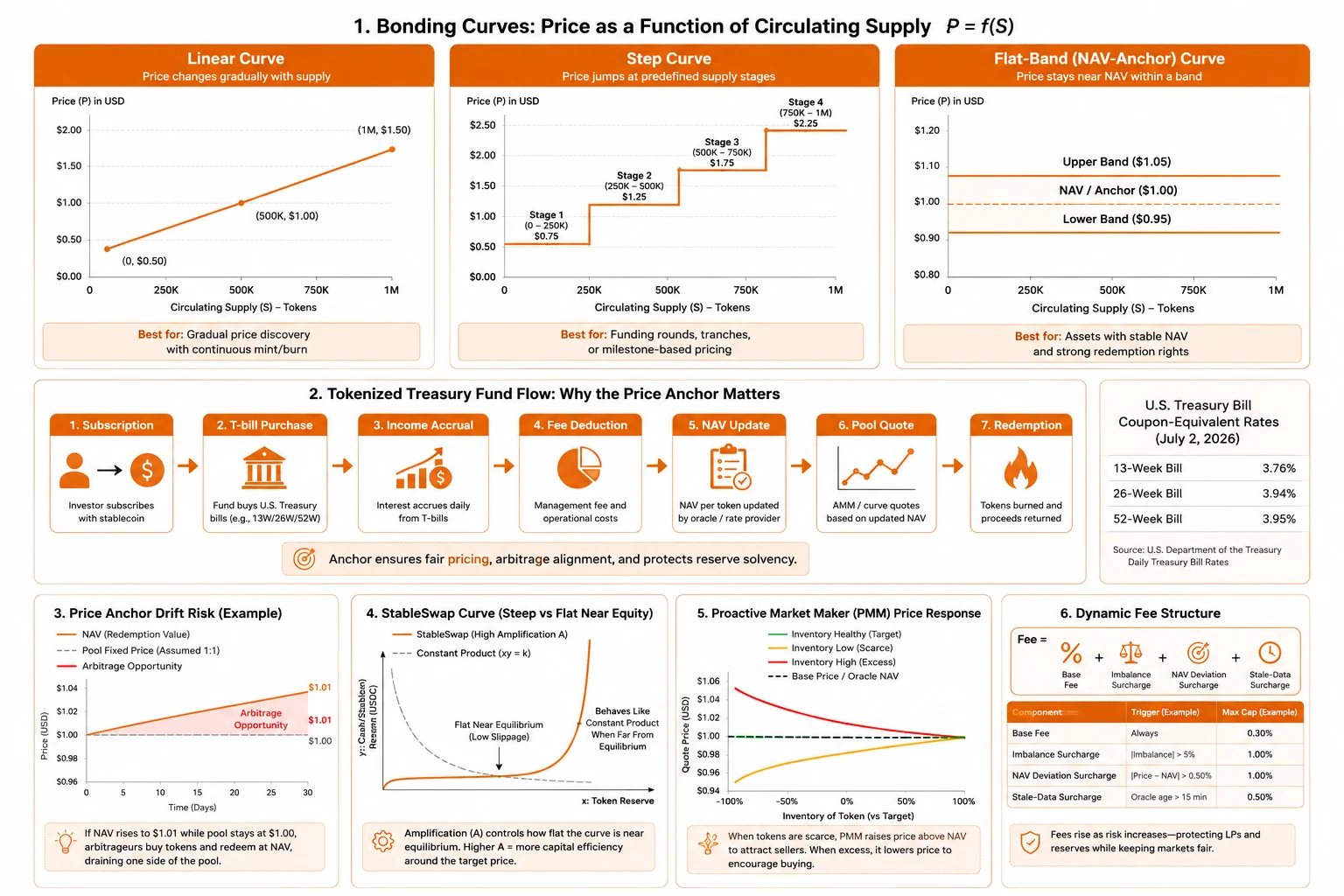
A bonding curve prices a token from the circulating supply:
P=f(S)
Here,
P = Token Price
S = Circulating Supply
Linear curves move gradually, step curves follow funding stages, and flat-band curves quote near NAV until reserve limits are reached. Unlike a dual-asset pool, pricing depends on a predefined supply function rather than the changing balance between two reserves.
However, a bonding curve is not automatically a secondary market. When purchases mint tokens and redemptions burn them, the curve operates as an issuer-controlled issuance and redemption module.
It may sit beside an AMM, a request-for-quote system, or a regulated marketplace where existing investors transfer tokens between themselves.
A bonding curve offers a deterministic exit quote only while reserves, redemption rights and settlement rails remain available. If the reserve vault is depleted or redemptions are suspended, the formula cannot create liquidity by itself.
A tokenized Treasury fund shows why the price anchor matters:
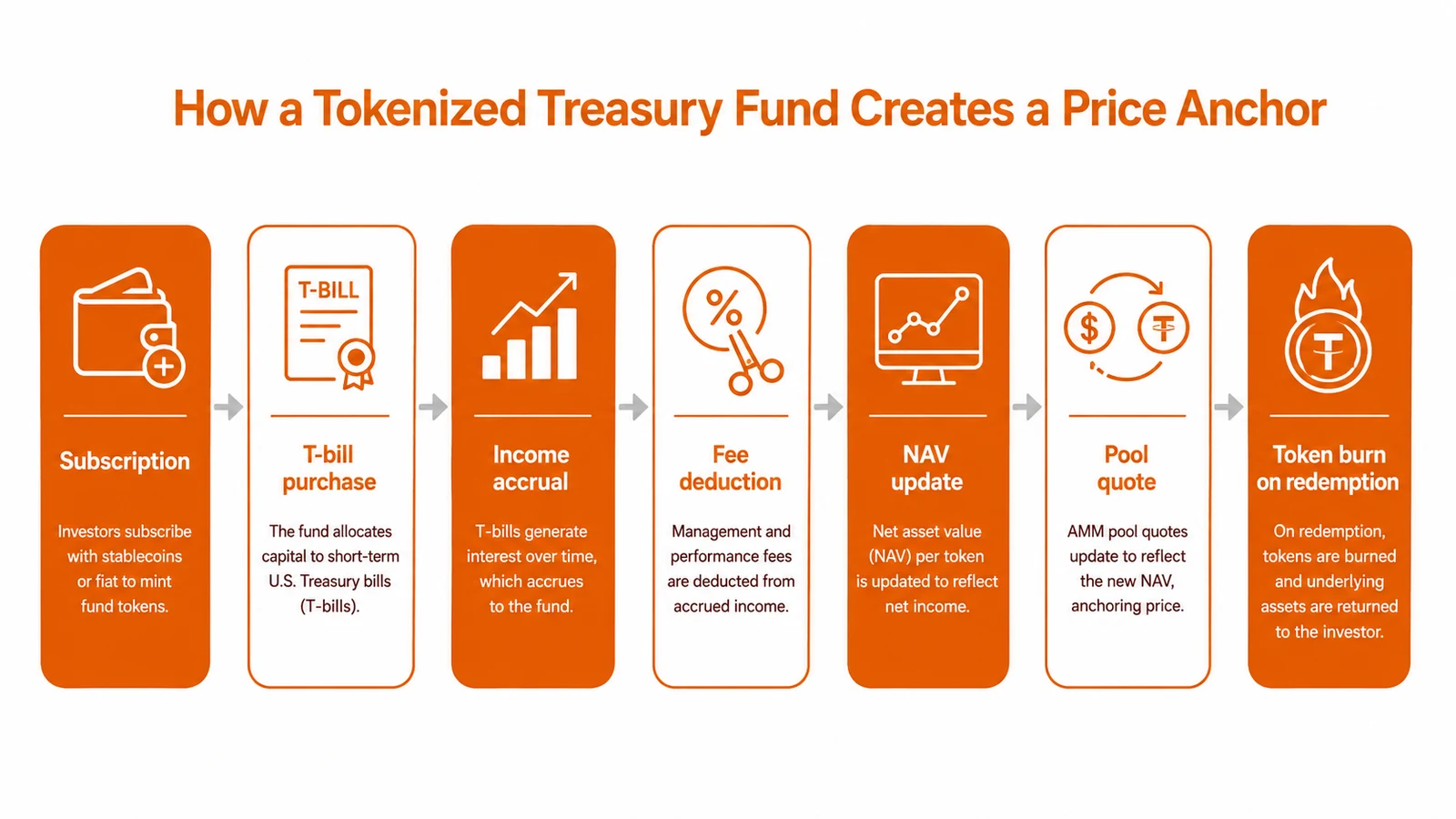
On July 2, 2026, U.S. Treasury coupon-equivalent bill rates were 3.76% for 13-week bills, 3.94% for 26-week bills, and 3.95% for 52-week bills. The underlying bills create the yield. The pool only adds a trading route, transaction fees and potential basis risk.
A yield-accruing token also needs a moving equilibrium price. If its NAV rises while the pool assumes a fixed 1:1 value against USDC, predictable arbitrage will drain one side of the pool.
A rate provider, updated NAV oracle or wrapper should therefore move the reference price with the token’s redemption value.
Curve’s StableSwap invariant can suit assets expected to remain close to a known relationship. It remains relatively flat near equilibrium and moves toward constant-product behaviour as reserves become imbalanced. Its amplification coefficient controls how strongly liquidity is concentrated around the target value.
An oracle-guided Proactive Market Maker offers another option. DODO describes its PMM as an inventory-management strategy. When an asset becomes scarce, the algorithm raises its quoted price to encourage inventory to return. Bid and ask depth can also be asymmetric.
That matters for an RWA issuer that needs more stablecoin on the sell side to support investor exits than token inventory on the buy side.
Dynamic fees can reinforce those controls:
Fee=Base Fee + Imbalance Surcharge + NAV Deviation Surcharge + Stale Data Surcharge
Each component needs a threshold and a maximum cap. The pool can charge its base fee while reserves are balanced, then increase charges as inventory weakens, trade size grows, or the valuation feed becomes older.
Engineering a Permissioned RWA Liquidity Pool
A credible RWA token liquidity pool begins with its legal and operating constraints, not its swap formula.
The core stack should include:
- A permissioned RWA token
- An investor identity registry
- A pool and a curve controller
- A signed NAV or appraisal oracle
- A settlement reserve vault
- A redemption module
- A dynamic fee controller
- A circuit breaker
- A reconciliation service
A normal swap should follow this order:

A thin pool should not use its own time-weighted average price as the only source of fair value. Sparse or manipulated trades can produce a technically valid TWAP that does not reflect the underlying asset.
A safer design uses independent valuation inputs, a maximum oracle age, and a permitted deviation from NAV.
Other controls should include wallet limits, daily outflow caps, review of unusually large trades, and reconciliation between token supply, the official ownership register and reserve assets.
The contract should also suspend trading when:
- The price feed becomes stale
- Pool price exceeds the permitted NAV band
- Redemption capacity falls below its minimum
- Reserve reconciliation fails
- Investor eligibility cannot be verified
Permissioning does not remove securities-law duties. In January 2026, staff from three SEC divisions stated that the tokenized format does not change the application of federal securities laws. They also distinguished issuer-sponsored, custodial, and synthetic tokenization structures.
The document was a staff statement, not a Commission rule, and created no new legal obligations.
Matching the Market Model to the Asset
The right design depends on valuation frequency, redemption speed, and who may legally trade.
Tokenized asset | Better market structure | Reference price | Minimum operating condition |
Treasury or money-market token | StableSwap or oracle-guided PMM | Daily NAV and redemption value | Cash buffer, rate-aware pricing, and frequent redemption |
Commodity-backed token | PMM or concentrated pool | Spot price and custody data | Redundant oracles and reliable conversion |
Private-credit token | Step curve or RFQ-AMM hybrid | Administrator valuation | Wider spread and scheduled repricing |
Real-estate SPV token | Batch auction or reserve-backed curve | Appraisal and cash-flow model | Defined exit windows and strict reserve limits |
Pre-IPO SPV interest | Regulated RFQ or venue-led market | Periodic manager valuation | Transfer approval and verified investors |
A continuous AMM fits assets with frequent prices and predictable redemption. Treasury and commodity tokens may qualify when custody, valuation, and conversion work reliably.
Private credit, real estate, and pre-IPO interests update less often and may require transfer approval. An RFQ, periodic auction, or regulated marketplace may preserve price integrity better than a permanent pool.
Existing protocols provide components rather than a complete RWA solution. Uniswap v3 shows range-based liquidity, Curve shows low-slippage trading near equilibrium, and DODO shows inventory-sensitive pricing.
Balancer Liquidity Bootstrapping Pools use changing weights during a fixed sale period and can migrate into another pool. That makes them useful for distribution and initial price discovery, but not necessarily for permanent secondary liquidity.
Choosing the Final Liquidity Model
Use a token-powered pool when the asset has:
- A current external reference price
- Enforceable redemption
- Adequate settlement reserves
- Frequent valuation updates
- Enough eligible trading flow to rebalance inventory
Use an RFQ, auction, or controlled marketplace when:
- Valuation is periodic
- Transfers require issuer consent
- Large trades need manual review
- The eligible investor base is small
- Redemptions occur only during scheduled windows
Report five items clearly for institutional due diligence: minimum trade size, executable depth near NAV, redemption time, transfer controls, and asset sector.
TVL alone is not a liquidity measure.
Illiquid tokenized assets need controlled exit architecture, not a generic AMM copied from a liquid crypto pair.
Disclaimer: This article is for educational and technical research purposes only. It is not financial, legal, tax, or investment advice. Tokenized assets, AMMs, bonding curves, and secondary liquidity pools involve market, smart contract, custody, liquidity, and regulatory risks. Readers should verify all data and consult qualified professionals before making investment or implementation decisions.
FAQs
Which AMM Model Works Best for Illiquid RWA Tokens?
StableSwap or an oracle-guided PMM can suit redeemable assets with frequent NAV updates. Step curves, RFQ hybrids and auctions are generally better for assets with periodic valuations or approval-based transfers.
How Does a Bonding Curve Price an RWA Token?
It calculates the price from the circulating supply. In an issuer-controlled model, purchases can mint tokens and redemptions can burn them. The quoted exit remains credible only while reserves and enforceable redemption rights remain available.
Can an AMM Guarantee Secondary Liquidity?
No. Execution depends on reserve depth, oracle quality, investor eligibility, settlement capacity, and the ability to redeem or rebalance the underlying asset.
How Do Permissioned Pools Enforce KYC?
They connect approved wallets to an identity registry and check residence, investor status, sanctions restrictions, holding periods, and other transfer rules before completing a trade.
How Can an RWA Pool Reduce Price Manipulation?
Use independent price sources, maximum oracle ages, NAV-deviation limits, dynamic fees, trade caps, circuit breakers, and reserve reconciliation. A thin-pool TWAP should not be the sole valuation source.