Many blockchain systems can be modeled as replicated state machines, where honest participants attempt to agree on an ordered state transition history. For developers deploying smart contracts, application integrity relies on two core guarantees: safety (honest participants never finalize conflicting states) and liveness (valid transactions eventually execute under valid network synchrony assumptions).
Understanding Consensus Taxonomy
To analyze finality accurately, we must separate the weighting mechanism from consensus protocols:
- Sybil-Resistance Weighting: Proof-of-Work (PoW) and Proof-of-Stake (PoS) define how block-production rights and voting influence are weighted.
- Consensus Paradigms:
- Nakamoto-Style Consensus: Uses dynamic availability where nodes extend valid chains independently (e.g., Bitcoin).
- BFT-Style Commit Protocols: Use explicit voting rounds to achieve deterministic finality (e.g., CometBFT).
- Hybrid Models: Combines chain-selection fork choices with finality gadgets (e.g., Ethereum's Gasper).
- Sampling-Based Systems: Uses repeated subsampled voting for rapid probabilistic convergence (e.g., Avalanche Snowman).
Achieving this balance introduces structural tradeoffs. Solana targets roughly 400 ms slot times for rapid provisional state updates, while finalization under its current Tower BFT architecture typically requires around 13 seconds under target conditions. Conversely, Ethereum's Gasper hybrid model advances protocol-level crypto-economic finality approximately every two epochs (~13 minutes).
Choosing the wrong consensus model or misconfiguring RPC block tags (such as querying latest instead of finalized) is not just a user experience issue; it is a critical vulnerability vector. In cross-chain routing and Real-World Asset (RWA) tokenization, a sudden chain reorganization can instantly turn a seemingly successful mint into a catastrophic multi-million dollar double-spend exploit, leaving a bridge or protocol fundamentally insolvent.
This article dissects the practical Byzantine Fault Tolerance (BFT) thresholds, latent synchronization trade-offs, and finality profiles across Proof of Work (PoW), Proof of Stake (PoS), and pure BFT architectures to provide developers with a definitive blueprint for risk modeling engineering.
To build these risk models, engineers must map application-layer vulnerabilities directly to the network's consensus thresholds. These thresholds dictate exactly how many malicious or faulty actors a system can sustain before safety or liveness fails.
Understanding the BFT Threshold
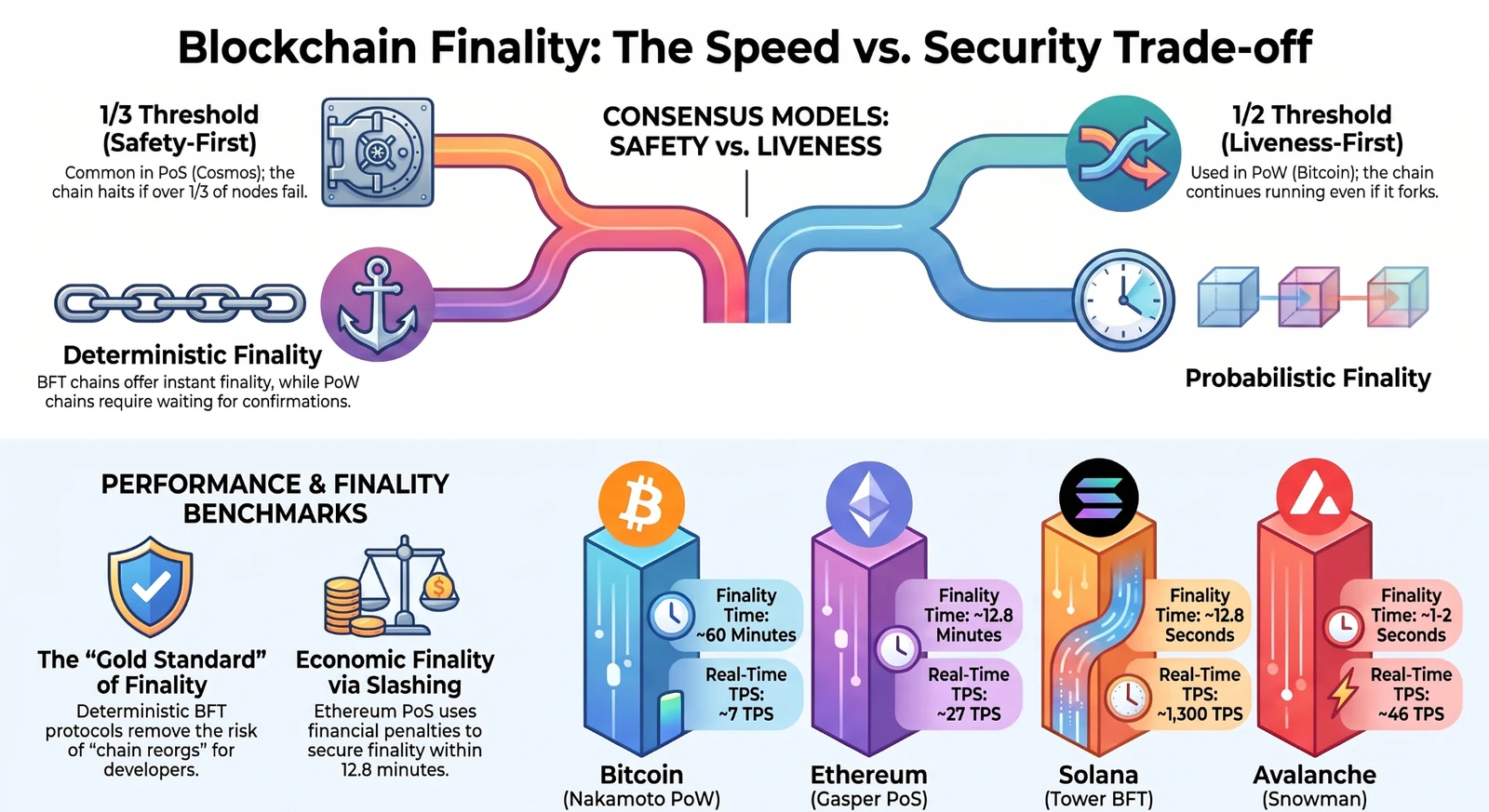
The fault tolerance threshold is the maximum number of malicious nodes a system can handle. Most classic BFT systems, such as Tendermint or PBFT, require that fewer than one-third ($1/3$) of the nodes are Byzantine. Because these protocols strictly prioritize safety over liveness, the network will intentionally halt consensus rather than commit a conflicting or invalid state transition during a partition.
This ensures that the state of the ledger is never in doubt, even if it means the network goes offline for a while.
In contrast, Nakamoto consensus assumes adversarial hash power remains strictly below 50% ($1/2$), alongside network synchrony and economic assumptions 1 . This model explicitly prioritizes liveness over safety 1, meaning nodes continue appending blocks to their local chains even during severe network partitions, resolving conflicts downstream via the most-work chain rule (commonly referred to as the longest chain) 1.
This is why Bitcoin can survive a netsplit (a network partition) where two halves of the world cannot talk to each other. Both halves would keep mining, creating two different versions of history. When the network reconnects, the longest chain rule forces one side to discard its work.
This leads to different types of finality that developers need to account for in their code. If you are building a payment gateway, you cannot treat a Bitcoin transaction the same as a Cosmos transaction. One might disappear after an hour, while a CometBFT transaction becomes final once its block is committed by the validator set. Developers must write logic that handles these chain reorganizations or reorgs to prevent double-spending.
- 1/3 Threshold: Common in BFT-style PoS (Cosmos, Polkadot). It requires $2f+1$ honest validators out of $3f+1$ total voting power. If bad actors or network outages control more than 1/3 of total stake or voting power, the chain halts to maintain safety.
- 1/2 Threshold: Common in PoW (Bitcoin, Litecoin). It requires a simple majority of honest hashing power. It prioritizes liveness, meaning the chain rarely stops, but it can fork easily.
- Validator Set Size: Classic BFT protocols usually have smaller validator sets (100-300) to keep communication fast. PoW and some PoS models can have thousands of nodes but at the cost of slower finality.
- Economic Threshold: Ethereum PoS uses a 1/3 threshold for finality, but adds slashing to make attacks expensive, as reported by Dwellir. This creates a cost of corruption that is much higher than the simple node count suggests.
Probabilistic vs. Deterministic Finality
Finality is the structural point where a transaction cannot be reversed. In PoW chains like Bitcoin, finality is inherently probabilistic. This means a transaction is never 100% final; instead, it simply becomes harder to reverse as more blocks are added to the ledger. Most exchanges wait for 6 confirmations to mitigate this risk, which takes about an hour according to Curve Grid. This latent wait time is a major bottleneck for user experiences in decentralized applications.
On the other hand, BFT-based chains provide immediate deterministic finality. Once a block is committed by the validator set, it is final instantly. This architecture is common in the Cosmos ecosystem using the Tendermint protocol (now CometBFT). There are no reorgs or chain splits in these systems because if the network cannot reach a 2/3 majority, the chain simply halts until the issue is resolved. For a developer, this is an ideal standard for finality because it stops developers from having to track multiple broken chains.
Ethereum uses a hybrid model called Gasper to bridge these two approaches. It combines an optimistic fork choice rule (LMD-GHOST) with a dedicated finality gadget (Casper FFG). That finality gadget locks blocks in roughly every two epochs, the 6.4 to 12.8 minute window mentioned earlier. However, before a block is fully final, the chain can still change. The chain can still experience small reorgs of 1 or 2 blocks. Because of this, developers must explicitly use the finalized tag in their JSON-RPC calls to ensure they are reading safe data instead of a temporary block.
Latency and Throughput Benchmarks
Latency is the time it takes for a transaction to be confirmed. Throughput is how many transactions the network can handle per second (TPS). There is usually a tradeoff between these two. Faster finality often requires more communication between nodes, which can limit how many nodes the network can have. This is why some of the fastest chains have the most centralized validator sets.
Protocol Status Note (As of July 2026): This technical breakdown reflects Solana’s active Tower BFT architecture. The upcoming Alpenglow consensus upgrade (planned for testnet and mainnet deployment in Q3 2026) is designed to modify timing, voting structures, and finality mechanisms.
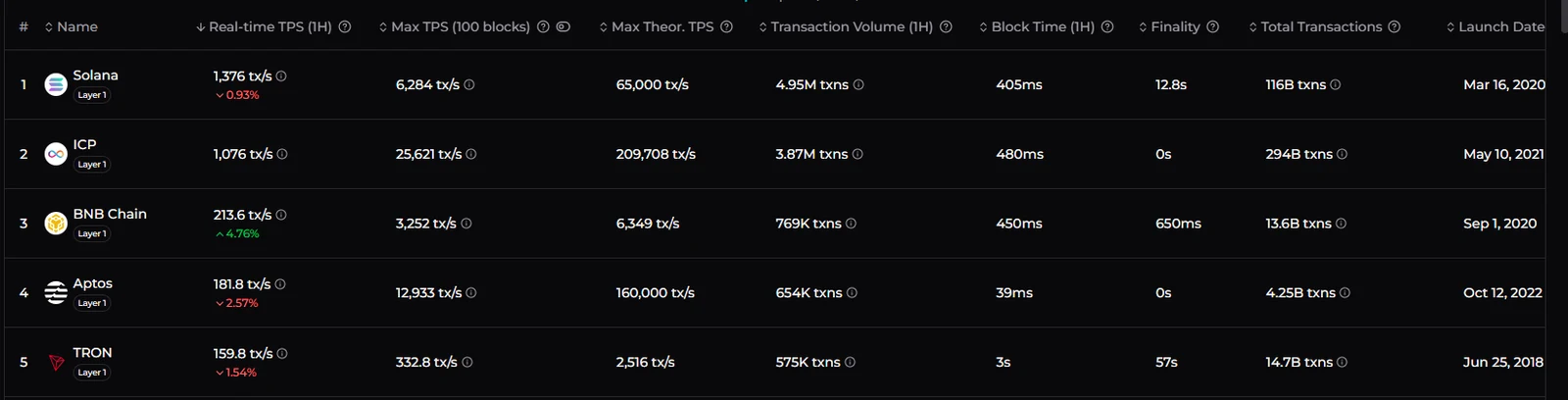
Solana uses a unique approach called Proof of History (PoH) to reduce latency. PoH acts as a decentralized clock, allowing nodes to agree on the passage of time without talking to each other. It can reach a confirmed state in about 400ms, though full deterministic finality takes about 12 seconds, as reported by chainspect. This optimistic confirmation is usually enough for low-value retail apps, but institutional transfers should wait for the full 12-second cycle.
Avalanche uses sub-sampled voting under the Snow consensus family. Instead of every node communicating with all others, each node repeatedly queries a small random sample of validators. This provides rapid probabilistic safety convergence rather than a classic BFT deterministic threshold, typically achieving sub-second operational finality under target conditions across a large validator set
Academic research shows that pipelining can improve throughput. HotStuff, the protocol used by Diem (formerly Libra), uses a three-round process to make the leader's job easier. In each round, the leader collects signatures and sends them out. This pipelining means that while one block is being finalized, the next one is already being proposed.
However, this adds to the latency of each block because it must wait for three rounds of communication.
New protocols like Fast-HotStuff try to reduce this to two rounds to lower latency, as per Arxiv.org. Fast-HotStuff uses aggregated signatures to keep the communication cost linear while avoiding the forking attacks that can happen in the original HotStuff. Aptos operates on AptosBFT, which is based on Jolteon—a direct descendant of the HotStuff protocol family.
Throughput is also affected by block time. Bitcoin has a 10-minute block time, which limits its raw TPS. Solana has a 400ms block time, allowing it to process thousands of transactions in the same window. However, faster block times require better hardware and faster internet connections for validators, which can lead to centralization. This is the scalability trilemma in action: balancing speed, security, and decentralization.
Comparison of Consensus Performance
Here's how the major consensus models stack up on live network data.
Protocol / Chain | Mechanism Type | Fault Tolerance | Finality Type | Median Finality Time | Real-Time TPS (Avg) |
Bitcoin | Nakamoto PoW | 1/2 (50%) | Probabilistic | ~60 Minutes | ~6-7 TPS |
Ethereum | Gasper (PoS) | 1/3 (33%) | Economic | ~12.8 Minutes | ~27 TPS |
Solana | Tower BFT | 1/3 (33%) | Deterministic | ~12.8 Seconds | ~1,300 TPS |
Cosmos Hub | Tendermint | 1/3 (33%) | Deterministic | ~6-7 Seconds | ~10-50 TPS |
Avalanche | Snowman | Probabilistic (Sub-sampled) | Rapid Probabilistic | Sub-second | ~46 TPS |
Polkadot | GRANDPA | 1/3 (33%) | Deterministic | ~12-60 Seconds | ~10-100 TPS |
Note: Real-time TPS varies based on network demand. Data sourced from Chainspect-Dashboard and Nakamoto Coefficients
Technical Tradeoffs for Developers
When building on these chains, developers must handle these differences in their code. For probabilistic chains, you need to wait for a specific number of confirmations. For deterministic chains, you can act once the block is committed or finalized according to that protocol’s RPC status. This impacts everything from UI design to backend database management.
- RPC Tags: On Ethereum, use the finalized block tag for irreversible actions like bridge transfers. This prevents "phantom" transactions that appear to succeed but are later reverted.
{ "jsonrpc": "2.0", "method": "eth_getBalance", "params": ["0xADDRESS", "finalized"], "id": 1 } |
- Node Counts: Chains with more nodes often have higher latency because of the communication overhead. If your app needs speed, look for chains with optimized p2p layers.
- Nakamoto Coefficient: This measures decentralization. A higher number means the chain is harder to halt. Solana has a coefficient of 10, while Polkadot is around 40, as published by Nakaflow.
- Liveness vs Safety: Decide if your app can afford to stop (BFT) or if it must keep running even if it forks (PoW). Most DeFi apps prefer safety over liveness.
Practical Takeaways
For developers, the choice of consensus affects how users experience the app. If you need instant payments, a BFT chain like Avalanche or a fast PoS chain like Solana is better. If you are handling high-value institutional assets, the economic finality of Ethereum might be more secure. The "cost to attack" is often more important than the time to finalize for large transfers.
Always check the finalized status before releasing funds or minting new assets. Relying on the latest blocks can lead to losses if a chain reorganization occurs. For example, if a bridge mints a token on Chain B because it saw a transaction on Chain A, but Chain A then reorgs and that transaction disappears, the bridge is now insolvent. That gap between confirmation and finality is exactly what several past bridge exploits have exploited.
The real decision comes down to liveness or safety. Can your app tolerate a fork, or does it need to know a block will never be reversed? Most financial applications are choosing BFT and PoS models now because the cost of getting a reversal wrong is too high. Match your confirmation policy to the chain's actual finality mechanism, not the one you assumed it had.
Choosing a Consensus Model at a Glance
- Building a payment app? Choose Solana or Avalanche.
- Building a bridge or custody logic? Choose Ethereum or Cosmos.
- Need offline resilience during network splits? Choose Bitcoin-style PoW.
Frequently Asked Questions
Should a bridge ever mint based on Solana's 400ms optimistic confirmation?
No. That confirmation can still revert. Bridges and custody logic should wait for the full deterministic finality window, not the optimistic one, regardless of how fast it looks.
Does a high Nakamoto coefficient also mean faster finality?
No, they measure different things. Nakamoto coefficient measures decentralization risk. Finality time measures consensus speed. A chain can score well on one and poorly on the other.
Can a single app use different confirmation depths for different transaction sizes on the same chain?
Yes, and many production systems do. A $50 payment might act on the latest block, while a $500,000 transfer waits for full finality on the same network.
Related Articles:
- Consensus, Custody & Cryptographic Architecture: A Technical Reference
- Smart Contract Architecture for Asset Custody: State Machines, Access Control and Upgrade Patterns
- Layer-1 Throughput Benchmarking: TPS, Finality Time and Decentralization Tradeoffs Across Chains
- Smart Contract Audit Reports Decoded" (6.2, Risk Modeling pillar)
- Custodian Risk Architecture" (2.5, RWA Tokenization pillar)