Tokenized U.S. Treasuries reached $13.6 billion in April 2026, up 170% from a year earlier, according to Boston Consulting Group. The increase shows growing demand for blockchain-based Treasury products.
A token may appear in a wallet instantly, while its value still depends on contracts, custodians, ownership records, and transfer rules.
So, what does an RWA token actually represent, and which record proves legal ownership?
An RWA token may represent direct ownership, a fund share, an SPV (special purpose vehicle) interest, a debt claim, a custodial right, or price exposure.
This guide explains the technical architecture, legal structure, compliance controls, settlement process, and market data behind tokenized assets.
What Is Real-World Asset Tokenization?
Real-world asset tokenization converts rights connected to a physical or financial asset into digital tokens recorded on a blockchain. The asset may be real estate, government debt, private credit, a fund interest, a commodity, or shares in a private company.
The important word is “rights.” Tokenization does not move a building or a share certificate on-chain. It creates a digital record linked to an off-chain legal arrangement.
That record can divide investments, automate distributions, and make transfers easier to trace. Yet it is only as reliable as the structure supporting it.
What Does an RWA Token Represent?
An RWA token is a fund share, an SPV interest, a note, a beneficial interest, a custodial right, or synthetic exposure. Two tokens may look similar in a wallet while providing very different legal and economic claims.
Suppose a building is divided into 10,000 digital units. Buying 100 may not give the buyer “1%” of the total. A special-purpose vehicle may own the building, while the tokens represent interests in that entity.
A special purpose vehicle (SPV) is a separate company created to hold certain assets or debts and protect them from other financial risks. |
Before treating a token as proof of legal rights, investors should identify five things :
- The underlying asset,
- It's the legal owner,
- The authoritative register,
- The smart contract
- And the documents defining holder rights.
If one link is missing, the wallet balance may be clear while the legal claim remains uncertain.
Core Principle of RWA Tokenization
A wallet balance does not always prove direct ownership. Its legal effect depends on the token structure, governing documents, applicable law, and the record designated as authoritative.
Blockchain records may form part of a legally recognized ownership system, but their effect depends on applicable law and the issuer’s governing records.
The real value of a token depends on how well the legal structure, technical system, and real-world asset operations work together. If these parts are not aligned, the token may still move on-chain, but its real-world value and enforceable claims can break down.
What Are the Main RWA Token Structures?
Most tokenized assets follow four structures that determine how rights are defined, how risk is distributed, and how investors can exit.
Direct or Native Tokenized Issuance
A native tokenized issuance integrates the blockchain or connected ledger into the issuer’s official register of investor rights records. A valid transfer on the approved system can change the legally recognized holder of the security.
- Franklin Templeton’s $BENJI is one example. One $BENJI token represents one share in the Franklin OnChain U.S. Government Money Fund.
The fund’s transfer agent uses a blockchain-integrated system to maintain the official register of investor positions.
This type of structure creates a close link between the token and the security. Investors must still follow the fund’s eligibility, transfer, and withdrawal rules.
SPV, Fund, or Trust Interests
A legal vehicle may own the assets and issue tokens linked to its shares, notes, fund units, or beneficial interests.
Suppose an SPV owns shares on the secondary market in a private company such as Anthropic, OpenAI & Stripe. A token connected to that SPV does not normally place the holder on the private company’s shareholder register. The holder owns an interest issued by the SPV.
The special purpose vehicle documents determine:
- Voting and information rights
- Management and performance fees
- Distribution procedures
- Transfer restrictions
- Treatment of an IPO or acquisition
- The manager’s authority
This difference is important in tokenized pre-IPO investing, where investors may receive exposure to private shares without becoming direct shareholders of the operating company.
Custodial Entitlements and Off-Chain Asset Risk
A custodian or third-party issuer may hold a traditional asset and issue tokens representing contractual entitlements against it.
The structure should state whether the underlying assets are held in a separate account and protected from the issuer’s other creditors. It should also explain how investors enforce their claims if the custodian or issuer fails.
A custody statement identifies the assets held in an account. Investor rights come from the asset holding arrangements and offering agreements.
Synthetic Exposure
A synthetic token tracks the price or financial performance of another asset without transferring direct claims to that asset.
The issuer may use collateral, derivatives, or a contractual payment promise to create the exposure. The token holder may have no voting, dividend, or information rights against the company that issued the referenced security.
The U.S. Securities and Exchange Commission staff explained that third-party tokenization structures may include tokenized linked securities or security-based swaps as forms of synthetic exposure in its January 2026 statement on tokenized securities
RWA Tokens vs Protocol Tokens
A protocol token may provide governance, incentives, or platform access. It does not automatically provide ownership of the investments sold through that platform.
For example, holding ONDO is not the same as holding USDY or OUSG. Each product has its own legal terms, eligibility rules, and redemption process.
Traditional Assets vs Tokenized RWAs
Feature | Traditional Assets | Tokenized RWAs |
Trading Hours | Business hours only | 24/7 |
Settlement | T+1 or T+2 days | Minutes or instant |
Minimum Investment | Usually high | Fractional (much lower) |
Transparency | Periodic reports | Real-time on-chain |
Ownership Record | Central registry or paper | Blockchain + legal documents |
Liquidity | Varies by market | Potentially higher but often restricted |
Accessibility | Limited by location & paperwork | Global (subject to compliance) |
Main Risks | Custody & legal | Adds smart contract & reconciliation risks |
Securitization vs Tokenization
Securitization pools assets and reallocates their cash flows and credit risk, often through senior, mezzanine, and junior tranches. Tokenization changes how a right or instrument is recorded, transferred and administered.
A securitization may use trustees, covenants, credit enhancement and payment waterfalls. A smart contract does not create bankruptcy remoteness or claim priority. A loan pool may therefore be securitized into notes and those notes issued as tokens: securitization defines the economic structure, while tokenization provides the digital rail.
How Real-World Asset Tokenization Works
An RWA tokenization platform (Securitize, Tokeny, Centrifuge, RWA Inc., and tZero) connects the asset, legal vehicle, investor identity, token contract, and payment process.
The operating flow usually follows this order:
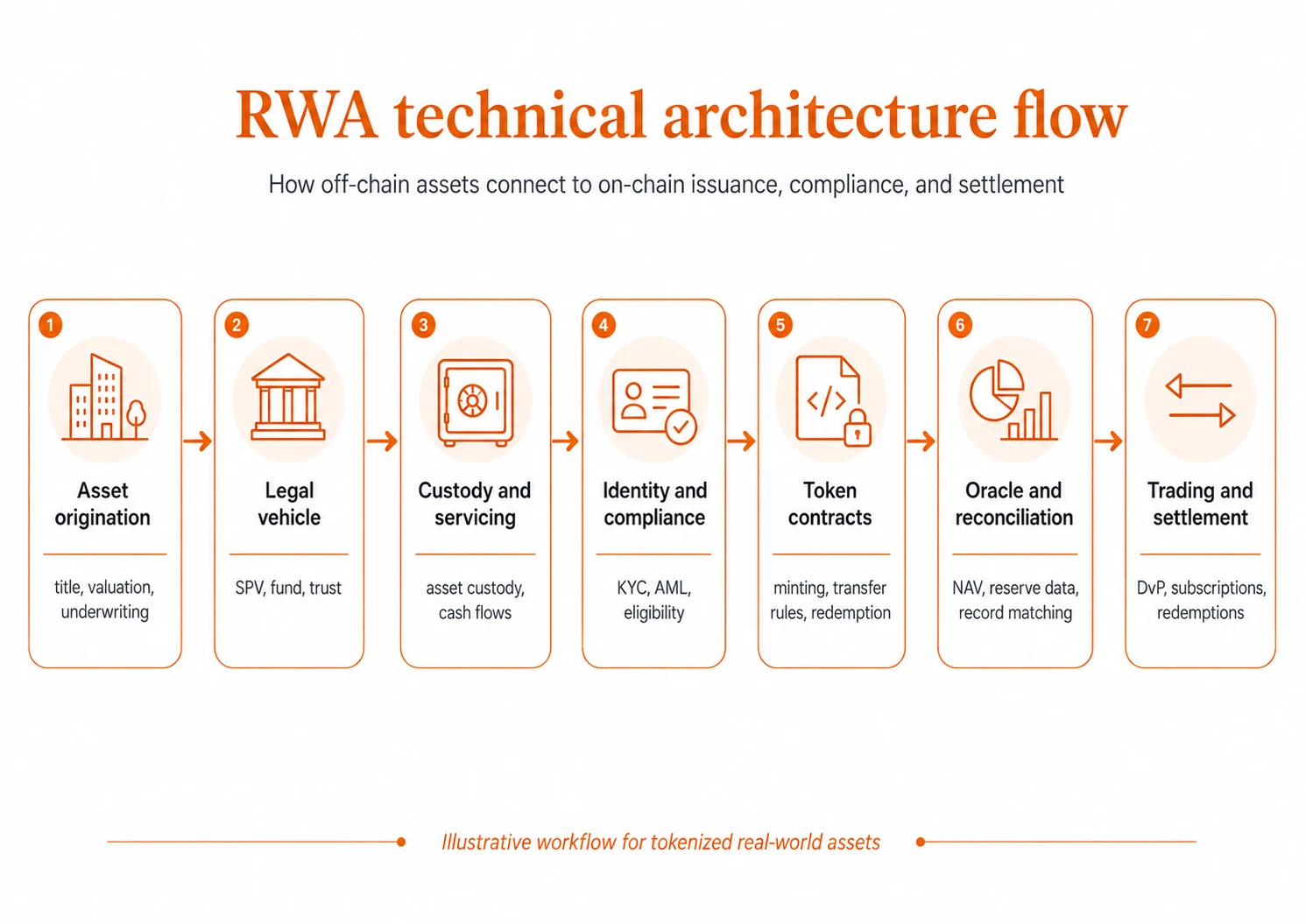
1. Asset Origination and Verification
The originator first confirms that the asset exists and can be legally transferred, pledged, or placed inside the planned structure.
The required checks depend on the asset class.
For tokenized real estate (RealT), the issuer may review title records, liens, leases, taxes, insurance, and appraisals.
For private credit (Centrifuge), the review may cover the borrower, collateral, covenants, repayment schedule, and servicing history.
When dealing with private-company shares such as Databricks, Tether, and Anduril, issuers must first verify the share position and review the relevant shareholder agreement. They must also assess any rights of first refusal and transfer-consent requirements that may restrict how those shares can move between parties.
The issuer must also define how the asset will be valued and how often the valuation will be updated.
2. Legal Vehicle and Investor Rights
The legal structure should be chosen before developers write the token contract.
The token may represent:
- Direct legal title
- A fund share
- An SPV interest
- A secured or unsecured note
- A beneficial interest
- A custodial entitlement
- Synthetic price exposure
This decision affects voting rights, tax treatment, cash distributions, bankruptcy priority, transfer restrictions, and exit options.
3. Custody and Servicing
RWA custody covers the assets and records needed to support the token.
Depending on the product, it may involve securities accounts, bank balances, collateral records, property deeds, private keys, and signed legal documents.
The issuer also needs a servicing process after the token is sold.
For example:
- Property rent must be collected and distributed.
- Loan payments must be recorded.
- Interest must be paid to eligible holders.
- Defaults and recoveries must be managed.
- Corporate actions must reach investors.
- Investor payout requests must be processed.
A token can continue trading while these off-chain duties are being performed. The issuer must keep the two systems synchronized.
4. Investor Identity and Transfer Compliance
Many tokenized securities use permissioned transfers. Investors complete identity and eligibility checks before an approved wallet can receive the token.
The compliance process may cover:
- KYC and AML checks
- Sanctions screening
- Investor accreditation or classification
- Country of residence
- Holding periods
- Ownership limits
- Product-specific eligibility
When an investor tries to transfer, the smart contract or connected compliance system checks whether both wallets meet the applicable rules.
Eligibility also needs ongoing review. A wallet owner’s status may change because of expired documents, sanctions, a court order, or a change in residence.
5. Token Issuance and Controls
After the asset, legal rights, secure safekeeping arrangements, and eligible investor set are established, the issuer can mint tokens.
The contract should state who may mint, burn, pause, freeze, recover, or force-transfer units. Such powers need clear roles, multiple approvals, and audit trails.
6. Oracles and Reconciliation
An oracle carries selected off-chain information into a blockchain system. It may provide market prices, net asset values, interest rates, payment status, reserve data, and valuation updates.
An oracle provides data from an external source. It does not verify legal rights or replace the need for official asset holding and recordkeeping systems.
Token reconciliation compares the token supply with the supporting assets and official registers. The issuer may compare:
- Tokens in circulation
- Transfer-agent records
- Custodian statements
- Bank balances
- Collateral reports
- Fund-administrator data
- Servicing records
A mismatch may indicate an incorrect mint, delayed burn, stale valuation, missing payment, or reporting error.
Proof-of-reserves reports can provide useful information, but they do not replace audited financial statements, title verification, legal review, or proof of solvency.
7. Trading, Settlement, and Redemption
A tokenized transaction normally has two parts:
- The asset moves to the buyer.
- Payment moves to the seller.
Delivery versus payment, or DvP, links these two movements. The asset transfers only when payment is completed, reducing the risk that one party performs while the other fails.
Payment may use a stablecoin such as USDC or USDT, a tokenized bank deposit, central-bank money, or a conventional banking rail.
Swift has tested tokenized bond transactions across blockchain and conventional financial systems. It includes DvP settlement, interest payments, and redemptions.
The redemption policy should state:
- Who may redeem
- The minimum exit amount
- The notice period
- Applicable fees
- The payment method
- The expected processing time
- Circumstances in which withdrawals may be suspended
What Technical Architecture Supports RWA Tokenization?
An RWA platform connects law, software, and daily operations.
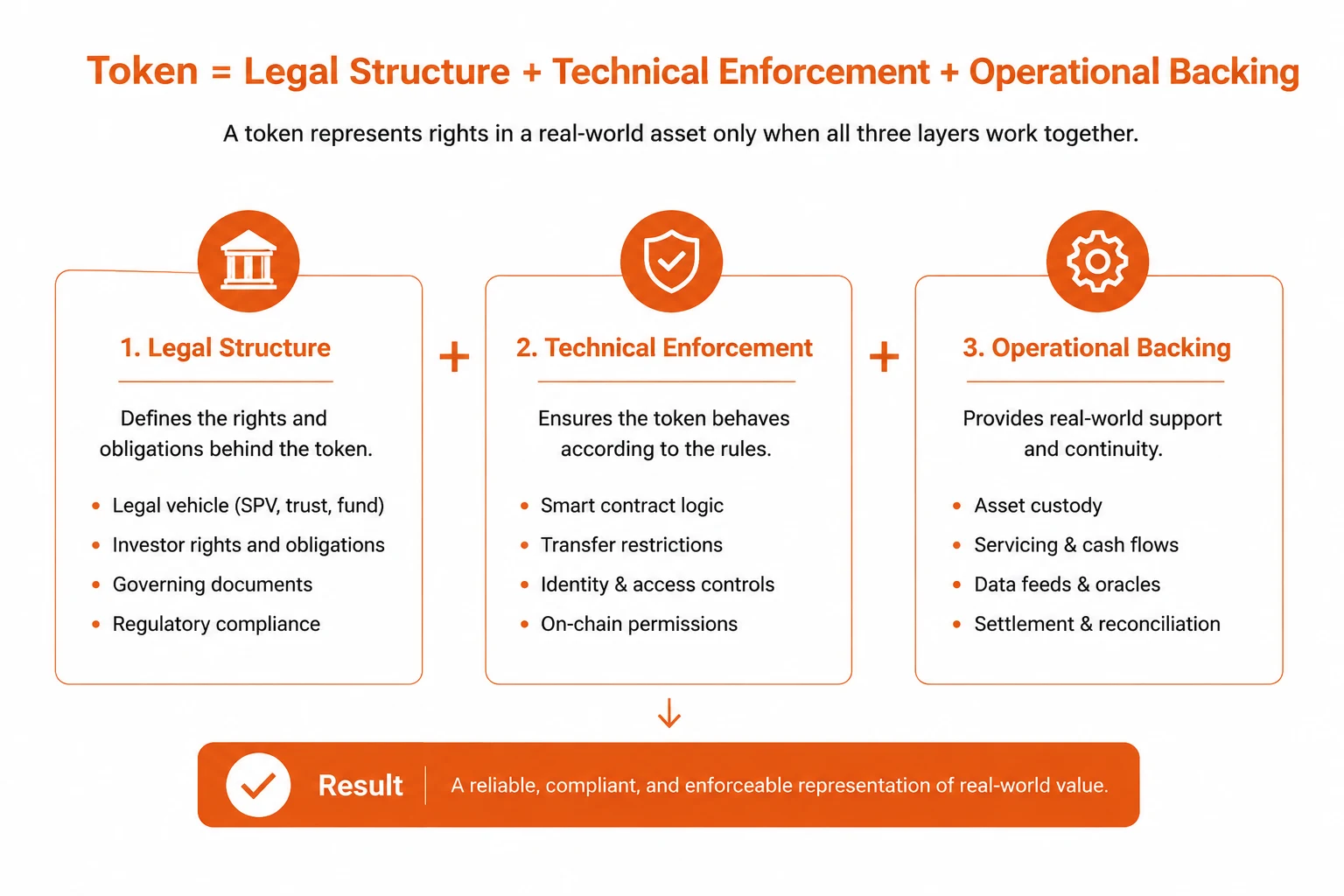
The 3 Layers of an RWA System
- The legal layer defines ownership and investor rights.
- The technical layer protects contracts, wallets, permissions, and data feeds.
- The operational layer handles asset safekeeping, valuation, servicing, and reconciliation.
Each layer must tell the same story. If the contract allows a transfer that the shareholder agreement prohibits, the transaction may succeed technically but fail legally.
The Bridge Between Law and Blockchain (Legal Layer)
The legal layer defines what the token actually means in law, not just on-chain.
It connects the token to enforceable rights through structures like SPVs, funds, or trusts.
Without this layer, a token is only data, not ownership, a claim, or legal protection.
Smart Contract Functions and Administrative Controls (Technical Layer)
Token standards define how RWA tokens manage balances, transfers and compliance controls. ERC-20 provides the basic fungible-token framework, while ERC-3643, ERC-1400 and ERC-1404 add features for regulated assets.
RWA Token Standards
Ethereum Request for Comments 20 (ERC-20)
ERC-20 is commonly used for fungible tokens. It supports basic balance and transfer functions.
The standard does not include built-in investor identity, transfer eligibility, account recovery, or execution controls. Issuers must add those functions through separate contracts.
ERC-3643
ERC-3643 is a finalized Ethereum standard for permissioned security tokens.
It combines ERC-20 compatibility with identity registries, pre-transfer checks, freezing, pausing, recovery, minting, and burning.
ERC-1400
ERC-1400 is a proposed modular framework for security tokens. It supports balance partitions, transfer validation, issuance, redemption, document management and authorized controller actions. Partitions can separate share classes, lockups, jurisdictions or investor categories.
ERC-1404
ERC-1404 is a lightweight proposed standard for restricted ERC-20 transfers. It allows contracts to detect prohibited transfers and return a reason for rejection. Identity management, wallet recovery and other institutional controls must be implemented separately.
RWA Token Standard Comparison
Standard | Identity Controls | Transfer Controls | Partition Support | Main Approach |
ERC-20 | Not native | Not native | No | Basic fungible token |
ERC-3643 | Integrated | Advanced | No | Permissioned security token |
ERC-1400 | Implementation-dependent | Advanced | Yes | Modular securities framework |
ERC-1404 | Implementation-dependent | Basic | No | Restricted ERC-20 transfers |
No token standard independently establishes legal ownership or regulatory compliance. The smart contract must remain aligned with investor records, offering documents and applicable law. A detailed code-level comparison appears in Token Standards for Regulated Assets: ERC-3643 vs ERC-1400 vs ERC-1404.
Custody, External Data, and Multi-Chain Risk (Operational Layer)
Institutional platforms may use hardware security modules, multi-party computation, or multisignature approval. They still need access controls, key rotation, and incident plans.
External data should use freshness checks, backup sources, and circuit breakers. Multi-chain products also need a canonical supply and a controlled mint-and-burn process. Otherwise, bridges and wrappers can fragment records or represent the same asset more than once.
How Do Blockchain Records Connect With Legal Ownership?
Every tokenized asset needs an authoritative record, such as a blockchain, transfer-agent register, custodian’s books, securities depository, or government registry.
The offering documents should identify that record and explain what happens when it conflicts with a wallet balance.
Three Levels of Legal Weight
- An informational token mirrors data held elsewhere.
- A certificatory token provides evidence of a contractual or beneficial claim.
- A dispositive token has the strongest effect because transferring it also transfers a legally recognized title.
Many RWAs sit closer to the certificatory model. During a dispute or insolvency, legal agreements and regulated registers may matter more than possession of the token.
Legal Documents and Bankruptcy Protection
Token terms, subscription documents, custody records, valuation policy, and withdrawal rules should describe the same rights.
They should also address lost keys, mistaken transfers, sanctions, chain forks, upgrades, custodian failure, and court orders.
An SPV may be called bankruptcy remote, but protection depends on valid transfers, segregated accounts, and legal documents. Investors should know their claim priority and who replaces a failed manager.
How Should Secondary-Market Liquidity Be Measured?
Fractional units do not create market depth. Institutional liquidity should be measured through bid-ask spreads, order-book depth, turnover, active market makers, holder concentration, days without trades, transfer rejection rates, redemption capacity, and discounts or premiums to NAV.
For tokenized real estate, property liquidity, SPV-interest liquidity, token-market depth, and issuer redemption are separate questions.
AMMs may support RWA trading through permissioned pools, approved liquidity providers, wallet checks, oracle-based prices, price bands and circuit breakers. They can improve execution availability but do not remove slippage, stale NAVs, redemption constraints, or liquidity-provider losses.
How Do Tokenized Treasury Products Generate Yield?
The blockchain does not generate Treasury yield. Income comes from Treasury bills, government money-market instruments, repo, or other permitted portfolio assets.
After fees and expenses, value may reach holders through a rising NAV, higher redemption value, additional units, rebasing, or distributions.
Investors should compare gross portfolio yield with net yield after management fees, cash drag, transaction costs, and settlement delays. They should also separate underlying Treasury risk from the risks of the issuer, settlement token, custody system, and redemption process.
What Happens When an RWA Structure Fails?
Failure | Immediate effect | Typical control or recovery route |
Asset default | Reduced interest or principal | Collateral enforcement and payment waterfall |
Servicer failure | Collection and reporting disruption | Backup servicer and data transfer |
Custodian insolvency | Access or title dispute | Segregation, control agreement and replacement |
Issuer or SPV insolvency | Claims enter formal proceedings | Trustee, administrator or security agent |
Contract exploit | Unauthorized transfers or supply error | Pause, freeze, recovery and register correction |
Oracle failure | Incorrect or stale valuation | Fallback source and suspension |
Bridge failure | Duplicate or unbacked representations | Freeze wrappers and reconcile canonical supply |
Settlement-token failure | Payment leg loses value or liquidity | Approved alternative settlement rail |
Recovery depends on who controls collateral, replaces service providers, resolves records and distributes proceeds.
How Is RWA Tokenization Regulated?
A tokenized security generally remains a security.
Hong Kong
Hong Kong regulates tokenized RWAs under existing securities laws, primarily through the SFC framework.
Most asset-backed tokens are treated as securities when linked to shares, funds, or investment products.
Regulatory sandboxes are being used to test tokenized bonds and secondary trading infrastructure.
Switzerland
Switzerland’s DLT Act created a legal basis for ledger-based securities and DLT trading facilities. Legal recognition is not automatic for every token; the instrument and register must meet the applicable statutory requirements.
This makes Switzerland one of the most advanced jurisdictions for compliant token issuance and transfer.
United Kingdom
The UK regulates tokenized RWAs based on economic substance under FCA oversight.
Security tokens fall under existing financial laws covering issuance, custody, and trading venues.
A Digital Securities Sandbox is enabling controlled testing of tokenized settlement and market infrastructure.
United States
SEC staff described issuer-sponsored and third-party tokenized securities in January 2026.
An issuer-sponsored structure may use distributed ledger technology as part of the official record of security holders.
A third party may instead issue a tokenized security entitlement, linked security, or security-based swap connected to another issuer’s security. Thus, these tools may give the holder different rights from the referenced security.
European Union
Crypto-assets that qualify as MiFID II financial instruments sit outside MiCA’s general crypto-asset framework.
The EU DLT Pilot Regime provides a framework for approved market infrastructures to trade and settle financial instruments through distributed ledger technology.
Singapore
The Monetary Authority of Singapore uses Project Guardian to test tokenized funds, fixed-income products, and settlement systems with financial institutions.
Its work includes tokenized fund servicing, shared data standards, and the use of tokenized bank liabilities in settlement.
Dubai International Financial Centre
The Dubai Financial Services Authority’s revised Crypto Token rules took effect on January 12, 2026.
The rules apply in the Dubai International Financial Centre, rather than across the entire UAE.
Firms operating in the DIFC must assess the suitability of the crypto tokens they use and keep written records supporting those assessments.
A security, fund interest, or investment token may also fall under separate financial-services requirements.
How Is Institutional RWA Infrastructure Developing?
RWA tokenization is steadily moving into mainstream finance as large institutions begin embedding blockchain into real financial products. BlackRock’s BUIDL fund and Franklin Templeton are early examples, offering tokenized money market and U.S. Treasury products within regulated fund structures.
In private markets, Apollo and Hamilton Lane are applying tokenization to credit and fund workflows to improve efficiency and capital access. On the banking side, UBS is testing tokenized settlement systems, while JPMorgan’s Onyx (Kinexys) enables blockchain-based repo, collateral movement, and liquidity operations.
As this adoption expands, infrastructure is shifting from pilots to regulated market systems. DTCC is preparing limited production trades through DTC’s tokenization service in July 2026, with broader rollout expected in October 2026, while maintaining existing custody and legal protections.
Similarly, Swift has tested tokenized bond workflows across traditional and blockchain rails, covering settlement, interest payments, and redemption processes.
Therefore, tokenization is developing into a coordination layer for financial markets, connecting, not replacing, the banks, custodians, and transfer agents through programmable infrastructure.
What Does the Current RWA Market Data Show?
RWA market totals vary because platforms use different measurement approaches. Some track assets are actively issued on public blockchains, while others include broader represented value tied to off-chain legal and financial structures.
RWA Market Snapshot
Metric | Reported value | Date and scope |
Tokenized U.S. Treasuries | $13.6 billion | BCG, April 2026 |
Annual growth in tokenized U.S. Treasuries | 170% | BCG, year over year |
Tokenized RWAs excluding stablecoins and repos | Below $25 billion | BCG, April 2026 |
BCG middle scenario | $14 trillion by 2030 | Excludes real estate and tokenized money or stablecoins |
BCG middle scenario | $55 trillion by 2035 | Same BCG forecast scope |
McKinsey's base estimate | About $2 trillion by 2030 | Selected financial assets; excludes cryptocurrencies and stablecoins like Tether ($USDT) |
McKinsey forecast range | About $1-$4 trillion | Pessimistic to optimistic scenarios |
These figures are not directly comparable because BCG, McKinsey, and RWA.xyz use different asset categories, definitions, and assumptions.
Readers should also separate measured market values from long-term forecasts.
June 2026 Market Reality
According to RWA.xyz mid-2026 data, the RWA ecosystem is measured across represented asset value, distributed on-chain issuance, and stablecoin-supported settlement liquidity.
- Strong growth in on-chain issuance, particularly in U.S. Treasuries and private credit
- Rapid expansion of stablecoin-based settlement, which continues to dominate transaction liquidity
- Increasing participation, with close to 900k+ wallet-level holders across RWA protocols
- Uneven liquidity distribution, where government debt products account for the majority of actively issued RWA value
Within distributed on-chain markets:
- Tokenized U.S. Treasuries remain the largest category (roughly $13-15B range, depending on methodology)
- Private credit and institutional funds represent a growing but fragmented share
- Tokenized equities remain relatively small (~low single-digit billions) but are expanding through SPV-based structures
Real-World Implications
The RWA market is expanding rapidly, but most value still sits in structured or semi-structured issuance rather than deep secondary trading markets. Demand is increasing, yet execution, compliance, and infrastructure remain the key constraints, not the headline market size.
What Does RWA Tokenization Mean for Pre-IPO Investors?
Pre-IPO tokenization commonly places private-company shares in an SPV and issues tokens linked to interests in that vehicle. The token holder usually does not appear on the operating company’s shareholder register.
Investors should review company consent, rights of first refusal, indirect-transfer limits, valuation, manager fees, and the treatment of an IPO or acquisition.
A technically transferable token may still be legally restricted. Liquidity may depend on an eligible buyer, a manager-led sale, redemption, acquisition, or public listing. The structure should never imply direct company ownership when the investor actually holds an SPV interest.
What Really Matters in an RWA Token
An RWA token may be the legally operative security, evidence an indirect entitlement, represent an SPV or fund interest, or provide synthetic exposure. Its value depends on the alignment of law, code, and operations.
Tokenization can improve recordkeeping, settlement, and administration. It cannot replace clear ownership, reliable custody, accurate valuation, or an enforceable recovery path. The decisive question is whether the full structure still works when transfers are restricted, data fails, or investors seek an exit.
Disclaimer: This article is for educational purposes only and is not financial, legal, investment, or tax advice. Tokenized and private-market assets carry risks, including loss, limited liquidity, custody issues, and regulatory changes. Review all documents and seek professional advice before investing.
FAQs
What Is Real-World Asset Tokenization?
It converts rights linked to a physical or financial asset into a blockchain token.
How Is an RWA Token Legally Backed?
Contracts, custody records, ownership documents, and redemption rights provide its legal backing.
Are RWA Tokens Securities?
Many RWA tokens are securities, but classification depends on their structure, rights, and jurisdiction.
Does Fractional Ownership Create Liquidity?
No, it lowers the investment amount, but liquidity still depends on buyers, trading venues, and redemption options.
What Is the Difference Between an RWA Token and a Protocol Token?
An RWA token represents an asset or financial claim. A protocol token usually provides platform access, utility, or governance rights.
Can Pre-IPO Shares Be Tokenized?
Yes, often the token shows an SPV interest linked to private-company shares.