
Tokenized U.S. Treasuries reached $13.6 billion in April 2026, up 170% year over year. As institutional issuance expands, verifying what sits behind each token is becoming an essential risk control rather than a reporting feature.
An investor can inspect token supply on a block explorer within seconds. The assets supporting those tokens are harder to see. Treasury bills may sit in a securities account, cash may remain at a bank, and commodities or private securities may be recorded in closed custodian systems.
A reserve dashboard alone cannot show whether those assets are eligible, current, properly valued, or sufficient across every blockchain where the token circulates.
A proof-of-reserve architecture closes part of that information gap. It connects an authoritative off-chain asset record with an on-chain reserve feed, reconciles that evidence against redeemable token liabilities, and applies predefined controls when coverage or data-freshness requirements fail.
Proof of reserve connects custodian or administrator records with an oracle feed, a canonical token-supply calculation, and an enforceable smart contract response.
This model is most relevant to stablecoins, tokenized funds, wrapped assets, tokenized commodities, and asset-backed notes supported by a defined reserve pool. Native tokenized shares or bonds recorded directly in an official ownership register require a different emphasis on legal title, registry finality, and settlement.
Proof-of-reserve architecture is a system that checks if a specific group of off-chain assets (like cash or other valuables held outside of a blockchain) is enough to cover a certain amount of tokens that have been issued. It ensures that, at a specific moment, these assets can back the tokens. Additionally, it ensures that smart contracts (automated agreements on the blockchain) take action if the assets are not enough to cover the tokens. |
What Proof of Reserve Establishes
Proof of reserve compares eligible asset backing with the liabilities represented by a token.
For institutional analysis, a simple one-to-one comparison is rarely sufficient. The calculation should account for asset quality, valuation adjustments, and the full set of redeemable claims.
Risk-Adjusted Coverage Ratio = Eligible Reserve Value After Haircuts and Encumbrances ÷ Total Redeemable Liabilities
A ratio of 1.00 means that the included reserve value equals the measured liabilities. However, that result is only useful when the methodology identifies four inputs clearly:
- Which assets qualify as reserves
- Which token liabilities are included
- How the assets are valued
- When the measurement occurred
The asset side may include cash, government securities, commodities, fund interests, or other collateral recorded by a bank, broker, custodian, trustee, or fund administrator. The calculation should explain whether those assets are valued at par, market value, or net asset value.
It should also reflect ineligible collateral, fees, settlement exposures, currency mismatches, valuation haircuts, and known liens or restrictions.
The liability side requires equal care. Reading totalSupply from one smart contract may miss tokens issued on other networks, bridged representations, pending mints, unsettled redemptions, or equivalent claims recorded outside the contract.
At the same time, treasury-controlled and escrowed tokens may not create the same immediate obligation as freely circulating units. Therefore, a methodology distinguishes among:
- Total minted supply
- Circulating supply
- Redeemable supply
- Treasury or escrowed units
- Pending mints and burns
- Canonical and wrapped tokens
- Accrued payment obligations
Proof of reserve answers whether the defined reserve pool covered the defined liabilities at the stated time. It does not provide a complete assessment of an issuer’s solvency, legal ownership structure, or creditor priority.
How Off-Chain Assets Become On-Chain Evidence
Consider a tokenized Treasury fund.
A legal vehicle purchases Treasury securities and holds them through a custodian. A fund administrator records the positions and calculates NAV. Investors receive tokens representing rights described in the fund or offering documents.
The blockchain can count those tokens, but it cannot directly inspect the custodian’s internal books. The proof-of-reserve system must therefore move evidence from the traditional financial system to the blockchain without hiding the remaining dependencies.
The authoritative reserve record
The process begins with the system that officially or operationally records the underlying assets.
Depending on the product, this could be a:
- Bank or brokerage account
- Custodian statement
- Transfer-agent register
- Fund-administrator ledger
- Securities depository record
- Commodity warehouse certificate
- Property or collateral registry
A headline balance is not sufficient for institutional verification. The evidence should identify the account holder, custodian, asset description, quantity, currency, valuation date, and reserve classification.
Where the source supports it, the evidence should also state whether the account is segregated and whether the assets are pledged, restricted, or otherwise encumbered. Without that information, the system may confirm that an asset exists without establishing that it is available to meet investor claims.
Reserve data can leave the closed system through several routes:
- A direct custodian API
- A digitally signed report
- A fund-administrator NAV feed
- An accountant’s attestation
- A bank or brokerage statement
- A privacy-preserving zkTLS query
Data supplied by an independent custodian or administrator generally provides stronger evidence than a balance entered by the token issuer. Still, an independent source must identify which accounts and assets were included.
A digital signature has a narrower role. It proves who signed the information and whether the signed message was altered. It does not confirm that the signer reported every relevant account or that the underlying database was complete.
How Oracle Networks Deliver Reserve Data
A decentralized racle network can retrieve information from designated sources, compare node observations, aggregate the result, and publish reserve data on-chain.
This reduces dependence on one delivery operator. However, if every node reads the same custodian API, the original source remains a common dependency even though transmission is decentralized.
Reserve feeds generally use one of two update models:
- Push feeds publish when the reserve value crosses a deviation threshold or a heartbeat interval expires.
- Pull feeds provide current data when a mint, redemption, or risk check requests it.
Each update should include the reported amount, unit, decimal format, methodology, reporting period, and timestamp.
Chainlink’s EVM feed interface shows how the latestRoundData function returns both the reported answer and an updatedAt timestamp. A production implementation should also validate the correct feed address, decimal precision, answer range, maximum data age, and, where applicable, Layer 2 sequencer status.
As explained in the pillar guide’s section on oracles and reconciliation, the oracle provides a controlled data route between external records and a blockchain application. It does not replace the custodian, administrator, or legally authoritative register.
The Complete Verification Path
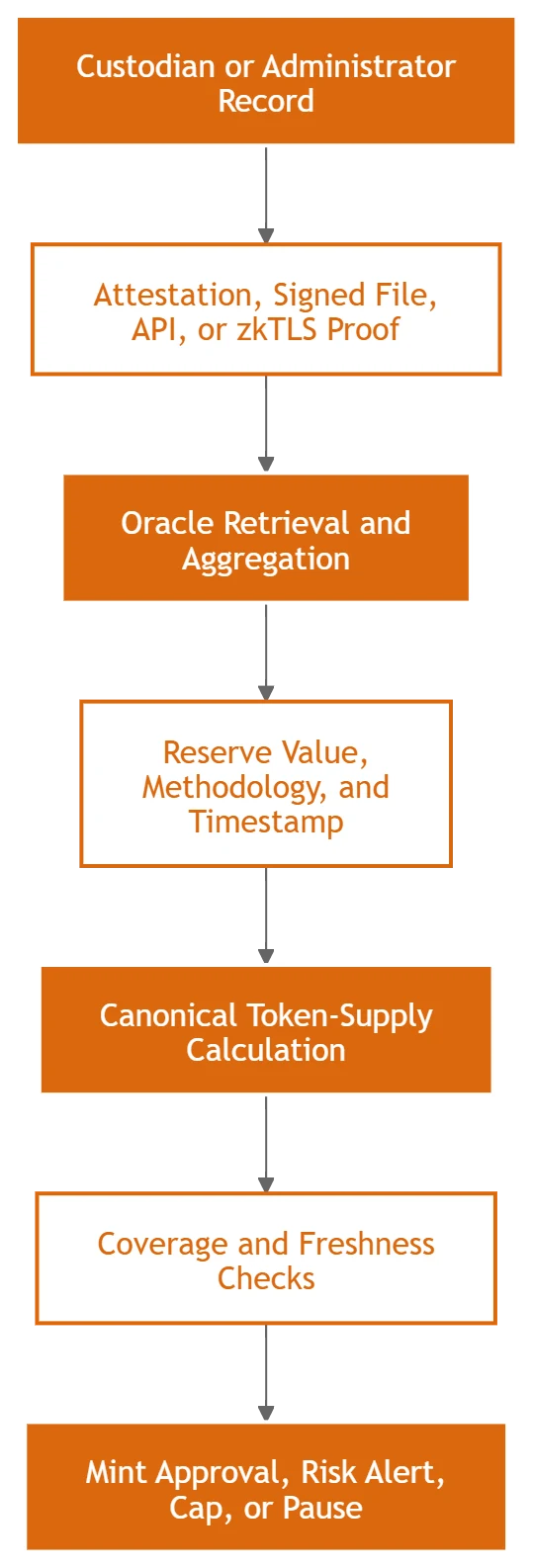
At the final stage, a smart contract compares the eligible reserve value with the redeemable token liabilities. It can then approve issuance, reject a transaction, notify risk teams, reduce an issuance limit, or pause minting.
What Each Verification Method Proves
Audits, attestations, Merkle proofs, oracle feeds, and zkTLS systems examine different parts of the reserve-verification chain. Combining them can produce stronger controls, but one method cannot automatically substitute for another.
Verification method | Evidence produced | Main institutional benefit | Main limitation |
Merkle proof | Inclusion of a balance in a defined liability dataset | Allows private holder-level inclusion checks | Cannot prove omitted liabilities or ownership of off-chain assets |
Custodian confirmation | Assets recorded in named accounts | Connects evidence to an independent asset holder | Usually periodic and limited to specified accounts |
Accountant attestation | Assurance over a defined reserve assertion | Applies an independent review methodology | Point-in-time and narrower than a financial audit |
Reconciliation report | Compares reserve records, token supply, pending mints/burns, and redemptions | Detects mismatch across systems | Depends on scope, frequency, and independent review |
Oracle PoR feed | Reserve data published on-chain from designated sources | Supports automated reconciliation and contract actions | Relies on the scope and quality of the source data |
zkTLS proof | Selected data came from an authenticated web session | Protects private information while proving data provenance | Does not establish legal title, completeness, or absence of liens |
Financial audit | Examination of broader financial statements and controls | Provides wider insight into the issuer’s financial position | Periodic and unsuitable for transaction-level mint checks |
Merkle Proofs Examine Liability Inclusion
A Merkle tree represents many account balances through a single cryptographic root. A customer can confirm that their balance was included in the dataset without seeing every other account.
Kraken is an exchange rather than an RWA issuer, but its methodology illustrates how this approach works. Customers can verify that their balances were included in a Merkle tree reviewed by a third-party accountant.
Kraken also identifies the limits of this process. Its documentation states that a PoR review cannot prove that funds were not borrowed temporarily for the review, or establish exclusive possession reveal hidden encumbrances of private keys.
A Merkle proof can therefore strengthen the liability calculation, but it does not establish the status of off-chain reserves.
Attestations Examine a Specific Assertion
An accountant’s attestation usually tests a defined claim, such as whether specified reserve assets exceeded tokens in circulation at a particular cut-off time.
The strength of that conclusion depends on the type of engagement, account scope, valuation policy, reporting frequency, and treatment of unsettled transactions. Agreed-upon procedures, examination attestations, review engagements, and full financial-statement audits provide different levels of assurance.
Circle provides a useful stablecoin comparison. It discloses USDC reserve holdings and related mint-and-burn flows weekly, while a Big Four accounting firm provides monthly assurance that reserve value exceeds USDC in circulation. This combines frequent reporting with periodic external assurance, but it is not a reserve test performed automatically during every mint.
zkTLS Examines Data Provenance
zkTLS can prove that selected information came from an authenticated web session without disclosing the complete account response.
The zkPass architecture extends TLS to a three-party model involving a prover, a verifier, and a data source. The prover obtains information from the source and generates a zero-knowledge proof that the verifier can inspect without seeing the underlying private data.
This can make private bank or brokerage information usable in a verification workflow. Nevertheless, zkTLS does not show whether the account is legally segregated, whether the source database contains every relevant liability, or whether another creditor has a claim against the assets.
How Automated Controls Prevent Over-Issuance
A public reserve dashboard informs investors. An enforced reserve check controls whether the token contract can create additional liabilities.
Before minting new units, the contract can apply the following condition:
Verified eligible reserves ≥ existing redeemable liabilities + proposed mint + required reserve buffer
The transaction should fail when:
- Reserve coverage falls below the required level
- The feed is older than the permitted data age
- The reporting period has expired
- The source is unavailable
- Units or decimal formats are inconsistent
- The reserve value falls outside a valid range
This protection only works when the mint contract is required to consult the reserve feed before issuing tokens.
Chainlink describes PoR integrations that can connect reserve checks directly to mint logic and trigger circuit breakers, redemption caps, or mint pauses when reserve thresholds are not met. Its current PoR materials also identify Backed Finance among implementations seeking verifiable one-to-one backing.
However, investors must determine whether a feed simply displays reserve data or actively blocks issuance. A public reserve figure and an enforceable mint restriction provide materially different protections.
A documented Aave implementation on Avalanche illustrates the second model. The system compared a PoR feed value with the total supply of the relevant wrapped asset. Under the documented Aave design, the V2 response disabled borrowing and froze affected assets, while the V3 response froze the affected asset and set its loan-to-value ratio to zero.
Freshness rules are equally important. A platform should disclose its heartbeat interval, deviation threshold, maximum feed age, valuation frequency, weekend treatment, and fallback process.
A feed may update within minutes, but it cannot make a monthly fund valuation current every hour.
Stopping new issuance must also be distinguished from suspending redemptions. A mint pause prevents liabilities from increasing. A redemption suspension restricts existing investors from exiting and creates different liquidity and legal risks.
Finally, institutions should inspect the administrative layer. Automated checks can be weakened when one administrator can replace the oracle, change the reserve buffer, upgrade the contract, or bypass a pause.
Multisignature approval, role separation, public time delays, and transparent governance can reduce this risk. An unrestricted administrator key can undermine an otherwise well-designed proof-of-reserve architecture.
Investors should check who can change the feed address, alter reserve buffers, upgrade the token contract, pause redemptions, or mint through an emergency path.
What Institutions Should Verify Before Relying on Proof of Reserve
An institutional review should follow the complete path from the underlying asset to the smart contract response.
Confirm the source
Identify who creates the original reserve information and whether that party is independent of the issuer. The custody agreement, administrator records, oracle methodology, and token documents should refer to the same asset pool.
Review the asset calculation
Determine which assets and accounts are included. Check whether reserves are valued at par, market value, or NAV and whether the calculation reflects fees, haircuts, foreign-exchange exposure, concentration limits, settlement timing, and encumbrances.
Reconcile all liabilities
Confirm that the methodology covers every network, bridge, wrapper, pending mint, pending burn, and unsettled redemption. It should distinguish redeemable liabilities from the total minted supply.
Test the technical controls
Review the feed and token-contract addresses, update rules, decimal precision, stale-data threshold, source-failure process, contract upgrade rights, and emergency authorities.
Examine the legal connection
Determine whether the assets are held for the correct legal entity, whether accounts are segregated, and whether token holders have contractual redemption or enforcement rights.
A practical hierarchy for comparing systems is:
Self-reported balance → independent confirmation → direct-source oracle delivery → canonical supply reconciliation → enforced mint control
The strongest proof-of-reserve architecture combines reliable off-chain records, transparent valuation rules, secure data provenance, timely oracle delivery, complete liability accounting, enforceable issuance controls, and constrained administrator permissions.
It does not remove every intermediary. Instead, it makes each dependency visible and reduces the number of unchecked steps between asset custody and token issuance.
Disclaimer: This article is for educational purposes and does not constitute investment, legal, accounting, or financial advice.
FAQs
What is proof-of-reserve architecture?
Proof-of-reserve architecture is the system connecting off-chain reserve records with an oracle feed, token-supply calculation, coverage test, and smart contract response.
How do on-chain systems verify off-chain asset backing?
They receive evidence from identified custodians, administrators, assurance providers, or APIs. Oracle networks publish the data on-chain, where a contract can compare it with redeemable token liabilities.
What is the difference between proof of reserve and an audit?
Proof of reserve usually tests a defined collateralization claim. A financial audit examines broader financial statements, liabilities, controls, and reporting processes.
Can proof of reserve establish legal ownership?
It can support evidence of asset backing. But ownership depends on custody agreements, offering documents, authoritative registers, account title, and applicable insolvency law.
How does secure minting prevent over-issuance?
The mint contract checks eligible reserves against current liabilities, the proposed issuance, and any required reserve buffer. It rejects the mint if the coverage or data-validity rules are not satisfied.
Can zkTLS replace a custodian attestation?
No. zkTLS can prove that selected information came from an authenticated source while protecting private data. It cannot independently establish asset segregation, legal title, solvency, or the absence of liens.