Citi Institute estimated in June 2026 that the global tokenized financial-asset market was approximately $17 billion, nearly three times its level a year earlier. It projects the market could reach $5.5 trillion by 2030 in its base case, with estimates ranging from $2.7 trillion to $8.2 trillion.
Yet this projected growth does not answer the most important ownership question. The legal wrapper structures for tokenized equity determine whether an investor owns company shares, an interest in an SPV, a beneficial claim under a trust, or only economic exposure created by a third party.
A digital wallet may show 1,000 equity tokens while the portfolio company’s official shareholder register names only an SPV, trustee, custodian, or transfer agent. Consequently, investors can face different voting rights, dividend routes, transfer restrictions, insolvency risks, and legal remedies even when the tokens appear technically similar.
So, which structure gives investors the clearest and most legally protected ownership rights?
This article compares SPV, trust, and direct issuance models to explain who legally owns the underlying shares, which ownership record controls, how voting and distributions work, and what happens when an intermediary fails.
For understanding how these ownership structures connect with custody, compliance, smart contracts, reconciliation, and settlement, read our guide to real-world asset tokenization architecture and legal structure.
Why The Legal Wrapper Matters
Tokenization can change how a security is recorded and transferred. It does not automatically change its legal nature. The wrapper connects the blockchain record to the underlying shares and determines who can enforce rights if an issuer, sponsor, trustee, custodian, or platform fails.
A legal wrapper describes the legal framework or entity structure used to bind digital tokens to real-world corporate assets. It provides on-chain instruments with recognized legal personality, enforceable rights, and liability protections. |
SEC staff explained in January 2026 that tokenized securities may be issuer-sponsored or created by an unrelated third party. An issuer-sponsored token may connect to the official ownership system. A third-party product may instead provide custodial or economic exposure without shareholder rights against the referenced company.
Investors should identify four records:
- The blockchain ledger
- The company’s shareholder register
- The transfer agent or registrar’s master record
- The SPV, trustee, custodian, or platform’s investor register
The documents must state which record controls if these systems disagree. A wallet transfer can succeed technically but fail legally when the official register is not updated, or the transfer breaches issuer consent, eligibility rules, lockups, rights of first refusal, or sanctions controls.
How SPV Tokenized Equity Works
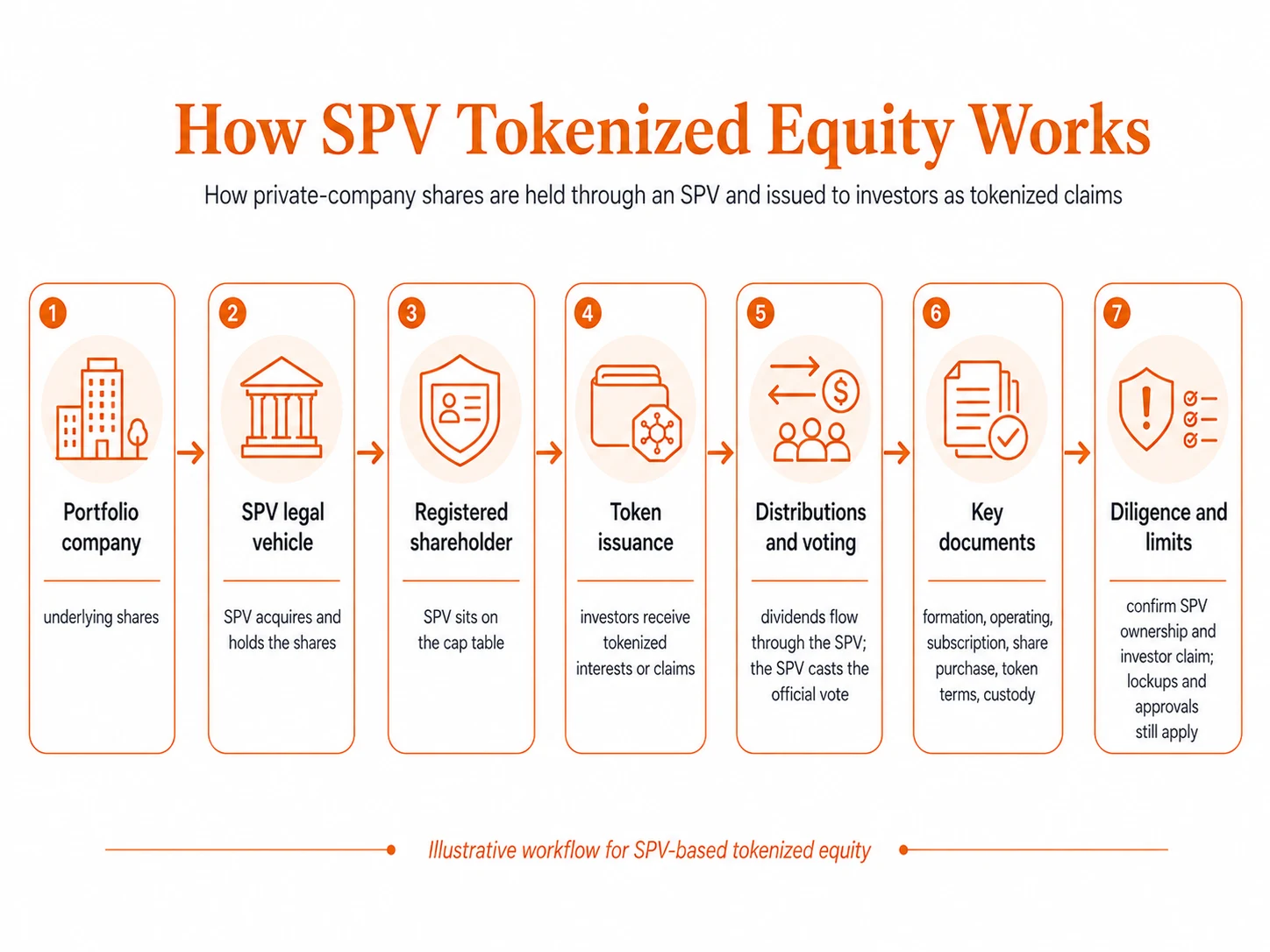
A special purpose vehicle is a separate company formed to acquire and hold an asset. The SPV purchases the portfolio company’s shares and becomes the registered shareholder in tokenized private-equity transactions. Investors receive tokenized membership interests, shares, debt instruments, participation rights, or contractual claims issued by the SPV.
This model is useful when a private company wants one cap-table holder rather than hundreds of token investors. However, the token holder usually owns an interest in the SPV, not the portfolio company’s shares directly.
- Dividends (a portion of a company's profit paid out to its shareholders as a reward for their investment) first move to the SPV;
- The SPV casts the official vote,
- And exit proceeds are distributed in accordance with the vehicle’s governing documents.
Institutional investors should test both links:
Does the SPV validly own the underlying shares, and does the investor have an enforceable claim against the SPV?
Key documents include the formation certificate, operating agreement, subscription agreement, share purchase agreement, token terms, and custody arrangements. They should explain voting, distributions, fees, tax reporting, transfers, and manager-removal rights.
An SPV may be bankruptcy remote, but it is not bankruptcy proof. Protection depends on separate accounts, limited purposes, controlled borrowing, valid asset ownership, and separation from the sponsor. Contractual protections cannot cure defective ownership or commingled assets.
Separate books, bank accounts, financial statements, assets, and legal identity are commonly used to preserve an SPV’s separateness. However, the exact protections depend on the vehicle’s documents and governing insolvency law.
Private-share restrictions remain effective. Tokenization does not cancel issuer approvals, co-sale rights, lockups, or limits on indirect ownership changes.
The exact rights depend on the SPV jurisdiction, entity type, governing documents, and securities-law treatment.
How Trust Structures Separate and Benefits
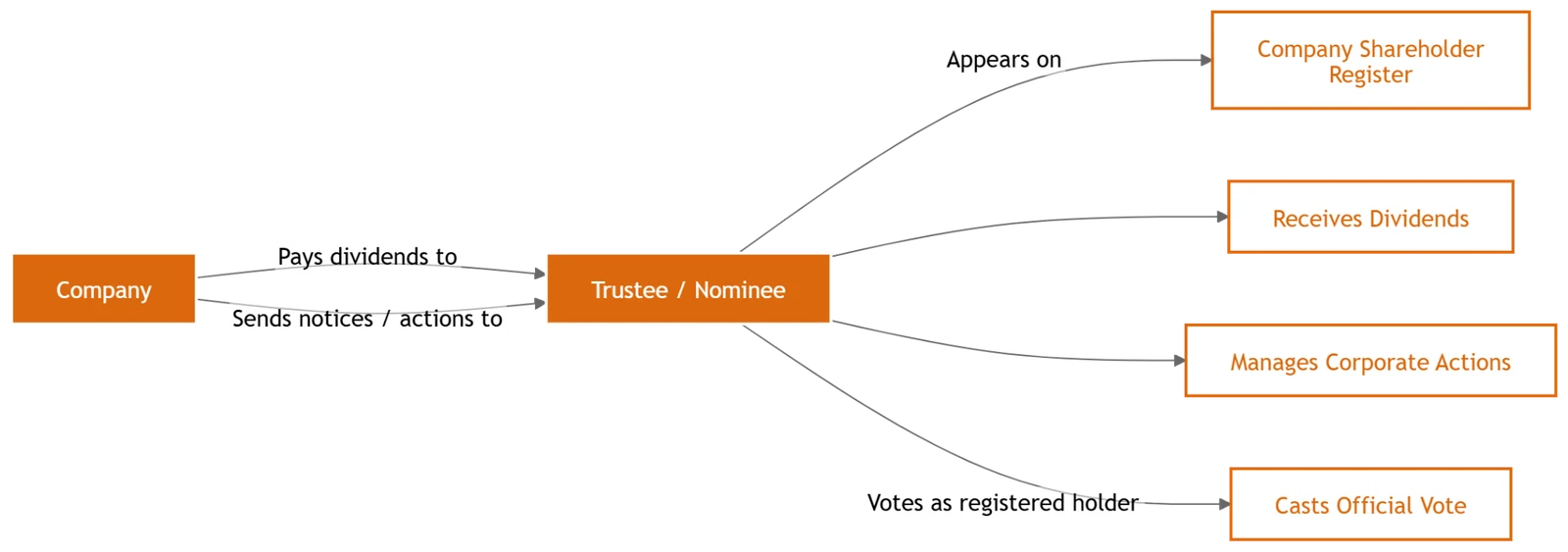
Under a trust structure, a trustee or nominee holds legal title while token holders receive beneficial interests defined by the trust deed. The trustee appears on the company’s shareholder register, receives dividends, manages corporate actions, and casts the official vote.
The trust documents should specify voting deadlines, beneficiary enforcement rights, whether the trustee may pledge the shares, and how a replacement trustee is appointed.
Asset segregation is the main protection. The deed and custody records should show that shares remain separate from the trustee’s operating property. Investors should review their standard of care, indemnities, and recordkeeping duties.
A beneficial interest is not always the same as a securities entitlement. A beneficial interest arises under the trust instrument and governing trust law. A securities entitlement arises when a financial asset is credited through a securities intermediary.
Practically, the investor may hold rights against a broker, custodian, or intermediary rather than appearing as the direct owner. UCC Article 8 addresses the acquisition of securities entitlements, intermediary duties, payments, voting directions, transfers, and competing creditor claims.
The documents must also define the token’s legal role. It may represent the beneficial interest, evidence an interest recorded elsewhere, or simply instruct the trustee’s register. If the wallet record changes but the trustee’s register does not, the transfer may not be legally complete.
How Direct Issuance Connects the Token to the Share Register
Direct issuance removes the separate SPV or trust. The company issues the tokenized security itself or authorizes a transfer agent to connect blockchain activity with the official shareholder record. The investor then holds the issuer’s equity security, subject to the rights and restrictions of that share class.
The blockchain may serve as the official register, form part of a combined system, send instructions to an authoritative off-chain register, or simply mirror another database. A blockchain mirror alone does not prove ownership.
SEC staff has stated that a registered transfer agent may use distributed ledger technology as its official master securityholder file, or as one component, while continuing to meet recordkeeping, safeguarding, reporting, and examination duties. Personal information may remain off-chain while wallet balances and transaction information are recorded on-chain.
The Exodus Movement provides an example. The October 2025 SEC filing stated that shareholders could represent Class A shares through tokens on Solana using co-transfer agent Superstate. The tokens were digital representations, while ownership remained reflected in the transfer agent’s books and records.
Direct issuance creates the shortest ownership chain but requires issuer participation. The company must verify wallets, enforce restrictions, process votes and dividends, and handle lost keys, court orders, duplicate issuance, and upgrades.
- Corporate law must support the selected record.
- Delaware law permits stock ledgers to be maintained through distributed electronic networks when statutory requirements are met. It includes the ability to produce legible records, prepare shareholder lists, and record legally effective share transfers.
SPV vs Trust vs Direct Issuance
Investor or approved nominee, depending on register design.
Decision Factor | SPV Model | Trust Model | Direct Issuance Model |
Registered Holder | The SPV entity itself | Trustee or designated nominee | Investor or approved nominee, depending on register design. |
What Investor Receives | SPV membership interest or contractual claim | Beneficial interest or securities entitlement | Issuer’s direct equity security |
Controlling Record | SPV member register | Trustee’s internal register | Issuer or transfer-agent record |
Voting Route | Managed through SPV governance | Passed through to the beneficiary by the trustee | Direct execution under the share terms |
Dividend Route | Company→ SPV → Investor | Company → Trustee → Beneficiary | Company → Shareholder wallet/account |
Main Insolvency Concern | Corporate separateness or title claims fail | Assets are commingled / not fully segregated | Issuer risk or severe record conflict |
Best Operational Fit | Private and pre-IPO asset pooling | Independent fiduciary administration | Issuer-led digital shares or transfer-agent-integrated securities |
Primary Failure Point | Token rights exceed underlying SPV assets | Trustee records are inaccurate/incomplete | Blockchain state and official register diverge |
Executive Takeaway: Choose an SPV when the issuer demands a single line item on their cap table. Choose a trust when independent title-holding and fiduciary administration are priorities. Move to Direct Issuance only when the issuer and its transfer agent possess the technical architecture to legally maintain digital shares.
Direct issuance becomes more compelling when an established issuer, transfer agent, and trading venue can coordinate ownership records.
Recent US exchange activity shows that direction. Nasdaq proposed supporting tokenized securities within the national market system in January 2026. The filing described tokenized and traditional orders interacting in the same order book, rather than placing tokenized shares in an isolated liquidity pool. However, the proposal did not initially make those shares available for continuous 24/7 trading.
The New York Stock Exchange also filed a 2026 rule change intended to enable securities to trade in tokenized form.
Operational Complexities: Key Recovery and Tax Logistics
A legal wrapper must plan for the friction where on-chain execution meets real-world administration. Two operational areas require explicit documentation before an issuance scales:
1. The "Lost Key" Protocol
Direct issuance requires clear recovery controls to handle lost private keys, security breaches, or court-ordered transfers. A transfer agent relies on a medallion signature guarantee to verify identity and replace lost stock certificates in traditional equity markets.
For direct token issuance, the legal framework must explicitly grant a smart contract administrator or transfer agent the authority to override the blockchain state. The corporate documentation should legalize a "burn-and-re-mint" function, which may include freezing, invalidating, and reissuing tokens to a verified wallet. This allows the administrator to invalidate tokens in an inaccessible wallet and re-issue them to a verified recovery wallet without requiring the original private key.
2. Tax Reporting Frictions (K-1 vs. 1099)
The choice of legal wrapper dictates the structural burden of year-end tax compliance. An SPV model often classifies token holders as partners or members. It requires the vehicle to issue an IRS Schedule K-1 (or local equivalent) to every investor. Managing and distributing thousands of individualized K-1 forms adds significant operational expense and creates a logistical bottleneck for retail-focused distributions.
Conversely, direct equity issuance or synthetic tracker notes typically trigger standard Form 1099 reporting. This allows automated processing through traditional financial clearing networks. This makes it more scalable for fractionalized or high-volume secondary market trading
Which Legal Wrapper Best Protects Tokenized Equity Rights?
The best wrapper is not the one with the most blockchain features, but the one that creates a clear legal link between the investor’s token and the underlying shares.
SPVs enable pooled access but add vehicle and manager risk. Trusts separate legal title from investor benefits but rely on asset segregation and trustee performance. Direct issuance offers the shortest ownership path but requires issuer-approved records, transfer-agent integration, and recovery controls.
Investors should first assess ownership, insolvency priority, voting, dividends, fees, and transfer restrictions before comparing token features or secondary-market access.
Disclaimer: This article provides general information and does not constitute legal, tax, or investment advice. Transaction documents and local law should be reviewed by qualified counsel before any investment decision.
FAQs
Does an SPV Token Make the Investor a Direct Shareholder?
Usually not. The SPV appears on the portfolio company’s register, while the investor owns an interest or claim issued by the SPV.
What Happens if an SPV or Trustee Becomes Insolvent?
The result depends on asset ownership, segregation, governing documents, creditor priority, and applicable insolvency law. The token may remain visible even when the underlying claim is impaired.
Can a Blockchain Transfer Override Private-Share Restrictions?
No, a wallet transfer may still breach issuer approvals, lockups, rights of first refusal, investor-qualification rules, or securities laws.
Which Record Proves Ownership?
The controlling record is the one recognized by the governing documents and applicable law. It may be the issuer’s stock ledger, transfer-agent file, SPV register, or trustee register.