Nearly 600,000 Celsius Earn accounts held approximately $4.2 billion in digital assets when the company entered bankruptcy. The U.S. Bankruptcy Court later concluded that assets deposited through the Earn program belonged to the debtors’ bankruptcy estates, leaving affected customers with unsecured claims rather than ownership of specific assets.
Although Celsius was not a regulated RWA issuer, the case exposes the central RWA issuer default risk: an account or token balance may prove possession, while contracts, custody arrangements, authoritative registers, and insolvency law determine recovery.
So, what happens when an RWA issuer fails but the linked loans, property interests, fund shares, or Treasury securities still exist?
This failure-mode analysis follows token holders from estate classification and register reconciliation through claim priority, smart-contract freezes, asset liquidation, and final distribution.
For more detail, review the legal and technical structure of real-world asset tokenization.
Failure Mode 1: The Issuer Fails While the Asset Still Performs
Issuer default is not the same as borrower default. A private-credit borrower may continue paying while the issuer, custodian, or redemption agent becomes insolvent. The reverse can also occur:
The borrower defaults while the SPV remains solvent.
Counterparty risk in tokenization extends beyond the borrower. Holders may depend on the issuer, custodian, trustee, servicer, settlement bank, oracle provider, and contract administrator.
If one party fails, payments may stop while collateral produces cash. Investors must identify which entity owes each obligation and owns each asset.
Failure Mode 2: Asset Separation Fails
Tokenized asset bankruptcy protection is strongest when assets are transferred to a separate SPV through a completed true sale. A bankruptcy-remote SPV structure should maintain separate accounts, independent governance, restricted activities, backup servicing, and enforcement rights.
The label “bankruptcy remote” is insufficient. If assets were never transferred, cash was commingled, or records are incomplete, creditors may challenge the separation.
Under Section 541 of the U.S. Bankruptcy Code, the debtor’s legal and equitable property interests generally enter the insolvency estate. If the issuer owns a loan portfolio, reserve account, or security, that property may become estate property.
Failure Mode 3: The Token Is Not the Authoritative Register
The legal weight of RWA tokens in insolvency depends on whether the token is dispositive or certificatory.
A dispositive token is designed to be the legally operative instrument of transfer. A certificatory token only evidences a right recorded somewhere else. That record may be a
- Transfer-agent ledger,
- Custodian book,
- Shareholder register,
- Land registry,
- Or trustee record.
Many institutional RWA structures remain certificatory. A wallet balance may prove a transaction without proving ownership of a loan, fund share, building, or security.
This off-chain asset risk in tokenized credit becomes critical when records conflict. The governing documents must state which record prevails.
Failure Mode 4: Token Holders Rank Lower Than Expected
After the estate boundary is determined, token-holder recovery depends on claim priority.
Legal position | Likely insolvency treatment | Evidence investors should verify |
Property or trust interest | An asset may remain outside the estate | Title, trust terms, segregation |
Secured creditor | Paid from collateral up to the value | Security agreement and perfection |
General unsecured creditor | Shares remaining value with comparable creditors | Allowed claim and register |
Subordinated creditor | Paid after senior contractual classes | Intercreditor and subordination terms |
Equity holder | Receives only residual value | Share or membership records |
Beneficial owner through trust | Assets may remain outside the issuer's estate if the trust is valid and assets are segregated | Trust deed, beneficiary register, custody record |
A holder may have a proprietary interest, custodial entitlement, secured claim, unsecured claim, subordinated claim, or equity interest.
Attachment makes a security interest enforceable against the debtor. Perfection protects it against competing creditors and the bankruptcy trustee.
A token marketed as “secured” may still rank as unsecured if the lien was not properly perfected.
If holders are owed $100 million but collateral is worth $70 million, the secured portion may be $70 million and the remaining $30 million an unsecured deficiency claim.
Administrative expenses, professional fees, servicing costs, statutory priorities, and senior liens can reduce recovery further.
Failure Mode 5: Technical Controls Diverge From Legal Authority
Smart contract administrative controls during issuer liquidation can freeze transfers, restrict wallets, force transfers, mint replacement tokens, burn old tokens, or recover access. ERC-3643 supports identity and compliance controls for these actions.
However, code does not decide legal authority. Former management may retain a multisig, while an administrator may have authority but no access to the keys.
Oracle and reconciliation discrepancies can worsen distress. A stale oracle may report an outdated value while the contract keeps accruing yield after payments stop.
Delivery versus Payment settlement risk arises when one leg completes, and the other does not. A token may move without cash, or cash may arrive after issuance is frozen.
Failure Mode 6: Servicing or Reporting Fails While the Asset Still Exists
The underlying loans, leases, receivables, or fund assets may continue generating cash even when the operational layer fails. However, if the servicer stops collecting payments, updating borrower records, reconciling collection accounts, or reporting delinquencies, the trustee cannot calculate principal, interest, fees, reserves, or payment-waterfall allocations accurately.
A failed administrator, reporting agent, or oracle may also leave collateral values, net asset values, covenant tests, and token accruals outdated. IOSCO identifies external oracle feeds as potential single points of failure in tokenized markets.
Therefore, RWA structures need backup servicing, accessible asset-level data, controlled collection accounts, record-transfer procedures, and clear replacement authority. Without these safeguards, assets may keep performing while token-holder balances, distributions, and default information become delayed, inaccurate, or disputed.
What Happens to Token Holders When an RWA Issuer Defaults?
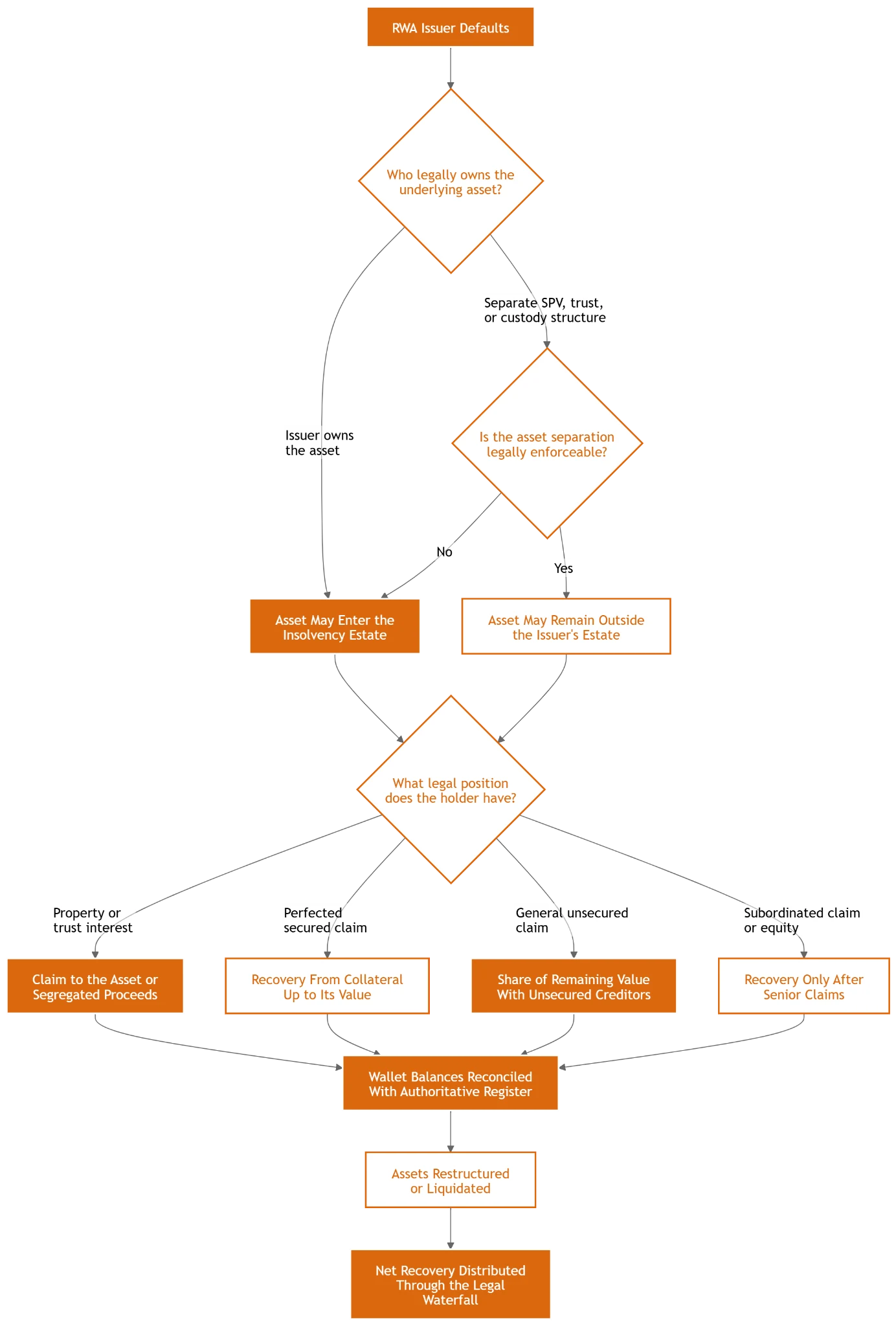
The flow diagram below shows clearly “what happens immediately after an issuer files?”

1. Payments, Transfers, and Redemptions Are Paused
The issuer, trustee, administrator, or court may stop distributions and restrict token movements to preserve assets.
Pending transactions are reviewed against cutoff times and settlement rules. A holder may transfer tokens without receiving cash, or send cash before issuance is blocked. Governing documents determine whether the transaction is completed legally.
2. Assets and Holder Records Are Reconciled
The administrator identifies assets, custody positions, receivables, liens, and outstanding tokens. Blockchain balances are matched with the authoritative register and supporting subscription or custody records.
The review may uncover duplicate minting, lost keys, unrecorded transfers, blocked wallets, supply differences, or nominee holdings. Only reconciled positions should enter the claims process.
3. Claims Are Filed and Classified
A token balance does not always become an allowed bankruptcy claim automatically. Holders may submit proof showing the debtor, amount, legal basis, priority, and supporting evidence.
The debtor, trustee, or another party may object. A claim can be reduced, reclassified, or disallowed when ownership, collateral rights, or the amount owed cannot be proved.
4. A Representative Takes Control of Enforcement
Individual token holders usually cannot seize collateral. Enforcement authority commonly belongs to a trustee, collateral agent, security agent, or insolvency representative.
That party may replace the servicer, collect receivables, enforce guarantees, seek stay relief, foreclose, or sell assets. Protection matters only when an independent party can use it after issuer failure.
5. Assets Are Restructured or Liquidated
The recovery method depends on the asset. Treasury securities may be sold through a custodian, private-credit loans may be restructured or sold at a discount, real estate may require foreclosure, and receivables may be collected over time.
Institutional investors can estimate the likely recovery using:
Expected Recovery Rate = Net Distributable Value After Senior Claims and Costs ÷ Allowed Token-Holder Claims
For example, suppose a $100 million loan portfolio produces $72 million in a distressed sale. Senior claims consume $15 million, while enforcement and administrative costs consume another $4 million. This leaves $53 million for $70 million of allowed token-holder claims.
Expected recovery rate = $53 million ÷ $70 million = 75.7%
Therefore, token holders may recover approximately 75.7% of their allowed claims before taxes, payment delays, and any additional insolvency expenses.
6. Recoveries Follow the Legal Waterfall
Distributions do not follow wallet order, purchase date, or withdrawal speed.
Proceeds may first cover preservation expenses, professional fees, secured claims, and statutory priorities. General unsecured creditors share their class allocation. Subordinated debt and equity remain lower.
Clawback mechanisms can affect holders who redeemed shortly before filing. Section 547 deals with avoidable preferences and includes defenses/exceptions.
7. Holders Receive the Approved Form of Recovery
A plan may provide cash, replacement notes, reorganized-company equity, recovery-trust interests, or a combination. The original token may be frozen, written down, migrated, exchanged, or burned after the final holder register is confirmed.
BlackRock BUIDL and Franklin Templeton BENJI are structural examples, not default precedents. They show that institutional tokenization still depends on fund documents, transfer agents, eligibility controls, custody, and holder records. They should not be used to infer how any default would be resolved. Centrifuge pool structures show how junior tranches absorb losses before senior investors once protection is exhausted.
Celsius and FTX Show Why Contract Terms Outrank Wallet Balances
RWA issuer precedent remains limited, so crypto insolvencies provide useful but imperfect comparisons.
In In re Celsius Network LLC, the bankruptcy court concluded that assets placed in Earn accounts became property of the debtors’ estates under the governing terms. Earned account holders were treated as unsecured creditors because the contract transferred title to Celsius. The lesson is direct:
displayed balances and marketing language cannot replace clear ownership terms.
FTX followed a different path. FTX is not an RWA case, but it shows that insolvency plans can convert customer positions into allowed claims and plan distributions rather than returning the exact original assets.
That outcome shows how insolvency valuation, claim verification, and plan treatment can diverge from later token prices.
Neither case involved a regulated tokenized fund backed by conventional RWAs. However, both demonstrate the same institutional principle:
- contract language,
- estate ownership,
- claim status,
- and the approved restructuring plan determine recovery.
What Institutional Investors Should Verify Before Buying
Institutions should obtain the entity chart, offering documents, true-sale and non-consolidation opinions, security agreement, perfection evidence, asset schedule, custody records, register policy, intercreditor terms, valuation method, backup-servicing plan, and key-succession procedure.
They should answer five questions:
- Which entity legally owns each asset?
- Which record controls when the wallet and authoritative register conflict?
- Who represents holders and enforces collateral?
- Who can replace the servicer and smart contract administrator?
- What will holders receive under liquidation or reorganization?
The strongest RWA structure aligns ownership, creditor priority, collateral control, servicing, settlement records, and smart contract administration after issuer failure under severe financial distress.
Disclaimer: This article is for educational and informational purposes only and does not constitute legal, financial, investment, or tax advice. RWA structures, insolvency rights, and token-holder recoveries vary by jurisdiction and transaction documents. Investors should consult qualified legal and financial advisers before making decisions.