
RWA.xyz’s global dashboard reported $27.65 billion in distributed tokenized assets and $441.38 billion in represented asset value in June 2026. That growth makes one question an increasingly important:
When an asset-backed claim moves on-chain, does its credit risk change, or does only its operating system change?
The answer defines the securitization vs tokenization debate. Securitization creates the asset pool, bankruptcy-remote issuer, tranche hierarchy, payment waterfall, and enforcement route.
Tokenization changes how the resulting security is issued, recorded, transferred, monitored, and settled. It may improve administration, but it cannot create a true sale, perfect a lien, or guarantee investor recovery by itself.
Structural Foundations of Securitization and Tokenization
The central difference is straightforward. Securitization creates the legal and economic claim. Tokenization provides the digital operating layer around that claim.
Securitization Creates the Asset-Backed Structure
A conventional cash-flow securitization commonly begins when an originator transfers mortgages, auto loans, receivables, or private-credit assets to a special purpose vehicle, or SPV. A trust may perform the same function.
The SPV issues notes or certificates backed by collections from the asset pool. Legal analysis focuses on whether the asset transfer qualifies as a true sale, whether security interests are perfected, and whether the vehicle remains separate from the originator during insolvency.
The servicer collects borrower payments and reports performance. The trustee represents investors and applies remedies. A calculation agent tests coverage ratios, while a custodian or account bank controls records and cash.
Tokenization Changes Representation and Administration
Tokenization represents a security or contractual entitlement through a digital token. The token may represent an SPV note, trust certificate, fund interest, loan participation, custodial entitlement, or synthetic exposure.
These claims may appear similar in a wallet but provide different legal rights. An issuer-sponsored token may form part of the official ownership system. A third-party token may provide only a claim against a custodian, platform, or intermediary.
Which Ownership Record Controls?
Transaction documents should identify whether the blockchain, transfer-agent register, trustee record, or custodian ledger is legally authoritative.
They should also explain how errors are corrected, lost credentials are replaced, court orders are processed, and conflicts between on-chain and off-chain records are resolved. A token balance does not automatically equal an enforceable security interest unless the governing documents and applicable law make that record legally operative.
Structural Comparison of Risk Tranching
Risk tranching determines who receives payments first and who absorbs losses first. Tokenization may automate this process, but it does not create seniority or change the contractual loss order.
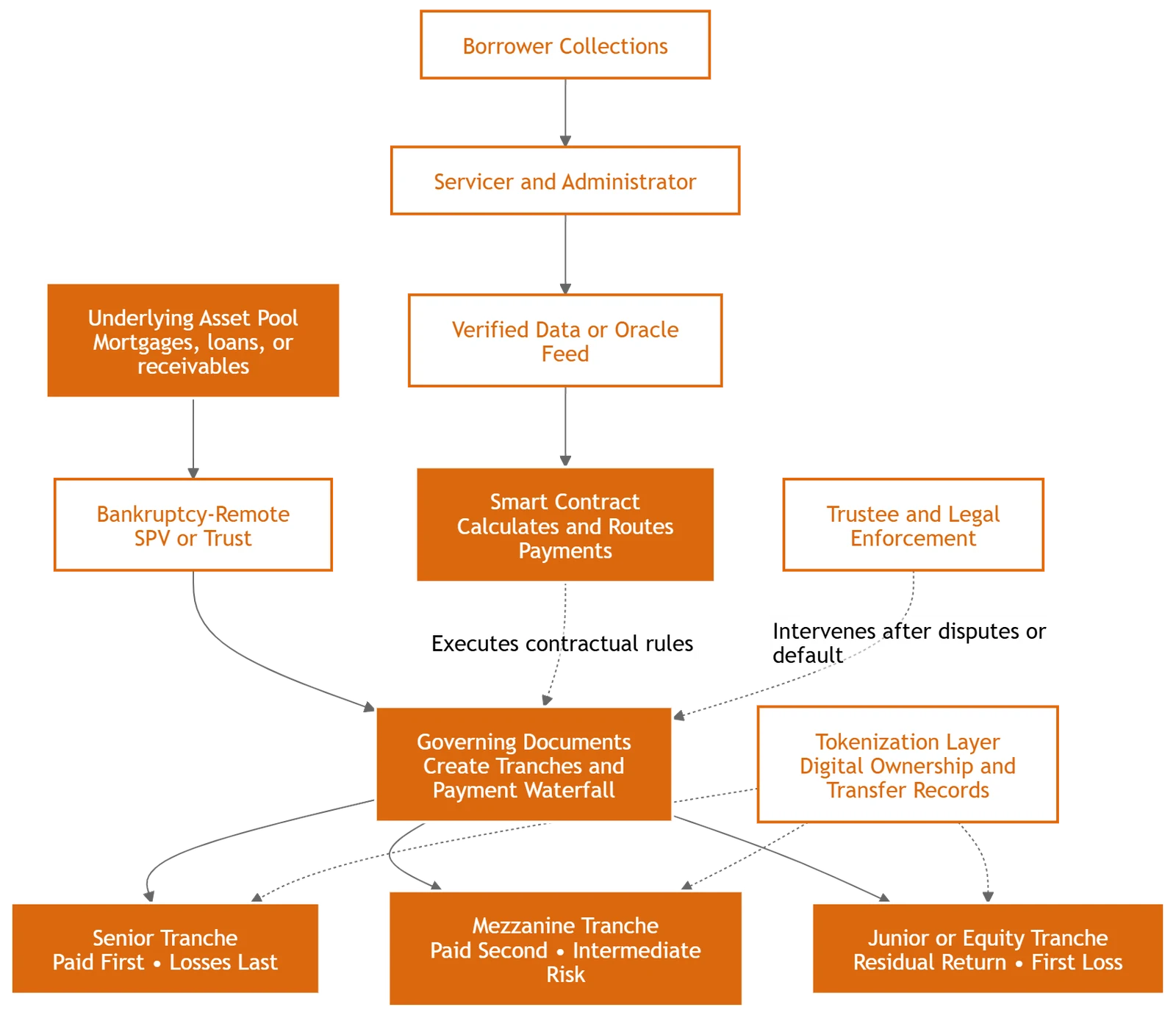
How Securitization Allocates Risk
Senior investors receive contractual payments first and usually absorb losses last. Mezzanine investors accept more credit risk for higher expected returns. Junior or equity investors receive residual cash but provide first-loss protection.
Mezzanine Investors are individuals or firms that provide mezzanine financing, a hybrid form of capital that combines debt and equity. They typically invest in companies seeking growth capital for expansion or acquisitions, receiving returns through interest payments and potential equity stakes. Mezzanine financing sits between senior debt and equity in the capital structure, offering higher risk and potential rewards. |
Consider a $100 million private-credit pool financed with:
- $70 million of senior notes
- $20 million of mezzanine notes
- $10 million of junior capital
An $8 million realized loss reduces the junior layer to $2 million. A $15 million loss eliminates the junior position and reduces the mezzanine tranche by $5 million. The senior tranche remains protected until the subordinated layers are exhausted.
A transaction may also use overcollateralization, reserve accounts, excess spread, guarantees, liquidity facilities, and performance triggers. If a delinquency or coverage test fails, cash intended for junior investors may instead repay senior principal.
A typical payment waterfall covers transaction expenses, servicing costs, reserve requirements, senior obligations, mezzanine obligations, and residual distributions.
What Smart Contracts Can Automate
A smart contract can calculate interest, test ratios, update balances, restrict transfers, and release payments after receiving validated data.
However, it cannot independently determine whether a borrower paid, whether a loan was legally transferred, or whether collateral data is accurate. It depends on a servicer, administrator, bank feed, or oracle.
If the input is wrong, the code may execute the wrong waterfall exactly as programmed. The structure must therefore identify who can pause the contract, correct data, replace an oracle, upgrade the code, or begin enforcement.
Risk-retention requirements also remain. Under standard U.S. rules, a covered sponsor generally retains at least 5% of the credit risk, subject to exemptions and transaction-specific conditions. A junior token may represent that exposure, but tokenization does not remove the underlying legal obligations.
Structural Comparison of Disclosure Regimes
Tokenization may increase the speed and visibility of reporting, but it does not replace legal, financial, or regulatory disclosure.
Traditional Securitization Disclosure
Traditional securitization disclosure covers:
- Collateral characteristics
- Underwriting standards
- Delinquencies and defaults
- Prepayments
- Servicing performance
- Credit enhancement
- Payment waterfalls
- Fees and conflicts of interest
For publicly registered U.S. asset-backed securities, Regulation AB provides an important disclosure framework. Form 10-D is used for distribution reports, while Form ABS-EE provides standardized asset-level information for covered transactions.
Private transactions use different structures. Rule 144A provides a safe harbor for qualifying resales to qualified institutional buyers. Regulation S applies to qualifying offshore offers and sales.
In these transactions, the offering memorandum, indenture, investor reports, and negotiated information rights explain the legal claim, collateral performance, structural protections, and material developments.
Tokenized Disclosure Requires an Additional Technical Layer
An on-chain ledger can show token supply, transfers, wallet concentration, payment timestamps, minting, burning, and contract changes.
It cannot independently prove that:
- The receivables exist
- The SPV owns the assets
- Liens remain perfected
- Valuations are current
- Servicing data is accurate
- Side agreements have been disclosed
A credible tokenized securitization therefore needs three connected information layers.
- Legal disclosure should explain the issuer, ownership rights, collateral claim, governing law, transfer restrictions, insolvency position, and enforcement process.
- Financial disclosure should report collections, delinquencies, defaults, prepayments, valuations, trigger tests, credit enhancement, fees, and tranche balances.
- Technical disclosure should identify the blockchain network, smart contracts, oracle model, custody structure, administrator permissions, audit results, upgrade process, cybersecurity controls, and recovery procedures.
The key distinction is frequency versus completeness. Tokenization may support faster updates, but those updates are only as reliable as the systems and people supplying the data.
Structural issue | Conventional securitization | Tokenized securitization |
Legal issuer | SPV or trust | Usually, the same SPV or trust |
Tranche priority | Created by transaction documents | Represented and partly automated through code |
Ownership record | Registrar, trustee, or transfer agent | On-chain, off-chain, or synchronized |
Performance data | Servicer and trustee reports | Servicer data plus administrator or oracle |
Disclosure | Regulatory or contractual reporting | Same baseline plus technical disclosure |
Default enforcement | Trustee action and courts | Automated triggers plus trustee and courts |
What the Structural Differences Mean for Investors
Investors should assess the legal claim before focusing on blockchain speed or wallet access.
Before buying a tokenized tranche, they should verify:
- The asset owner and SPV transfer
- Lien perfection and bankruptcy remoteness
- Tranche position and credit enhancement
- Payment and post-default waterfalls
- The authoritative ownership record
- Servicing and oracle governance
- Smart-contract audits and administrator permissions
- Custody, wallet recovery, and settlement arrangements
- Trading restrictions and permitted venues
Technical transferability is not the same as market liquidity. A token may move between approved wallets while lacking executable bids, market makers, independent pricing, qualified custody, or a compliant secondary market.
Likewise, faster settlement does not automatically create legal finality. But legal finality still depends on the settlement asset, available liquidity, network rules, insolvency treatment, custody arrangements, participant eligibility, and governing law.
Tokenization Works Only When the Structure Is Sound
Securitization and tokenization solve different structural problems.
Securitization creates the asset-backed claim, allocates credit risk through tranches, establishes disclosure obligations, and defines enforcement rights. Tokenization changes how that claim is represented, recorded, transferred, monitored, and settled.
A sound tokenized securitization must preserve the legal ownership chain, contractual loss order, disclosure discipline, and investor remedies of the underlying transaction.
Tokenization adds value when it reduces reconciliation, improves verified reporting, strengthens transfer controls, or accelerates settlement without weakening investor protection.
Disclaimer: This article is for general informational and educational purposes only. It does not constitute legal, tax, accounting, regulatory, or investment advice. Readers should consult qualified professionals before making decisions involving securitization, tokenized securities, or digital assets.
FAQs
Does tokenization make securitized debt safer?
No. It may improve administration and transparency, but credit risk still depends on the asset pool, waterfall, credit enhancement, and enforcement rights.
Can smart contracts replace trustees or servicers?
No. They can automate instructions, but servicers, trustees, custodians, and courts still handle real-world payments, defaults, collateral, and enforcement.
Can a tokenized tranche still default?
Yes. If the underlying asset pool underperforms, token holders can still lose interest, principal, or residual distributions depending on tranche priority.
Does faster settlement mean better liquidity?
No. Faster settlement helps execution. But liquidity still depends on buyers, market makers, transfer eligibility, pricing, and redemption terms.