
Tokenized U.S. Treasuries reached $13.6 billion in April 2026, up 170% from a year earlier. On July 1, 2026, the 26-week Treasury bill’s coupon-equivalent yield was 3.97%. For a 26-week holding period, the dollar income would be roughly half the annualized figure before considering bill-pricing conventions, reinvestment, and fees
Yet the Treasury benchmark is not automatically the return that reaches an investor’s wallet. Custody, administration, cash reserves, subscription timing, and redemption costs can all reduce it.
Corporate treasurers need to understand the difference between gross portfolio yield and net realized yield. Meanwhile, DAO managers need to know whether income appears through additional tokens, a rising token value, or regular balance adjustments.
The practical question is clear.
How does a dollar move from a wallet into Treasury assets, earn income off-chain, and return to an on-chain holder?
Where Tokenized Treasury Yield Comes From
The blockchain does not generate Treasury yield. Instead, it records and administers an investor’s claim on income produced by a conventional portfolio.
The U.S. Treasury issues bills with terms of 4, 6, 8, 13, 17, 26, and 52 weeks. Bills are sold at a discount or at face value. At maturity, the holder receives face value, while the difference between the purchase price and repayment amount represents the interest earned. Treasury bills are available in minimum increments of $100.
Dollar income at maturity = Face value received - Purchase price
A tokenized product may hold Treasury bills directly. However, many products also invest in cash, government money-market instruments, or repurchase agreements backed by government securities.
Therefore, a product may hold Treasury bills directly. However, many products also invest in cash, government money-market instruments, orrepurchase agreements backed by government securities.
That distinction affects how yield is calculated, which fees are deducted, how assets are held, and when investors can redeem their tokens.
How Capital Moves From a Wallet Into a Treasury Portfolio
The process begins before any token is issued.
An investor normally completes identity verification, sanctions screening, investor-classification checks, and wallet-ownership verification. Many institutional products also use approved-address lists, meaning tokens can move only between eligible wallets.
Next, the investor subscribes using a bank transfer or an accepted stablecoin. A fiat payment can move directly into the product’s bank account. By contrast, a stablecoin subscription may first be converted into bank money because the investment manager generally purchases Treasury securities through traditional market infrastructure.
After the subscription clears, the manager invests according to the product mandate. The portfolio may contain short-duration Treasury bills, Treasury-backed repo, and a cash reserve for withdrawals.
Several parties support this process. The manager selects the investments, while the custodian holds the securities. The bank handles cash, the administrator calculates portfolio value, and the transfer agent maintains the official investor record.
Only after the subscription is accepted and the investor record is updated should the corresponding tokens be minted.
Redemption follows the reverse route. The tokens are transferred, locked, or burned; the official register is updated, and fiat or an approved stablecoin is returned to the investor.
The complete flow is:
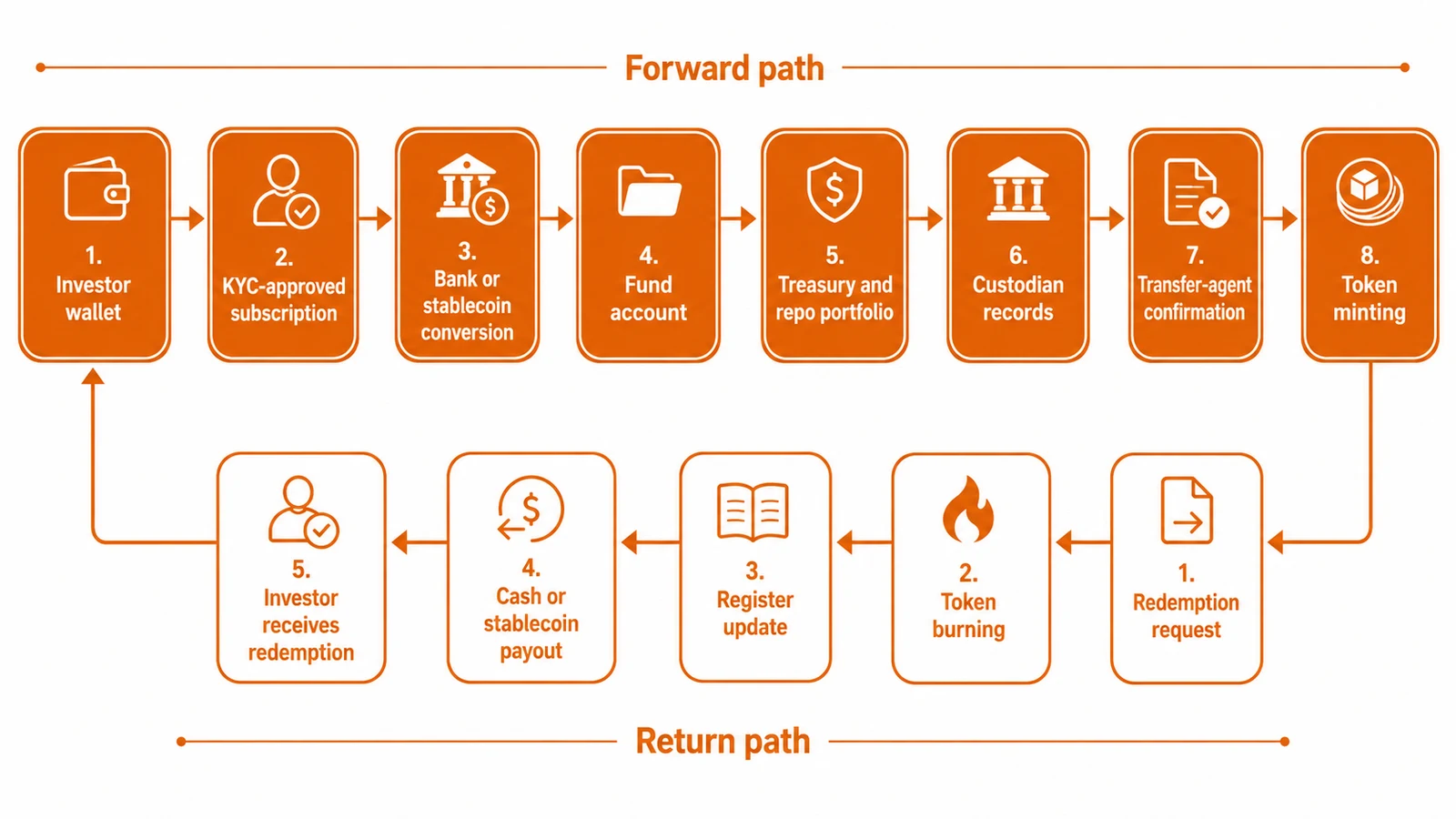
Throughout the investment lifecycle, the on-chain supply must reconcile with custody, administrator, and transfer-agent records. This synchronization is central to real-world asset tokenization architecture. A correct wallet balance cannot compensate for missing assets or inconsistent legal ownership records.
How On-Chain Treasury Products Deliver Yield
Once the portfolio starts earning income, the issuer must determine how that return will appear in the investor’s wallet. Three main structures are used.
Distribution Model
Under this structure, the token seeks to maintain a stable reference value, often close to $1. Portfolio income accrues during the calculation period, and additional tokens are later credited to eligible holders.
BlackRock’s BUIDL launched with this general model. The private fund invests in cash, U.S. Treasury bills, and repurchase agreements. It seeks to maintain a $1 token value and pays daily accrued dividends monthly through additional tokens. Securitize provides tokenization and transfer-agent services.
As a result, the investor’s return appears as a larger token balance after the distribution. The reference value of each unit remains broadly stable.
This design can be useful when tokens are used as collateral because every unit continues to represent a familiar dollar-based value.
- Accumulating Value Model
An accumulating structure keeps the investor’s token quantity unchanged while the published price or redemption value rises as income accrues.
USDY uses this general design. A holder may retain the same number of tokens, but each unit becomes redeemable for a larger dollar amount over time. The investor realizes the return through redemption or a sale at the higher value.
This model is sometimes described as accumulating token NAV. However, “token price” or “redemption value” is more precise when the legal instrument is a note rather than a fund share.
Rebasing Model
A rebasing token generally maintains a relatively stable reference price while changing the number of tokens held in the wallet.
Instead of a token increasing from $1.00 to $1.01, a holder’s balance may rise from 10,000 units to approximately 10,100 units.
Ondo’s rUSDY provides the contrast with USDY. USDY reflects accrued return through its value, while rUSDY is designed to reflect the return through changes in the wallet balance.
The economic exposure may be similar, but the formats behave differently within accounting systems, DeFi protocols, lending markets, collateral engines, and tax-reporting processes. Treasury teams should confirm that their wallets, custodians, and reporting software can handle the selected model correctly.
How Fees and Redemption Affect the Return
The gross Treasury rate is only the starting point.
Net token yield = Gross portfolio yield − management fees − administration and custody costs − cash drag − transaction costs − investor conversion costs
Management, transfer agency, administration, custody, banking, audit, and legal expenses may all reduce the product’s return.
Cash drag also matters. A product may retain part of its portfolio in cash or stablecoins to meet withdrawals. Although this can support faster redemptions, that portion may earn less than funds fully invested in Treasury assets.
Stablecoin users may also face conversion spreads, blockchain gas fees, bridge charges, and delays between subscription and the point when income begins accruing.
For that reason, two advertised yields are comparable only when they use:
- The same measurement date
- The same annualization method
- Net rather than gross returns
- Comparable fee treatment
- Comparable liquidity assumptions
For example, a 3.97% gross portfolio yield would fall to approximately 3.62% if structural expenses and cash drag totaled 0.35% points. This calculation is illustrative and is not a quoted return for BUIDL, USDY, or another named product.
Redemption introduces another layer of operational friction. The investor first submits a verified request. The tokens are then transferred, locked, or burned, and the official investor register is updated. Cash is subsequently sourced from available reserves, maturing securities, or asset sales.
Some products support faster stablecoin exits through prefunded liquidity, market makers, or token-for-stablecoin facilities. However, a rapid token swap does not mean the underlying Treasury securities settle immediately. Instead, another party supplied the cash leg and accepted the settlement-timing risk.
Atomic delivery versus payment can coordinate the token and payment transfers, thereby reducing principal risk. Still, it cannot remove stablecoin failure, banking interruptions, depleted liquidity reserves, compliance delays, or contractual redemption suspensions.
How BUIDL and USDY Deliver Treasury Yield Differently
BUIDL and USDY show why allocators should compare structures rather than select a product solely because it displays a higher yield.
At its March 2024 launch, BUIDL was offered to qualified purchasers with a reported minimum subscription of $5 million. That figure is historical and should be checked against current private offering documents before an allocation. Its stable-value design may suit institutions seeking a permissioned fund interest that can also operate as on-chain collateral.
USDY is a tokenized yield-bearing instrument with an appreciating-value structure, while rUSDY provides a rebasing format. Access, minimums, transferability, supported networks, and redemption rules vary by jurisdiction and distribution channel.
Option | Legal exposure | How the return appears | Minimum and access | Main liquidity route | Best fit |
Direct Treasury bill | Direct U.S. government security | Discount realized at maturity | $100 through TreasuryDirect | Maturity or transfer to a bank, broker, or dealer for sale | Investors prioritizing direct ownership |
BUIDL | Private tokenized fund interest | Additional tokens from accrued dividends | $5 million at launch for qualified purchasers; verify current terms | Fund redemption and approved liquidity arrangements | Institutions seeking permissioned on-chain fund shares |
USDY | Tokenized yield-bearing instrument | Rising token price or redemption value | Jurisdiction and channel dependent | Issuer redemption or supported markets | Eligible treasuries seeking an accumulating token |
rUSDY | Rebasing representation linked to USDY | Increasing wallet balance | Jurisdiction and channel dependent | Conversion, redemption, or supported markets | Users requiring a rebasing asset |
Secondary-market purchase | Rights depend on the token acquired | Depends on the underlying token | Venue and wallet rules apply | Sale to another eligible buyer | Buyers accepting spreads for faster entry |
Direct issuer access usually provides clearer reference-value execution and formal redemption rights. A secondary marketplace may offer faster entry or smaller transactions, but the trade can occur above or below the issuer’s reference value. In addition, not every secondary buyer will qualify for direct redemption.
Before choosing a product, an allocator should compare:
- The legal instrument being acquired
- The underlying portfolio assets
- Gross and net yield
- The complete fee schedule
- The income-distribution model
- Minimum subscription requirements
- Approved blockchain networks
- Custodian and transfer agent
- Valuation frequency
- Subscription and redemption cut-offs
- Liquidity reserves
- Transfer and suspension rights
The highest displayed APY may not deliver the strongest realized return once onboarding time, fee drag, trading spreads, and exit conditions are included.
Bottom Line
Tokenized Treasury products do not create a new source of yield. They package off-chain Treasury and repo income into blockchain-compatible fund shares, notes, or tokens.
The decisive questions are how income reaches the wallet, how much return is lost through structural friction, and whether the product’s redemption terms match the investor’s liquidity needs.
FAQs
How do tokenized Treasuries distribute yield?
They generally use additional token distributions, an appreciating token value, or rebasing balances. The underlying income comes from Treasury bills, repo, cash, or other permitted short-duration assets.
Do tokenized T-bills pay the full Treasury rate?
Usually not. Product expenses, cash reserves, conversion spreads, and transaction costs can reduce the net yield received by the investor.
What is the difference between rebasing and accumulating tokens?
A rebasing token changes the holder’s wallet balance. An accumulating token keeps the balance constant while its published price or redemption value increases.
How long does tokenized Treasury redemption take?
Timing depends on product cut-offs, compliance checks, banking rails, portfolio liquidity, and stablecoin facilities. Burning a token does not guarantee immediate off-chain cash settlement.
Are tokenized Treasuries the same as stablecoins?
No. Stablecoins primarily support payment and settlement at a stable reference value. Tokenized Treasury products are investment instruments connected to income-producing portfolios.
Disclaimer: This article is for educational purposes only and does not constitute investment, legal, accounting, or tax advice.