Why can an investor in Singapore buy a crypto token that is unavailable to someone in the United States? Why do exchanges sometimes display messages such as "This asset is not available in your jurisdiction" even though blockchain technology is designed to operate globally?
The answer usually lies in jurisdiction-specific securities laws, licensing requirements, investor protection rules, and AML/KYC obligations. Each country applies its own legal framework to digital assets, which means the same token may be freely available in one market but restricted or prohibited in another. To manage these differences, many exchanges and token issuers choose where to operate and which markets to serve based on local regulations.
This guide explains regulatory arbitrage, how it applies to crypto markets, and why token availability varies across jurisdictions under securities law.
What Is Regulatory Arbitrage?
Regulatory arbitrage occurs when businesses structure activities across jurisdictions to benefit from differences in regulatory treatment, compliance costs, or legal classification. This may involve legitimate jurisdiction selection, but it can also create supervisory and enforcement risks.
This strategy has long been used in traditional finance and is now common in the crypto industry. Because digital asset regulations vary across jurisdictions, exchanges and token issuers decide where to incorporate, obtain licenses, launch token offerings, and make assets available. These decisions directly affect whether a token is accessible, restricted, or unavailable in different markets.
How Regulatory Arbitrage Applies to Crypto Markets
Crypto businesses operate globally, but regulations differ from one jurisdiction to another. Instead of following a single rulebook, they must comply with the laws of each market they serve. This is where regulatory arbitrage comes in.
Before launching a token or exchange, companies decide where to incorporate, obtain licenses, and offer their products. They compare securities laws, licensing requirements, compliance obligations, and tax rules to identify suitable jurisdictions.
These decisions directly affect token availability. A token may be available in countries with clear regulatory pathways but restricted where securities laws are strict or additional approvals are required. Exchanges also adjust their token listings and services to comply with local regulations.
In short, regulatory arbitrage does not alter a token’s technical architecture; it determines where and how an entity can legally offer access to it.
Extraterritorial Jurisdiction and Enforcement Risk
Incorporating offshore or choosing a crypto-friendly jurisdiction does not automatically insulate a business from regulatory enforcement. Regulatory authorities often assert jurisdiction based on where activities are targeted or conducted rather than where an entity is incorporated. Key factors evaluated include:
- Target audience and active marketing locations
- Physical presence of executive personnel or servers
- Accepted fiat currencies and payment intermediaries
- Economic effects within a jurisdiction
A business may therefore be subject to regulatory obligations in multiple jurisdictions simultaneously.
Blockchain Access vs. Regulated Market Access
While public blockchain networks are globally accessible at a protocol layer, market access to digital assets is multi-layered. A token being “unavailable” can refer to several distinct operational or legal restrictions:
- Technical Protocol Layer: A blockchain network and smart contracts remain globally operational.
- Centralized Exchange Level: A custodial platform blocks users based on IP geolocation or KYC records.
- Issuer Level: An issuing entity restricts token transfers or primary sales to verified wallets.
- Regulated Venue Level: An exchange refuses to list an asset due to compliance or listing rules.
- Smart Contract Level: On-chain code enforces wallet eligibility or transfer restrictions.
- Marketing Level: Local laws prohibit promoting, soliciting, or advertising the asset to resident investors.
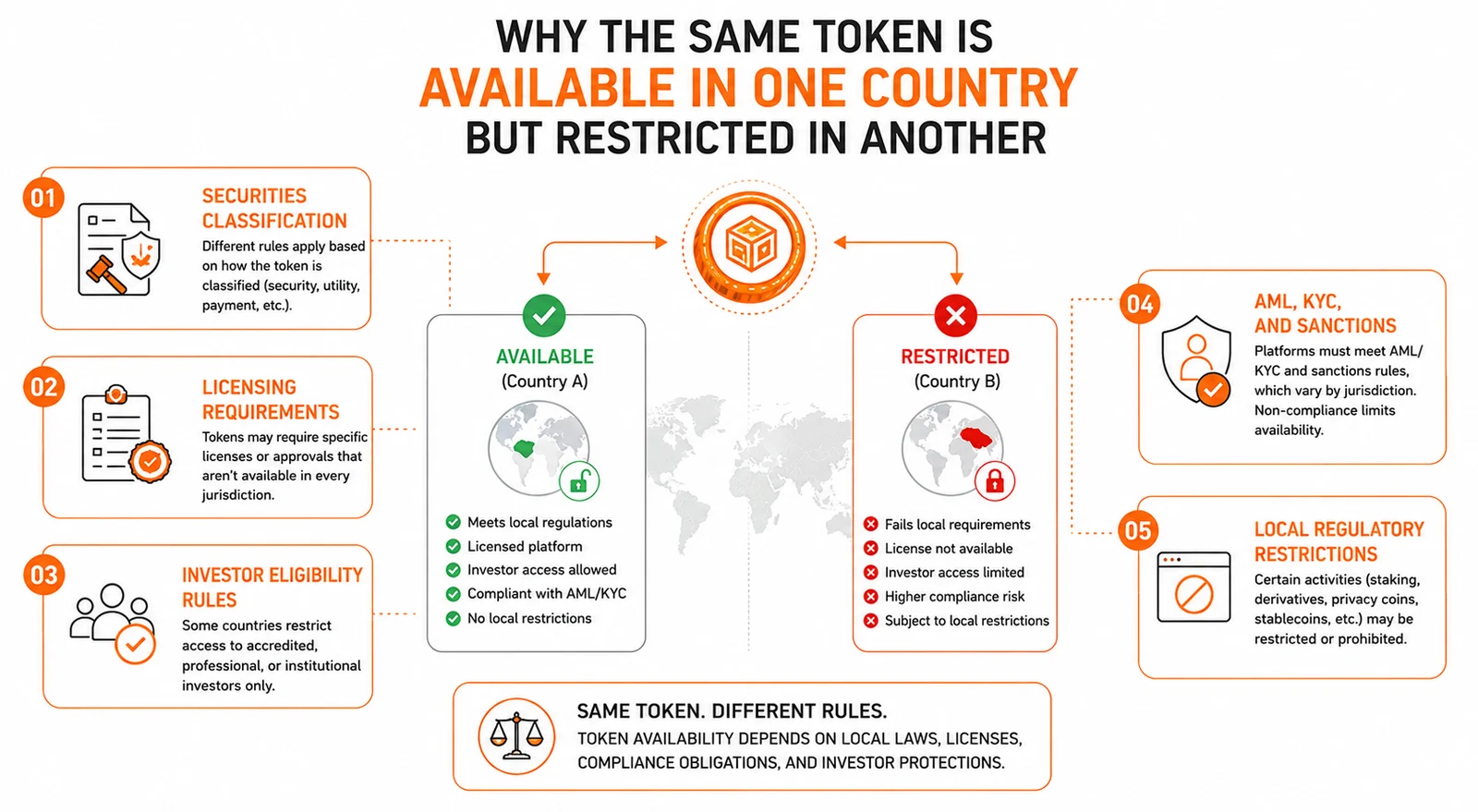
Why the Same Token Is Available in One Country but Restricted in Another
The same token or transaction may receive different legal treatment because jurisdictions apply different legal definitions, offering rules, and intermediary requirements.
Legal treatment across markets varies due to several factors:
- The structure of the primary token offering
- Specific legal rights attached to the token in a given jurisdiction
- Local marketing, solicitation, and distribution methods
- The specific activities performed by intermediaries (e.g., custody, execution, broker-dealer services)
- Applicable local statutory exemptions or safe harbors
1. Securities Classification
One of the most important factors is how a regulator classifies the token. In some jurisdictions, a token may be treated as a security because it represents an investment contract or provides rights similar to traditional financial instruments. In others, it may be classified as a utility token or payment token, subject to a different regulatory framework. This classification determines which laws apply before the token can be offered to investors.
2. Licensing Requirements
Exchanges and crypto platforms often need specific licenses or regulatory approvals before offering digital assets. If the required authorization is unavailable or difficult to obtain, companies may decide not to offer certain tokens in that jurisdiction.
3. Investor Eligibility Rules
Some countries allow retail investors to access a wide range of digital assets, while others restrict certain offerings to qualified, professional, or institutional investors. These rules directly affect who can legally invest in a token.
4. AML, KYC, and Sanctions
Before offering a token, regulated platforms must comply with anti-money laundering (AML), know your customer (KYC), and sanctions screening requirements. These obligations help prevent financial crime and may influence whether a platform can operate in a particular market.
5. Local Regulatory Restrictions
Some jurisdictions impose additional restrictions on specific crypto activities, such as staking services, privacy-focused tokens, derivatives, or stablecoins. Even if the underlying blockchain remains accessible, these rules can limit how a token is listed or promoted.
How Securities Laws Shape Token Availability
Whether a token is available in a particular country often depends on how local securities laws classify and regulate it. While many jurisdictions recognize the same blockchain technology, they may apply different legal tests to determine whether a token falls within existing financial regulations.
- United States: In the United States, the Howey Test remains relevant when determining whether an offer, sale, or arrangement involving a crypto asset constitutes an investment contract under federal securities laws. The asset's inherent characteristics and the surrounding transaction structure must be evaluated separately. In addition, state money-transmission laws, derivatives frameworks, and payment stablecoin frameworks (such as the GENIUS Act framework for payment stablecoin issuers) dictate platform and exchange listing paths.
- European Union: The EU framework cleanly distinguishes between general digital assets and traditional financial instruments. MiCA covers crypto-assets within its scope (including Asset-Referenced Tokens and E-Money Tokens), while tokenized financial instruments remain governed by MiFID II and established securities laws.
- United Kingdom: Token availability in the UK is heavily influenced by both licensing perimeters and financial promotion rules. Promotions involving qualifying cryptoassets must comply with strict FCA requirements concerning risk warnings, marketing channels, customer journeys, and cooling-off periods.
- Singapore: The Monetary Authority of Singapore (MAS) applies a functional approach under the Payment Services Act (PSA) and Securities and Futures Act (SFA). Regulatory obligations depend on whether an activity involves Digital Payment Tokens (DPTs), capital markets products, or regulated payment services.
Jurisdiction-by-Jurisdiction Mapping of Token Availability
The same crypto token can face very different regulatory treatment depending on where it is offered. Some jurisdictions classify certain tokens as securities, while others regulate them under dedicated crypto frameworks. These differences influence who can access the token, how it can be marketed, and what compliance obligations apply.
The table below highlights how major financial jurisdictions approach digital assets.
Jurisdiction | Main Legal Perimeter | Key Access Consequence |
United States | Securities, commodities, payments, AML, and state laws | Availability depends on transaction structure, registration or exemption, intermediary status, state access, and stablecoin issuer status. |
European Union | MiCA or MiFID II depending on asset classification | Authorized CASPs may provide covered services across the EU under MiCA, subject to asset classification, white-paper disclosures, and conduct rules. Financial instruments follow MiFID II. |
United Kingdom | Current AML/promotion rules and expanded 2027 FSMA regime | Specified activities will require authorization under the expanded FSMA regime (expected Oct 25, 2027). Marketing must strictly comply with FCA financial promotion rules. |
Singapore | Payment Services Act (PSA) and Securities and Futures Act (SFA) | Treatment depends on token function (DPT vs. capital markets product) and the specific regulated activity performed. |
Hong Kong | SFC virtual-asset (VATP) and securities frameworks | Licensed VATPs may serve eligible clients subject to token due diligence, custody, conduct, and investor-protection requirements. |
UAE | Separate VARA (Dubai), DFSA (DIFC), FSRA (ADGM), and federal regimes | Licensing scope and permitted token availability depend on the applicable financial zone and authority. |
Japan | Payment Services Act (PSA) and Financial Instruments and Exchange Act (FIEA) | Exchange listings and asset availability are subject to strict JVCEA self-regulatory reviews and FSA registration requirements. |
Australia | Corporations Act and proposed Digital Assets Framework | Availability depends on financial product classification and AFS licensing requirements during ongoing regulatory reform. |
Switzerland | FINMA financial-market laws and DLT framework | FINMA applies technology-neutral token classifications, while DLT legislation provides infrastructure for ledger-based securities. |
No single jurisdiction follows exactly the same approach. A token that qualifies as a security in one country may fall under a different regulatory category elsewhere. Likewise, an exchange may decide to list, restrict, or completely block a token depending on the legal requirements of each market.
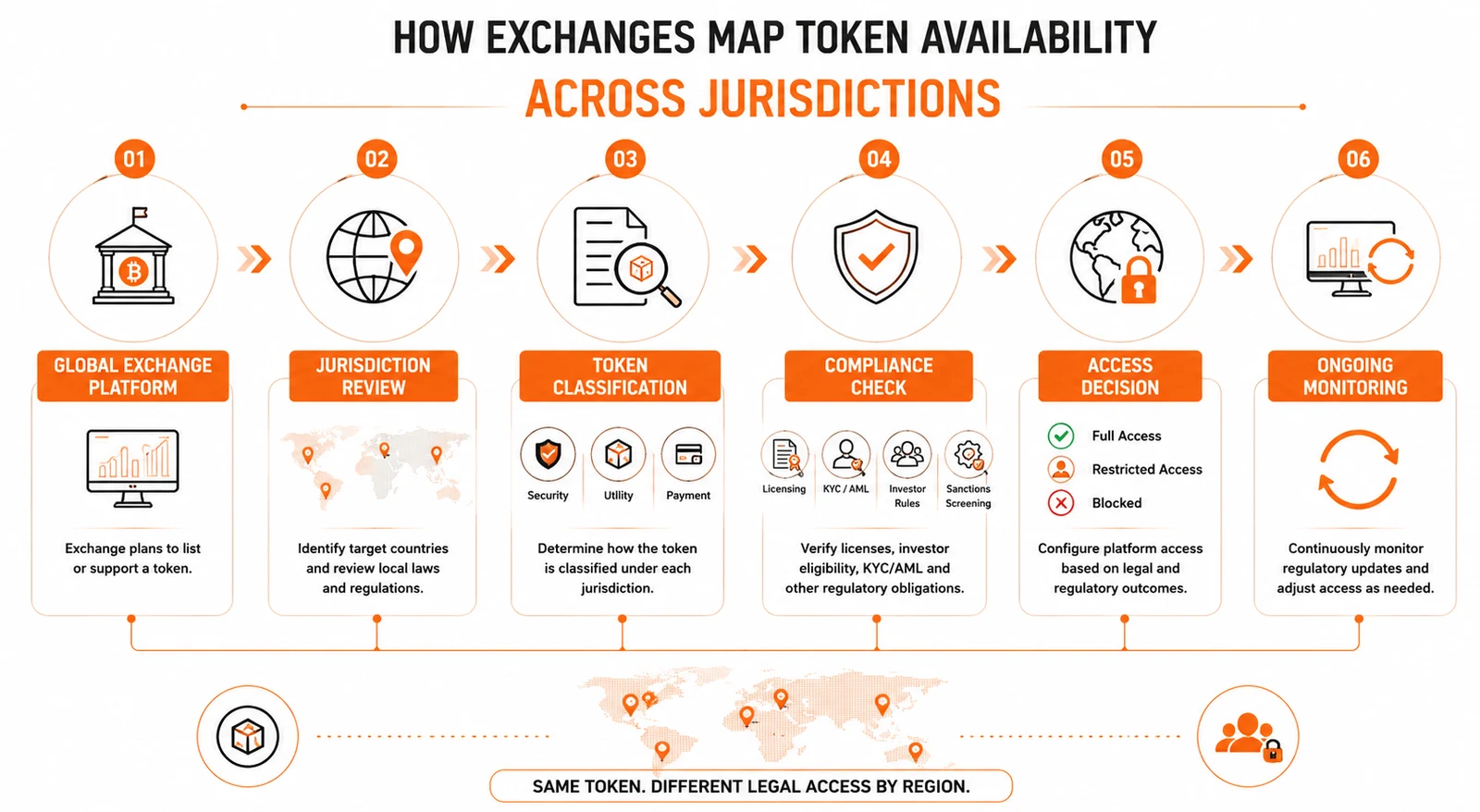
How Exchanges Map Token Availability Across Jurisdictions
Before listing a token, exchanges do not simply decide whether to support it. They first evaluate where the token can legally be offered. This process combines legal analysis, compliance reviews, and local regulatory requirements.
A simplified workflow looks like this:
Step 1: Identify the Target Jurisdictions
The exchange first decides which countries or regions it plans to serve. Every jurisdiction has its own securities laws, licensing requirements, and crypto regulations, so each market must be reviewed separately.
Step 2: Determine the Token's Legal Classification
Next, the exchange evaluates how the token is classified under the laws of each jurisdiction. A token treated as a security in one country may be considered a utility or payment token in another. This classification determines the applicable regulatory obligations.
Step 3: Review Local Regulatory Requirements
The exchange then assesses whether it has the necessary licenses, registrations, or approvals to offer the token. It also reviews investor eligibility rules, financial promotion restrictions, AML/KYC obligations, and sanctions requirements before making the asset available.
Step 4: Apply Jurisdiction-Specific Access Controls
Based on the legal review, the exchange configures its platform for each market. It may list the token, restrict it to accredited or professional investors, limit certain services such as staking or derivatives, or block access entirely. These controls are typically enforced through KYC verification, residency checks, and IP geofencing. However, technical access controls face operational limitations, including:
- VPN usage and proxy services
- Outdated residency or identity documentation
- Complex corporate structures and dual nationalities
- Unrestricted peer-to-peer wallet transfers after onboarding
- Decentralized front-end interfaces
- Dynamic sanctions list updates and inaccurate IP geolocation databases
Step 5: Continuously Monitor Regulatory Changes
Regulations continue to evolve, so exchanges regularly review their token listings. If a jurisdiction introduces new rules or changes its regulatory approach, the platform may add, restrict, or remove tokens to remain compliant.
This ongoing process explains why the same exchange can offer different tokens and services to users in different countries. The blockchain remains the same, but token availability changes to reflect local securities laws and regulatory requirements.
Role-Based Compliance Obligations
Regulatory responsibilities are distributed across industry participants rather than falling on a single party:
Market Participant | Primary Regulatory Responsibilities |
Issuer | Offering compliance, white-paper disclosures, token rights structuring, and primary sale restrictions. |
Exchange / Venue | Operating licenses, listing due diligence, fair trading, market integrity, and access geofencing. |
Broker / Intermediary | Customer suitability, advice rules, distribution licensing, and financial promotion compliance. |
Custodian | Asset segregation, bankruptcy-remoteness, key management, and reserve auditing. |
User / Investor | Local tax reporting, accreditation verification, and adherence to local holding prohibitions. |
Real-World Examples of Jurisdiction-Specific Token Availability
1. Privacy-Enhanced Cryptocurrencies
Regulatory treatment of anonymity-enhanced cryptocurrencies (e.g., Monero, Zcash) varies by legal mechanism. In Dubai, VARA explicitly prohibits the issuance and activity surrounding anonymity-enhanced cryptocurrencies under its Virtual Assets Regulations. In other markets, such as Japan and South Korea, restrictions stem from regulatory licensing conditions and exchange AML risk management policies leading to voluntary or mandated delistings.
2. Asset-Referenced and E-Money Stablecoins
Under the EU’s MiCA framework, stablecoin issuers offering fiat-backed tokens within the EEA must obtain authorization as Electronic Money Institutions (EMIs) or credit institutions. Consequently, centralized exchanges operating in the EEA have adjusted their offerings, restricting non-authorized stablecoins (such as USDT) for trading or yield products while supporting compliant E-Money Tokens.
3. Dated Platform Case Studies
Global platforms adjust trading pairs based on regional enforcement and licensing:
- U.S. Spot Market Restrictions (2023–2024): Major exchanges restricted U.S. resident access to specific tokens (e.g., MATIC, SOL, ADA) following SEC complaints alleging those assets were sold as unregistered securities.
- UK Financial Promotion Changes (October 2023): Platforms like Binance and PayPal restricted or modified UK user journeys to comply with FCA financial promotion regulations, requiring mandatory cooling-off periods and risk questionnaires.
- Derivatives & Staking Limits: Regulated venues routinely restrict leveraged derivatives and pooled staking products in retail-focused markets such as the UK, Germany, and Hong Kong while offering them in institutional zones.
4. Tokenized Real-World Assets (RWAs)
Tokenization does not remove the underlying legal classification. A tokenized share, bond, fund interest, or property-linked instrument is assessed according to the legal rights and transaction structure it represents. Jurisdictions like Switzerland (DLT Act) and Singapore (MAS Project Guardian) provide specific legal frameworks for ledger-based securities.
5. Legacy ICO Tokens
Tokens distributed via public sales without registration or clear safe-harbor exemptions remain subject to legal scrutiny. In the U.S., secondary trading on regulated platforms remains restricted when ongoing promoter involvement creates an investment contract risk under Howey.
Compliance Checklist for Token Issuers and Crypto Exchanges
- Identify Token Rights and Functions: Map the underlying economic, governance, and utility rights attached to the token.
- Analyze Distribution & Transaction Structure: Evaluate primary sale methods, marketing tactics, secondary trading venues, and lock-up periods.
- Determine Regulated Activities: Identify which entity performs broker, exchange, custody, or advisory services.
- Identify Licensing and Exemption Routes: Confirm required venue approvals (e.g., MiCA CASP, VARA license, SFC VATP) and verify that FinCEN MSB registration is recognized as an AML registration rather than authorization to offer securities or operate across all state jurisdictions.
- Assess Investor Eligibility & Promotion Rules: Check accredited investor thresholds, retail restrictions, and local marketing rules.
- Implement AML/KYC & Travel Rule Compliance: Establish customer due diligence, sanctions screening, and on-chain transaction monitoring.
- Deploy Multi-Layered Access Controls: Combine IP geofencing, residency verification, and smart-contract transfer restrictions.
- Monitor Regulatory Changes: Track law updates, enforcement actions, and asset re-classifications on an ongoing basis.
Compliance is an ongoing process. As regulations evolve, issuers and exchanges should regularly review their obligations to ensure that tokens remain available only where they can be lawfully offered.
Future Trends in Jurisdiction-Specific Token Regulation
Digital asset regulation continues to evolve. Governments are introducing clearer rules for stablecoins, tokenized real-world assets (RWAs), and crypto service providers. The EU's MiCA Regulation has created a harmonized framework across member states. Meanwhile, jurisdictions such as Singapore, Hong Kong, the UAE, and the United States continue to refine their regulatory approaches.
Regulators are also increasing cross-border cooperation to strengthen investor protection and AML compliance. However, differences in securities laws, licensing requirements, and token classification still exist. These differences will continue to affect where digital assets can be issued, listed, and traded. As regulations develop, staying informed will remain essential for issuers, exchanges, and investors.
Regulatory Status Date: Information and regulatory status verified as of July 15, 2026. Legal frameworks, administrative guidance, and platform policies remain subject to rapid change
Wrap Up
Blockchain technology enables digital assets to move across borders, but token availability is ultimately shaped by local regulation. Securities laws, licensing requirements, investor protection rules, and AML/KYC obligations determine where a token can be legally offered and who can access it.
Regulatory arbitrage explains why digital asset businesses choose certain jurisdictions, while jurisdiction-specific securities laws explain why the same token may be available in one country but restricted in another. As crypto regulations continue to evolve, understanding these legal differences will help issuers, exchanges, and investors navigate global markets, maintain compliance, and make more informed decisions.
Disclaimer: This article is for educational purposes only and is not financial, legal, investment, or tax advice. Tokenized and private-market assets carry risks, including loss, limited liquidity, custody issues, and regulatory changes. Review all documents and seek professional advice before investing.