
Companies now delay IPOs and raise larger funding rounds while staying private for longer periods. As a result, private markets continue growing rapidly. Global private assets held in funds reached nearly $14.9 trillion in 2025, rising 15.4% year over year.
Investors now follow companies earlier because much of the valuation growth happens before public listings. Pre-IPO investing explains how companies price private shares through funding rounds, secondary share sales, and limited market activity before public buying and selling begin.
Private markets provide less transparency, so investors rely more on valuation models, deal structures, and transaction data today.
What Is Pre-IPO Investing?
Pre-IPO investing means buying shares in a private company before it officially goes public through an IPO (Initial Public Offering). Instead of entering after the stock is listed on a public exchange like NASDAQ or the New York Stock Exchange, investors try to get in earlier, while the company is still privately owned.
This matters because some of the biggest valuation jumps can happen before the IPO. Companies may raise money across multiple private funding rounds, and each round can increase the company’s value as the business grows.
Traditionally, pre-IPO investing has mostly been limited to venture capital firms, institutions, wealthy investors, employees, or insiders with private access. That is why many retail investors only hear about these companies once they are already close to listing.
In simple terms, pre-IPO investing is about trying to access growth before the public market stage.
Where Pre-IPO Shares Come From?
Pre-IPO shares often come from founders, early employees, angel investors (individuals who invest early-stage capital into startups), and venture capital funds. Founders may sell a small portion of their stake after years of building the company.
Employees may sell when their stock options become valuable, but they still cannot be easily turned into cash. Early investors and VC funds also sell to lock in gains or return money to their own investors.
Primary vs Secondary Deals
In a primary deal, the company creates and sells new shares, and the money goes directly into the business. This is usually done to raise capital for growth, hiring, product development, or expansion.
In a secondary deal, existing shareholders sell their shares to new investors. The company does not receive that money. Instead, the seller gets liquidity before the company goes public.
How do investors get access?
Most investors do not buy pre-IPO shares the way they buy public stocks. Access usually comes through venture funds, brokers, secondary marketplaces, SPVs, private banks, or company-approved liquidity programs. In many cases, the company must also approve the transfer.
That is why pre-IPO investing is not just about finding a private company early. It is also about understanding who is selling, what type of shares are being sold, and how the deal is structured.
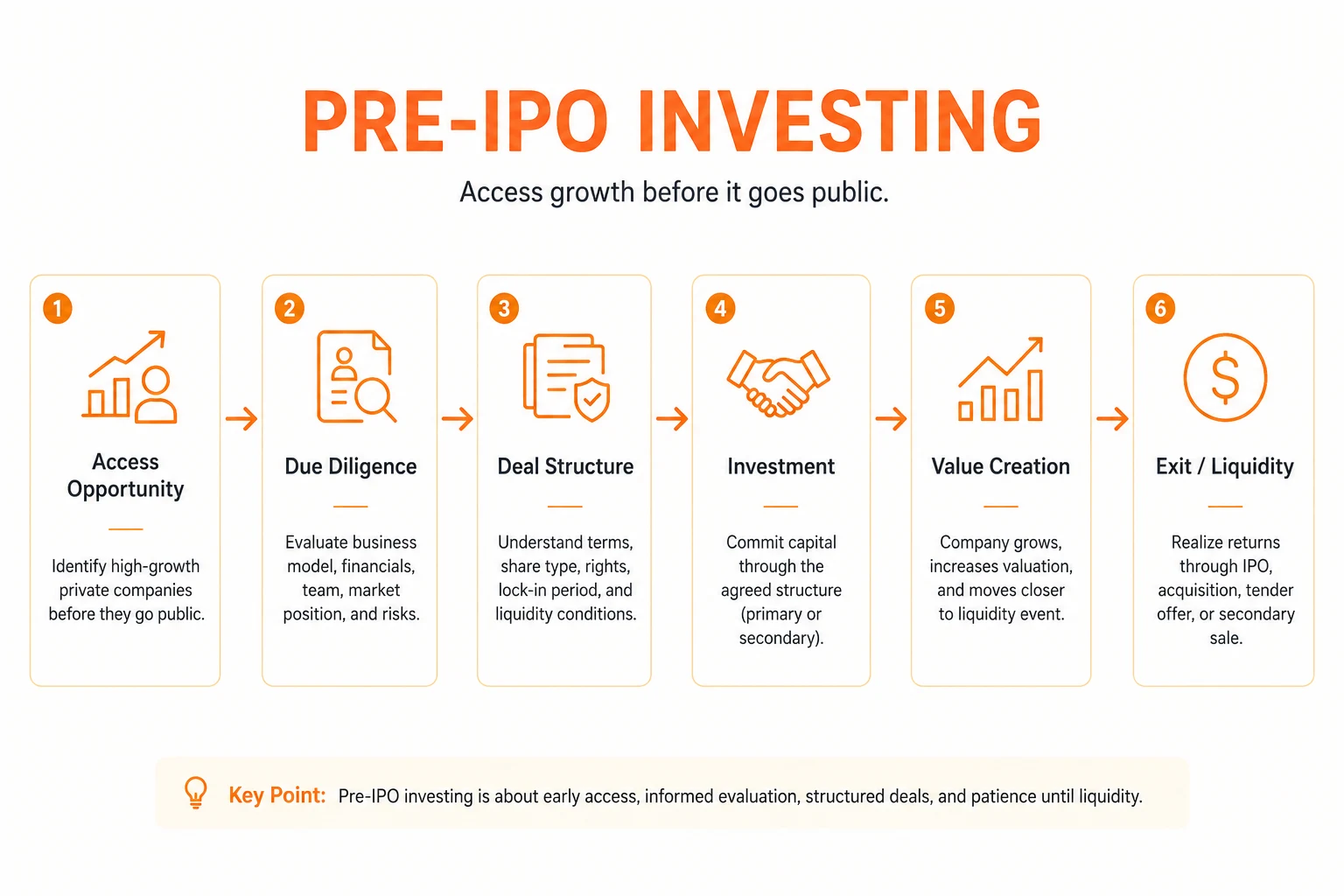
How Pre-IPO Investing Actually Works?
Pre-IPO investing usually occurs in two main ways: the company may issue new shares to raise capital, or existing shareholders may sell their shares to outside investors.
Step 1: Shares Become Available for Sale
A pre-IPO deal begins when shares are offered in the private market. In some cases, the company itself issues new shares to raise fresh capital. In other cases, existing shareholders, such as founders, employees, or venture capital funds, decide to sell part of their stake before the IPO.
Step 2: Investors Get Access to the Deal
Once shares are available, buyers enter through private-market channels rather than public stock exchanges. Access may come through brokers, private banks, SPVs, secondary marketplaces, or company-approved liquidity platforms.
Large institutional investors are the biggest buyers, but qualified investors may also participate through shared investment structures.
Step 3: The Deal Is Structured as Primary or Secondary
If the company issues new shares, it is a primary transaction, and the proceeds go directly to the business. If an existing shareholder sells their own shares, it is a secondary transaction, and the seller receives the proceeds.
Step 4: Pricing and Transfer Terms Are Agreed
Unlike public stocks, pre-IPO shares do not have one live market price. Buyers and sellers must agree on valuation, share type, transfer restrictions, and other terms before the transaction closes. In many cases, the company must also approve the sale.
Step 5: Investors Hold the Shares Until a Future Exit
After the deal closes, investors usually hold the shares until a future liquidity event such as an IPO, acquisition, tender offer, or another secondary sale.
Pre-IPO Investing vs IPO Investing
Pre-IPO investing and IPO investing both involve buying company shares, but investors enter at different stages. In pre-IPO investing, investors buy shares before the company enters the stock market. Investors usually get limited information, and they may hold shares for years before selling. However, they may also enter before major company growth happens.
IPO investing starts after a company lists on a public stock exchange. Public companies share more information, and investors can buy or sell shares more easily. IPO investing usually carries lower risk, but some early growth may already be reflected in the stock price.
Factor | Pre-IPO | IPO |
Liquidity | Low (7–13+ years typical hold) | High (list anytime) |
Transparency | Limited (less public information) | High (SEC filings & quarterly reports) |
Access | Restricted (qualified only) | Public (brokerage account) |
Risk | Higher (illiquidity + limited information) | Lower (but volatile) |
Potential Upside | Higher (earlier growth access) | Lower (slower growth after listing) |
Why Valuation Is Harder in Pre-IPO Markets
Valuing a private company is harder than valuing a public stock because private markets are less transparent and less active.
- No live marketplace: Private companies do not trade on public exchanges like NASDAQ or NYSE. Investors cannot see a constantly updated market price.
- Fewer transactions: Private shares trade far less often. Some companies only see transactions during funding rounds or occasional secondary sales. Less trading means less pricing data.
- Limited public information: Public companies must publish earnings reports, filings, and quarterly updates. Private companies disclose far less information, and access often depends on the investor.
- Different share structures: Not all investors receive the same type of shares. Some get preferred shares with extra protections or voting rights, while others receive common shares with fewer benefits.
- Misleading headline valuations: A company may announce a $50 billion valuation, but different investors may still pay different effective prices depending on deal terms and share rights.
- Valuation relies on assumptions: Investors often estimate value using revenue growth, market demand, comparable companies, funding rounds, and future expectations instead of real-time market pricing.
In public markets, price discovery happens every second through constant listing activity. In private markets, valuation is built from signals, negotiations, deal terms, assumptions, and real transactions. That is why pre-IPO investing requires deeper analysis.
Pre-IPO Valuation Models Explained
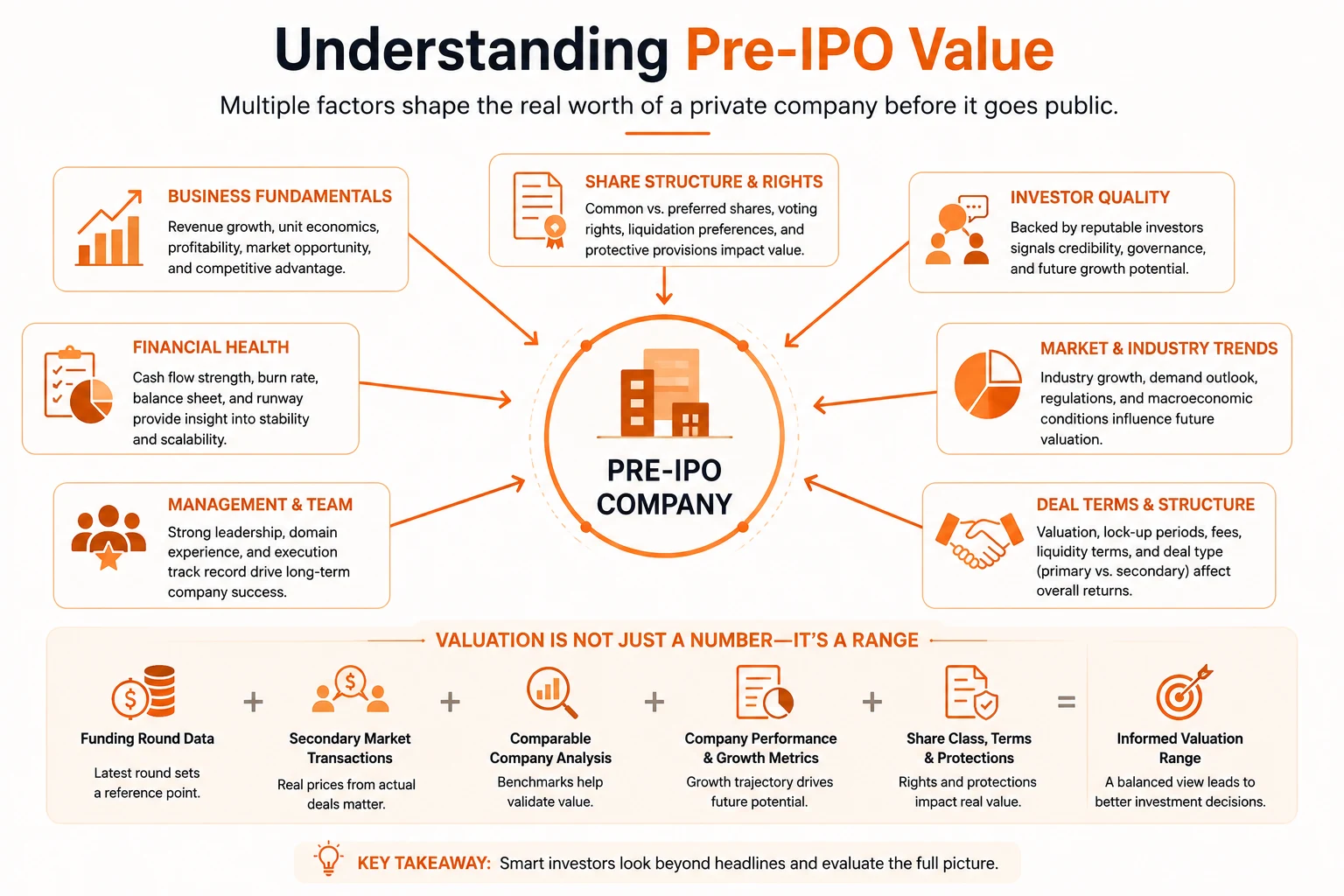
Pre-IPO valuation is usually not one single number. It is a working estimate built from multiple methods, and investors often compare several models before deciding what a company may be worth.
Last Funding Round Valuation
The last funding round valuation is the price at which investors agreed to invest in the company’s latest fundraising round. In private markets, investors often use this as the main reference point for pricing because it reflects a real investment deal.
Companies use pre-money and post-money valuation terms in these rounds. Pre-money valuation shows the company’s value before new investment enters the business. Post-money valuation includes the new capital raised after the deal closes.
This method helps investors understand how the market recently valued the company. However, it still has limits. The round may be old, market conditions may change, and investors may receive preferred shares that common shareholders do not get.
- Comparable Company Valuation
Comparable company valuation is a method in which investors estimate a company's value by comparing it with similar businesses in the same industry. They use metrics like revenue multiples, user growth, profit margins, and simple industry standards to guide pricing.
Valuation differs across sectors. Investors usually assign higher multiples to SaaS and AI companies due to expected growth. They apply different standards for fintech, biotech, and consumer companies based on revenue models, risk, and margins.
Investors rely on both public comparables (companies already publicly listed) and private comparables (companies still private). Public comps are easy to access because financial data is available.
However, they may not match early-stage startups. Private comps can offer closer comparisons, but investors access them less often due to limited private transaction data.
Discounted Cash Flow (DCF) in Pre-IPO Analysis
Discounted Cash Flow (DCF) is a method investors use to estimate a company’s value based on the cash flows it may generate in the future. They project future cash flows and convert them into today’s value.
Investors use DCF more for later-stage companies because these businesses show stable revenue and clearer financial data. It works less well for early-stage startups because their growth and earnings can change quickly.
The model uses a few key inputs. Investors estimate revenue growth, profit margins, and future cash flow. They also apply a discount rate to adjust for risk and time. At the end, they add a terminal value to estimate long-term worth.
DCF can look very precise, but it depends more on assumptions. Small changes in inputs can change the final valuation.
Venture Capital Method
The venture capital method is a valuation approach in which investors estimate what a company could be worth at exit. They look at a future IPO or sale of the company. Then they work backward to find the company’s current value.
Investors also include their required return. They set a target return because early-stage investments carry high risk. This target return reduces the present valuation.
Investors use this method often in venture investing because it fits startups with strong growth potential but limited current profits. It focuses more on future outcomes than present earnings.
This method works best for high-growth companies, especially in technology and AI. However, it can create wide valuation ranges because small changes in exit value, timing, or growth assumptions can change the result a lot.
409A Valuation
409A valuation is an independent valuation used by US private companies to set the value of common shares. Companies mainly use it for employee stock options.
It helps set the fair market value for shares for tax and compliance purposes. This value decides the price at which employees can buy their stock options. 409A valuation is not the same as the headline investor valuation from funding rounds. Investors value companies using preferred shares, which have extra rights and protections.
A key difference is that preferred share valuation and 409A valuation can be very different. 409A is often lower because common shares have fewer rights, lower protection, and less liquidity than preferred shares.
Secondary-Market Transaction Pricing
Secondary-market transaction pricing is the price at which buyers and sellers trade existing private shares. It shows what people are willing to pay in real deals.
Investors track different types of deals. These include private share deals, platform transactions, employee share sales, and investor-to-investor sales. This data matters because it reflects real demand and real prices, not estimates. It gives one of the clearest signals for private-market value.
However, it has limits. One deal does not set the full company value. Price can change based on deal size, seller urgency, share class, and transfer rules. Investors always look at multiple deals, not just one.
Hybrid Valuation Approach
The hybrid valuation approach is how investors value pre-IPO companies. They do not rely on one method. They combine different signals to build a clear image.
They look at the latest funding round, secondary-market transactions, and comparable company multiples. They also check 409A valuation when it is available. Along with this, they review company growth, profit margins, and overall momentum.
Investors also study the cap table and share-class rights. This helps them understand who owns the company and how different shares are valued.
The goal is not to find one exact number. The goal is to build a valuation range using real data from different sources. This gives a more balanced view of what the company may be worth.
Recent Pre-IPO Companies Investors Followed
Recent activity around companies like Databricks, OpenAI, Anthropic, and SpaceX bring more attention to pre-IPO investing. Databricks reached private valuations above $134 billion in 2026, while OpenAI reached nearly $852 billion after major funding rounds.
Anthropic also grew rapidly and approached a $965 billion valuation in 2026. SpaceX went public in June 2026 at a nearly $1.77 trillion valuation, and its market value later crossed $2 trillion after listing began.
Investors followed these companies by studying funding rounds, private share sales, AI demand, revenue growth, and market expansion. Secondary share sales also helped investors measure market interest and possible IPO demand before public trading started.
These companies showed how much valuation growth can happen while businesses still remain private.
The Main Types of Pre-IPO Shares and Why They Matter
Pre-IPO shares do not work the same way. Different share types come with different rights, risks, and value. This matters because two investors may both own pre-IPO shares but still hold very different positions.
- Common shares are a type of pre-IPO shares that founders and employees usually hold. These shares give basic ownership in the company but offer fewer protections.
If the company is sold, common shareholders usually receive payment after preferred shareholders. Common shares carry more risk, but they can also increase significantly in value if the company grows successfully.
- Preferred shares are a form of pre-IPO shares that institutional investors usually receive during funding rounds.
These shares often include extra protections like liquidation preferences, anti-dilution protection, conversion rights, and information rights. Because of these added benefits, preferred shares often carry more value than common shares.
- RSUs (Restricted Stock Units) are company shares given to employees after a certain time or when specific conditions are met. Options and employee equity are other forms of compensation companies use instead of giving direct shares upfront.
Stock options give employees the right to buy shares later at a fixed price. RSUs convert into shares after a vesting period. Tax rules, vesting schedules, and transfer restrictions can affect their real value.
Two investors may both own pre-IPO shares, but the rights and value behind those shares can still be very different.
Pre-IPO Deal Structures Explained
In private markets, deal structure can matter almost as much as valuation.
Direct Secondary Share Purchase
Direct secondary share purchase is a deal where an investor buys existing shares from a current shareholder. Employees and early investors often use these deals when they want to sell shares before an IPO.
Companies usually approve these transactions and apply transfer rules. This structure can give investors direct access to a known private company. However, paperwork, approvals, and restrictions can make the process slower and more complicated.
SPV Structure
SPV (Special Purpose Vehicle) structure is a setup where multiple investors combine money into one deal. The SPV buys the shares, while investors own part of the SPV instead of holding shares directly.
Private markets use SPVs often because they lower minimum investment sizes and make deals easier for smaller investors to join. However, SPVs may charge extra fees and give investors less direct control.
Tender Offers
Tender offers are programs where companies or investor groups buy shares from employees or existing shareholders at a fixed price. Large private companies often use these programs before going public.
This structure gives employees and early investors a way to sell shares without waiting for an IPO. At the same time, the company keeps more control over the process and who can buy shares.
Forward Contracts and Structured Access
Forward contracts and structured access are deals where investors gain exposure through legal agreements instead of direct share ownership. The structure can vary from deal to deal.
Some agreements give investors the right to receive shares later. Others only track the value of the shares. Investors need to understand what they legally own, when ownership starts, and what rights the agreement includes.
Fund or Platform-Based Exposure
Fund or platform-based exposure is a structure where investors access pre-IPO markets through private funds, feeder funds, venture funds, or digital platforms. These groups combine investor money into larger private-market deals.
This approach helps smaller investors enter private markets without finding direct deals themselves. However, investors usually pay management or platform fees for access.
Company-Led Liquidity Programs
Company-led liquidity programs are structured internal sales where employees and shareholders can sell shares before an IPO. Late-stage private companies often organize these programs.
These programs help employees gain liquidity earlier while companies keep control over pricing, buyers, and share transfers. This helps companies manage secondary-market (helps companies manage private share sales before going public) activity more carefully.
Deal Terms That Can Change the Real Economics
Deal Term | Description | Prevalence (2025–2026) | Impact on Pre-IPO / Secondary Investors |
Liquidation Preferences | Priority payout before common shareholders | 1x non-participating in 98% of deals (Cooley Q2 2025) | Senior preferences reduce common payout in moderate exits |
Participation Rights | Preferred to take preference + share in the remaining money | Non-participating in 93–95%; participating 5–8% | Strongly favors preferred holders and reduces returns for common shareholders |
Anti-Dilution Protection | Adjustment in down rounds | Broad-based weighted average 80–85%; full ratchet (strong anti-dilution protection) <5% | Protects early investors; increases dilution for others |
Lockups & ROFR | Restrictions on selling shares | Common in nearly all secondary transfers | Delays or blocks liquidity; creates a high risk that the deal may not complete |
Fees & Platform Costs | SPV, management, broker, carry fees | 1–5% transaction + 2% annual typical | Directly reduces net returns |
Deal terms can change investor outcomes as much as valuation itself.
Why the Same Company Can Trade at Different Pre-IPO Prices
Private companies often trade at different prices at the same time. Unlike public markets, private markets usually do not have one single live market price.
Different factors can change pricing:
- Common vs preferred shares: Preferred shares often include extra protections and rights.
- Old funding rounds vs new transactions: Market conditions may change after a funding round.
- Small deals vs large deals: Bigger transactions may negotiate different pricing.
- Seller urgency: Sellers need fast liquidity and may accept lower prices.
- Company approval rules: Transfer restrictions can affect demand and pricing.
- Lockups and transfer limits: Some shares cannot move freely.
- Sector sentiment: AI, fintech, or biotech valuations can change quickly.
- Information differences: Some buyers may have more company data than others.
Because of this, private markets often don’t have one fixed or official valuation.
Empirical Market Data in Pre-IPO Investing
Pre-IPO investing works better when investors combine valuation models with real market data. Companies like SpaceX, OpenAI, and Anthropic attracted more investors to private markets before public listings.
Funding Round Data
Funding round data helps investors understand how the market recently valued a company. Investors look at the amount raised, company valuation, lead investors, and timing of the deal.
They also check whether the company raised money at a higher, similar, or lower valuation than the previous round. Strong investors and rising valuations can signal growing market confidence.
Secondary Transaction Data
Secondary transaction data shows what buyers recently paid for private shares. Investors track recent prices, whether shares traded above or below the last funding round price, deal size, buyer demand, and how often transactions happen.
More transactions usually provide stronger pricing signals.
409A and Internal Valuation Signals
409A valuation gives investors another way to understand common-share pricing. Companies mainly use it for employee stock options and tax purposes. Investors review this data because it can show how companies internally value employee shares.
However, investors do not rely on it alone because investor shares often include extra rights and protections.
Cap Table and Share-Class Data
Cap table and share-class data help investors understand company ownership. Investors study who owns the company, how much ownership may be reduced in future funding rounds, and where their shares stand in payout order.
They also check whether a small group controls most of the company.
SEC and Regulatory Filings
SEC and regulatory filings can reveal useful company information. Investors may review fundraising filings, tender offer disclosures, secondary sale details, and IPO filings if the company plans to go public.
These documents can show fundraising activity, investor participation, and possible IPO plans.
Operating Metrics Behind the Valuation
Valuation becomes more meaningful when investors compare it with the company’s performance. Investors often track revenue growth, profit levels, spending rate, available cash, customer growth, customer retention, and market position.
In AI and SaaS companies, investors may also study regular revenue, product usage, and business adoption growth.
Secondary transactions grew 48% in 2025, reaching $240 billion, showing strong demand from LPs for liquidity and real pricing signals beyond paper valuations. This trend highlights the need to use real data from funding rounds, secondary deals, and company performance when making pre-IPO investment decisions.
Private-Market Growth and Secondary Activity
Companies stayed private longer between 2023 and 2025, which pushed private markets and share sales to grow quickly.
Metric | 2023 | 2024 | 2025 |
Global Secondary Volume | $102–116B | $152-162B | $240B |
US VC Secondaries | Lower ($40–60B est.) | Record growth | $106.3B (midpoint) |
Unicorn Count (Global) | 1,200–1,300 | 1,300–1,450 | 1,290–1,600 (active) |
Median Time to IPO/Exit | 7-9 years | 10+ years | Prolonged (10–13+ years) |
Private AUM | $13.7T | $14–15T | $14.9T |
How Institutional Investors Build a Pre-IPO View
Institutional investors usually do not rely on one valuation number. They build a broader view using market data, share structure, and company fundamentals.
Step 1: Start With the Last Clean Price
Investors usually begin with the latest funding round or the most recent transaction. This gives them a starting point for current pricing. They also check how recent the deal was because market conditions can change quickly.
Step 2: Adjust for Share Class and Terms
Investors then review the type of shares involved in the deal. Preferred shares often include extra protections and stronger rights, while common shares usually offer fewer protections. These differences can change the real value of the investment.
Step 3: Cross-Check With Comparable Companies
Investors compare the company with similar businesses in the same sector. They look at growth, margins, market position, and valuation levels across competitors.
Step 4: Use Secondary Data for a Reality Check
Investors also review recent secondary transactions to see what buyers are actually paying in the market. Real transactions often give a clearer pricing signal than older funding rounds.
Step 5: Build a Valuation Range, Not One Number
Instead of using one exact number, investors usually build a base case, upside case, and downside case. This helps them prepare for different outcomes.
Step 6: Review the Deal Structure
Before investing, they also review fees, lockup periods, legal rights, share restrictions, and exit options.
How Pre-IPO Investors Eventually Exit
In most cases, investors wait for a major event that creates liquidity. These exit opportunities help investors turn private shares into cash, although the timeline can take several years.
Exit Type | IPO | Key Stats (2025-2026) |
IPO | Shares become publicly tradable (often with lockups) | 48 VC-backed IPOs in 2025; top ones (e.g., SpaceX at $1.77T) drive strong market activity |
Acquisition | Another company buys the business | Most common exit route; accounted for the majority of VC exits in 2025 |
Tender Offer | Company or investors buy existing shares | Common for liquidity; SpaceX, Stripe used tenders at $100B+ valuations |
Secondary Sale | Investors sell shares privately before IPO | Record $240B globally / $106B US in 2025; now comparable to IPO + M&A liquidity |
Liquidation | Company goes down | High risk: many early-stage investments result in total or near-total loss |
What Investors Should Check Before Joining a Pre-IPO Deal
Before joining a pre-IPO deal, investors should understand exactly what they are buying and what risks come with it.
- What type of shares am I buying?
- Is this a primary deal or a secondary transaction?
- What valuation is being used, and how recent is it?
- Are recent market transactions supporting this price?
- What rights and protections come with these shares?
- Are there lockups or transfer restrictions?
- Am I buying shares directly or through an SPV?
- What fees could reduce my return?
- How and when could liquidity happen?
- What happens if the company delays its IPO for several years?
Final Outlook
Pre-IPO investing is not simply about buying shares before an IPO. The real challenge is understanding how private markets price companies, structure deals, and manage risk before public listing begins.
The strongest pre-IPO analysis usually combines three key layers: valuation models, deal structure, and real market data. Share rights, liquidity terms, transfer restrictions, investor protections, and real transaction activity can all change the true value of a deal.
The smartest investors rarely rely on one valuation number alone. They compare multiple signals, study real market activity, and carefully review the structure behind the deal before making investment decisions.
Disclaimer: This article is for informational purposes only. It is not financial advice. Always conduct your own research and consult a licensed financial advisor before investing.