
Private markets are attracting record levels of capital, yet they remain far less transparent than public markets. Investors are putting billions into private companies, secondary markets, and private equity, often with limited access to information. That difference has become more important as authorities increase their focus on private-market disclosures.
In June 2026, the U.S. Securities and Exchange Commission (SEC) expanded its scrutiny of private equity continuation funds, particularly their valuation methods and investor disclosures.
The move reflects a broader concern across private markets: not every investor has access to the same information. Understanding what companies disclose, what stays private, and how investors bridge that gap is essential for making better investment decisions.
What Is Information Asymmetry in Private Markets?
Information asymmetry is a situation where one party has access to more information than another. In private markets, company insiders usually know much more about the business than outside investors.
Founders and management have access to financial performance, customer data, future business plans, and operational risks. Potential investors often receive only a portion of that information, and usually only after entering a fundraising process or signing a confidentiality agreement.
This information gap directly affects investment decisions. Investors have less certainty when estimating a company's value, growth potential, or financial health. As a result, private-market investing often requires more research and deeper due diligence than investing in public companies.
The information itself may exist, but access to it is limited. That is the key difference between information asymmetry and a lack of information.
Why Private Companies Are Not Required to Disclose Everything
Private companies generally face fewer reporting requirements because they do not raise capital from the public through a stock exchange. Their shares are usually owned by founders, employees, venture capital firms, private equity funds, or a limited group of accredited investors.
This gives companies greater flexibility over what information they share and when they share it. Many businesses also choose to keep financial performance, pricing strategies, customer relationships, and product development confidential to protect their competitive position.
That does not mean private companies operate without records. Most maintain detailed financial statements, accounting records, capitalization tables, board minutes, and tax filings. The difference is that these documents are typically shared only with those who have a valid business or legal need.
Public Companies | Private Companies |
Regular public reporting | Limited public reporting |
Quarterly and annual filings | Internal financial reporting |
Equal access for investors | Selective access |
Continuous market disclosures | Information shared when required |
Regulated public transparency | Confidential by default |
Who Gets Access to Private Company Information?
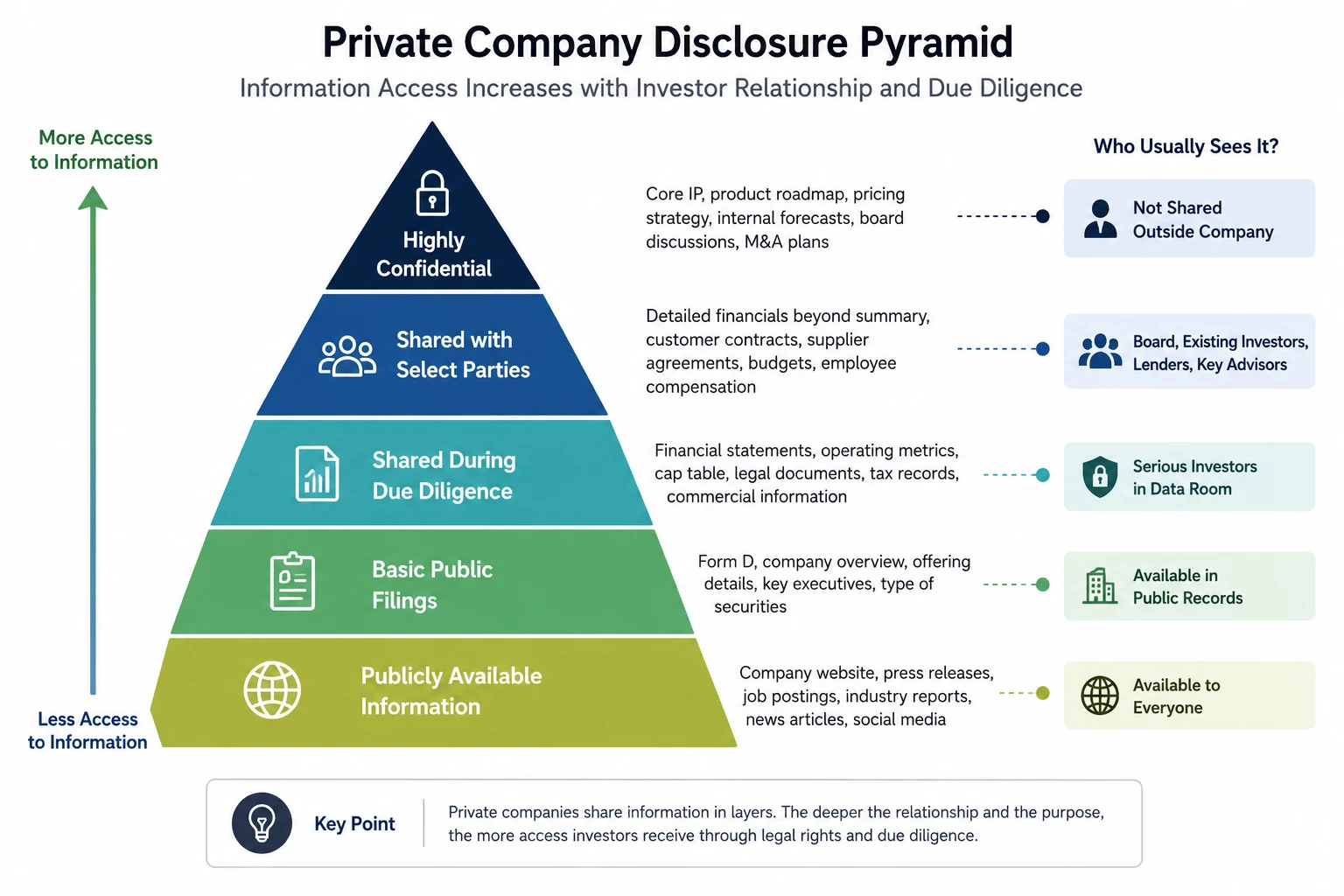
Not every investor sees the same level of information. Access usually depends on the investor's relationship with the company and the stage of the transaction.
Existing shareholders often receive regular financial updates through shareholder agreements. Venture capital and private equity firms typically review detailed financial and operational data before investing. Lenders may also request financial statements and cash flow information when evaluating credit risk.
Prospective investors usually receive limited information at first. As discussions progress, companies may grant access to additional documents through a secure data room after a non-disclosure agreement (NDA) is signed.
This approach protects sensitive information while giving investors enough data to assess the opportunity. Different levels of access can lead to different conclusions.
What Financial Information Do Private Companies Actually Disclose?
Private companies rarely publish financial information, but they maintain detailed records for tax reporting, fundraising, and investors. The information shared depends on the company's size, stage, and purpose. During fundraising or due diligence, investors review financial statements, operating metrics, ownership records, and funding history to evaluate the business.
Financial Statements
Financial statements provide the clearest picture of a company's financial position. Investors typically review the income statement, balance sheet, and cash flow statement to evaluate profitability, assets, liabilities, and cash generation. Early-stage companies may provide management-prepared reports, while larger businesses often share audited financial statements for greater credibility.
Operating Metrics
Operating metrics show how the business is performing beyond its financial statements. Common examples include ARR, MRR, revenue growth, gross margin, customer acquisition cost (CAC), customer churn, active users, and burn rate. According to Carta's State of Private Markets, investors increasingly prioritize recurring revenue growth and capital efficiency alongside financial statements.
Capitalization Table (Cap Table)
A capitalization table, or cap table, shows who owns the company and how ownership is divided among founders, employees, and investors. It also tracks changes after each funding round, helping investors understand dilution, voting rights, and liquidation preferences.
Funding History
Funding history explains how the company has raised capital over time. Investors review previous funding rounds, valuation changes, capital raised, lead investors, and financing dates to understand the company's growth and whether its valuation has developed at a sustainable pace.
What Information Is Usually Not Available to Outside Investors?
Even during fundraising, investors rarely receive complete access to a company's internal information. Most private businesses disclose only what is necessary to support an investment decision while protecting commercially sensitive information.
Some of the most commonly restricted information includes:
- Product development roadmaps
- Customer contracts
- Supplier agreements
- Board meeting discussions
- Employee compensation
- Internal budgets and forecasts
- Pricing strategies
- Proprietary technology or source code
Companies also limit access to information that could weaken their competitive advantage if it became public. For example, a software company may share revenue growth and customer retention figures but keep product development plans confidential.
The level of disclosure usually increases as investors move through the due diligence process. However, even institutional investors may never receive unrestricted access to every internal document.
When Private Companies Must Legally Share Information
Private companies have fewer reporting obligations than public companies, but they are still required to disclose information in several situations.
During Fundraising
The most common example is raising capital. Before investing, potential investors need enough information to evaluate the business and its risks. Companies typically share financial statements, capitalization tables, business plans, and key operating metrics. The exact level of disclosure depends on the size of the investment, the company's stage, and the agreement between both parties.
During Due Diligence
As an investment moves forward, companies usually provide additional information through a virtual data room (VDR). Access is granted only after investors sign a non-disclosure agreement (NDA), which protects confidential business information.
A typical data room contains financial, legal, tax, and operational records used to verify the company's claims. Rather than making these documents public, companies share them only with qualified investors involved in the transaction.
Existing Shareholders and Corporate Transactions
Disclosure also becomes necessary after an investment has been made. Existing shareholders may receive annual financial statements or periodic business updates if their shareholder agreements include information rights.
Companies also share key financial, legal, and operational records during corporate transactions to complete a thorough review before closing the transaction.
SEC Rules That Affect Private Company Disclosure
Private companies are not exempt from securities laws. Instead, many raise capital under Regulation D, which allows eligible businesses to sell securities without full public registration. While this reduces ongoing public reporting requirements, companies are still expected to provide investors with enough information to evaluate the investment.
Regulation D
Regulation D is the most widely used exemption for private fundraising in the United States. It allows companies to raise capital from eligible investors with fewer disclosure requirements than public companies. The exact level of information shared depends on the type of offering, the investors involved, and the agreements between both parties.
Rule 506(b) vs. Rule 506(c)
Regulation D includes two commonly used exemptions.
Rule 506(b) | Rule 506(c) |
No public advertising | Public advertising allowed |
Primarily accredited investors, with limited participation from sophisticated non-accredited investors | Only verified accredited investors may invest |
Investor relationships often established before the offering | Companies can broadly market the offering |
Both exemptions allow unlimited fundraising but have different marketing and investor rules.
What Does Form D Tell Investors?
After completing many Regulation D offerings, companies file Form D with the SEC. This filing provides basic information about the fundraising rather than the company's financial performance.
Investors can see the company's name, the amount being raised, the amount already sold, the type of securities offered, and the names of key executives or promoters. However, Form D does not include financial statements, customer metrics, profitability, or future business forecasts.
For that reason, investors should view Form D as a record of a private offering rather than a complete source of investment information.
Where Institutional Investors Find Information Beyond Public Records
Professional investors rarely rely on one document when evaluating a private company. Instead, they combine multiple sources to build a more complete picture of the business.
Some of the most common sources include:
- Company data rooms
- Management presentations
- Customer and supplier interviews
- Industry experts
- Independent market research
- Commercial databases such as PitchBook, CB Insights, and Crunchbase
These sources help investors verify information instead of relying solely on company presentations.
The demand for better private-market data continues to grow as more companies stay private for longer. According to PitchBook, private capital fundraising remained above $1 trillion globally in 2025, increasing the need for reliable company information.
How Investors Reduce Information Asymmetry
Information asymmetry cannot be eliminated. Investors use due diligence (careful checking) to lower risks before investing. Here’s a short, easy table of key facts:
What It Shows | Simple Statistic | Why It Matters |
Startup Failures | 90% of startups fail | Due diligence helps avoid most bad investments |
Time Spent Checking (Angel Investors) | More than 20 hours of checking → 5.9x return Less than 20 hours → 1.1x return | Spending more time checking leads to much better profits |
Even More Checking | Over 40 hours of checking → 7.1x return | The most careful investors do the best |
Growth from Due Diligence | Companies that go through checking grow ~30% more in 2 years | Even if not funded, the process helps businesses improve |
Deal Success Rate | Only about 0.6% of applications get funded after full checking | Investors are very picky to reduce risk |
M&A Failures | 70-90% of company acquisitions fail | Often because of weak checking beforehand |
Key Takeaways
Information asymmetry is a core reality of private markets. Unlike public companies, private businesses are not required to openly share detailed financial and operational data. Instead, access depends on investor rights, fundraising activity, and due diligence.
But that doesn’t mean information is missing; it’s just shared selectively. Financial statements, operating metrics, capitalization tables, funding history, and legal records all exist, but only reach certain investors.
As private markets grow, investors must understand how information is created, shared, and verified. This matters as much as valuation itself. Investors who navigate these data sources make more confident, informed decisions and manage risk more effectively.
Sources
- U.S. Securities and Exchange Commission (SEC) – Regulation D and Exempt Offerings
https://www.sec.gov/resources-small-businesses/exempt-offerings - Reuters (June 2026) – SEC scrutiny of private equity continuation funds
https://www.reuters.com/legal/government/us-sec-probes-popular-type-private-equity-fund-it-steps-up-industry-scrutiny-2026-06-24/ - PitchBook – Global Private Market Fundraising Report 2025
https://pitchbook.com/news/reports