
A June 2026 study reviewed 23,818 public audit findings from 22 security firms and 218 blockchain exploits linked to about $7.76 billion in losses. Nearly half of those losses came from private-key compromise, phishing, and social engineering, showing that visible technical evidence can still miss the controls that determine whether a claim deserves trust.
That problem becomes critical when a platform presents an on-chain investment track record. A transaction hash may confirm that data existed, yet it does not reveal whether the original call was specific, authorized, made before public disclosure, or reported alongside unsuccessful predictions. Recent blockchain-auditing research therefore separates existence, ownership, valuation, and internal controls rather than treating ledger visibility as complete assurance.
This guide explains how to reconstruct commitments, compare block timestamps with public announcements, reproduce payload hashes, verify signers and contract upgrades, and determine whether the published record includes every mature call.
What a Verifiable On-Chain Platform Track Record Must Prove
A March 2026 research paper on blockchain auditing argues that cryptoasset assurance must distinguish four separate questions:
- existence,
- ownership,
- valuation,
- and internal controls.
Its analysis drew on more than 4,000 hours of protocol-audit experience, over 50 protocol assessments, 12 governance configurations, and work involving more than $100 million in assets under management. Although the paper is currently a preprint, its central conclusion is directly relevant: blockchain visibility does not remove the need to verify authority, controls, and economic meaning.
For a platform track record, that principle produces five tests.
- Existence requires a hash, IPFS content identifier, Merkle root, or structured commitment to appear in a finalized blockchain record.
- Timing requires the commitment to predate the earliest independently verifiable public disclosure.
- Integrity means the later-revealed prediction reproduces the exact committed value.
- Provenance links the submitting wallet or digital signature to an authorized platform identity.
- Completeness requires the audit population to include successful, failed, cancelled, expired, unrevealed, and unresolved calls.
A cryptographic timestamp proves prior existence. It does not prove that the prediction was precise, correct, executable, or profitable. RFC 3161 clarifies this boundary by treating timestamping as evidence that data existed before a given time, rather than as evidence that the content itself was true.
That distinction should also inform the broader methods and failure modes in model validation architectures for algorithmic deal screening.
Step 1: Reconstruct the Commitment and Contract State
The audit starts with an evidence register, not a blockchain-explorer screenshot.
Request the network and chain ID, wallet addresses, smart contract address, deployment transaction, transaction hash for every claimed call, block number, raw input data, event signature, emitted logs, revealed payload, hashing algorithm, model version, and original outcome rules.
For a Merkle commitment, obtain the leaf bytes, index, sibling hashes, ordering convention, tree size, padding rule, and proof path. A valid inclusion proof establishes that one item belonged to a committed tree. It does not establish that every leaf has been disclosed.
On Ethereum, reconstruct the historical record through node queries such as:
eth_getTransactionByHash
eth_getTransactionReceipt
eth_getBlockByNumber
eth_getLogs
eth_getCode
eth_getStorageAt
Record the sender, recipient, nonce, calldata, execution status, block number, block hash, log index, event topics, contract bytecode, and finality status. Ethereum’s interface distinguishes between latest, safe, finalized, and pending, so the audit report must identify which state was used.
The workflow below summarizes the full audit sequence used to verify whether a platform’s claimed track record is genuine, time-valid, and complete.
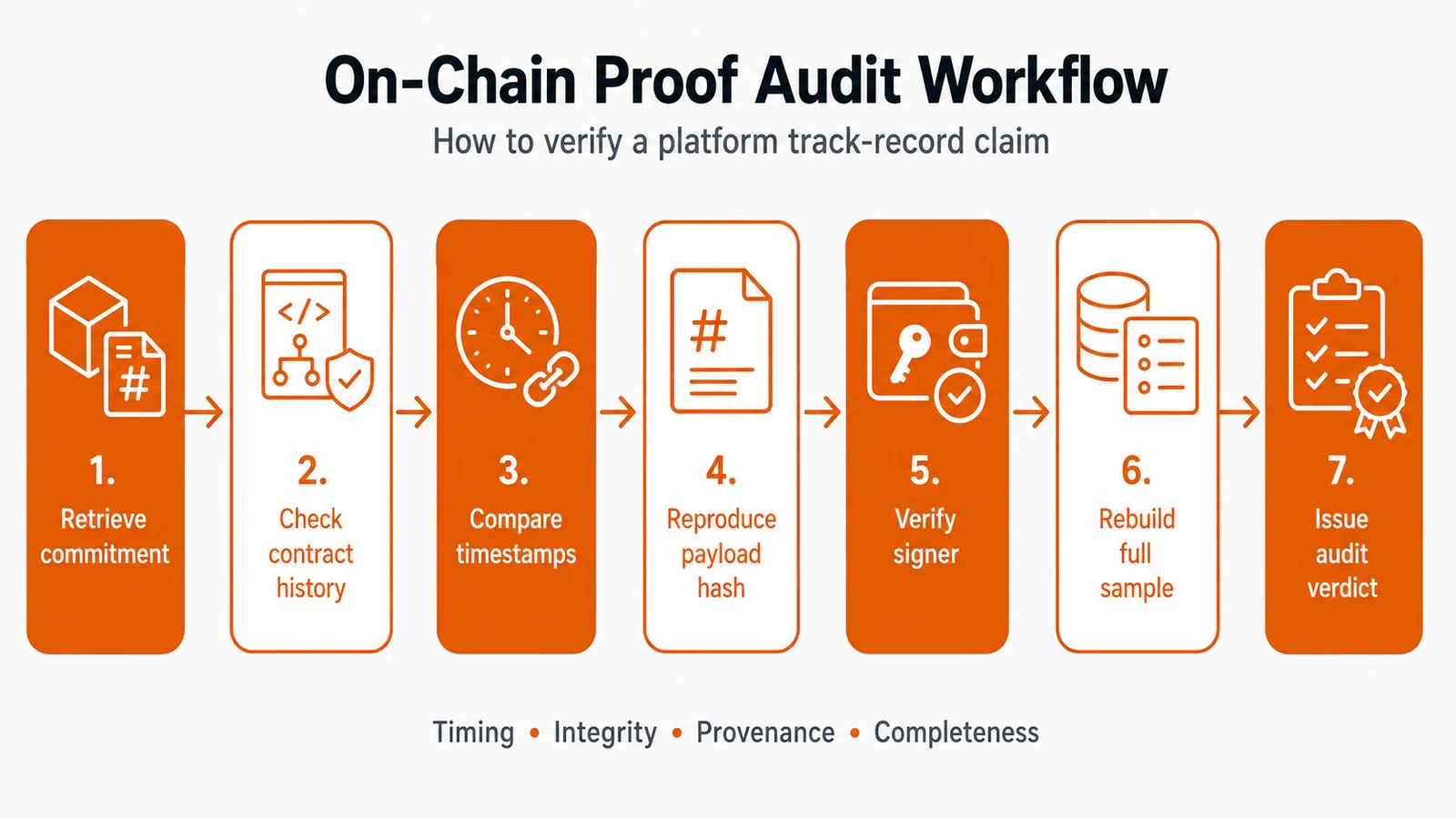
Figure 1. On-chain proof audit workflow for verifying a platform’s track-record statement, from commitment retrieval and contract-history review to signer verification, full-sample reconstruction, and final audit verdict.
Verify More Than the Event Name
A smart contract log is not automatically reliable evidence.
The 2025 Phantom Events study identified five categories of log forgery, including counterfeit events, inconsistent logging, contract imitation, transfer spoofing, and event-handling errors. The researchers also found examples across wallets, bridges, blockchain explorers, DeFi applications, NFT services, and gaming platforms.
Therefore, a log named PredictionCommitted must be tied to:
- The correct emitting contract
- The expected function and execution path
- An authorized caller
- Corresponding state changes
- The implementation is active at that block
- The platform’s documented commitment procedure
Contract dependencies also matter. A large 2025 Ethereum study examined more than 41 million contracts and 11 billion interactions. It found that 59% of transactions involved multiple contracts, with a median of four contracts per transaction in 2024. It also reported that only 11 deployers controlled 20.5 million, or half, of the live contracts in its dataset.
These findings mean an auditor should trace the complete call path rather than reviewing only the visible contract address.
Reconstruct Proxy Upgrades
A proxy address may remain unchanged while its implementation is replaced.
ERC-1967 defines standard implementation, beacon, and administrator slots and recommends an Upgraded event when the underlying logic changes.
An empirical study of 57,118 open-source proxy contracts found 583 that had been upgraded, involving 973 implementation versions. The researchers identified 4,334 ABI-breaking changes across 276 proxies, 36 upgrades involving storage collisions, and five proxies exposed to initialization risk.
For each claimed prediction, record:
- The implementation address in the commitment block
- upgrade transactions before and after the call
- administrator changes
- pause or invalidation functions
- storage-layout changes
- any method capable of replacing historical references
The same procedure supports verifying compliant asset tokenization stacks.
Step 2: Prove That the Commitment Predated Disclosure
The timing test compares two independently sourced records.
Tcommit is the timestamp of the finalized block containing the prediction commitment.
Tpublic is the earliest dependable public disclosure of the relevant financing, acquisition, listing, partnership, or market event.
The audit condition is:
Tcommit + δchain < Tpublic
The term δchain represents a pre-agreed allowance for finality and timestamp uncertainty. It must be defined before the result is known.
The decision flow below shows how an auditor converts finalized block data and public-disclosure evidence into a pass, qualified, fail, or unverifiable result.
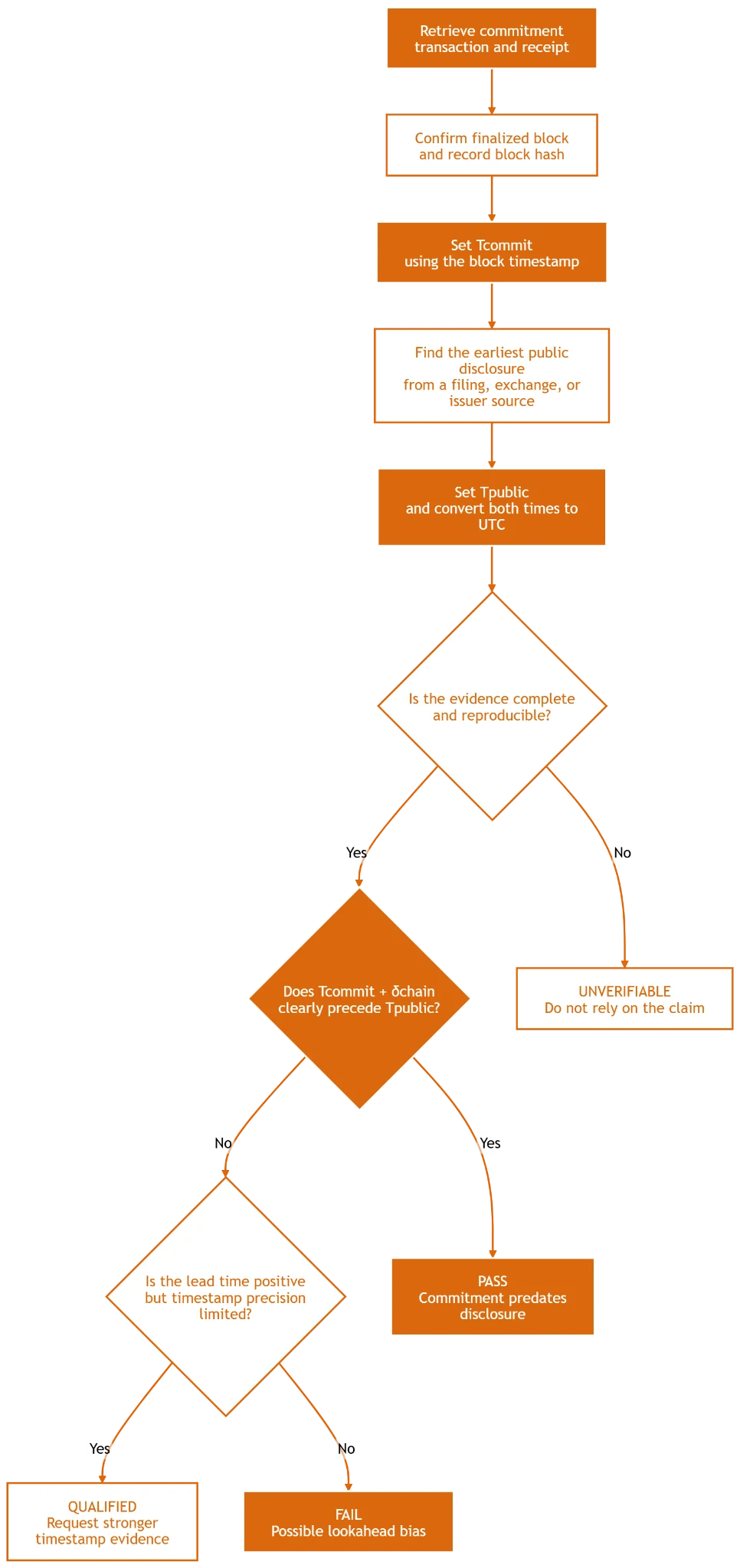
Figure 2. Timestamp-verification process for determining whether a platform’s on-chain commitment predates the earliest independently verifiable public disclosure.
A stored field such as createdAt is not acceptable evidence. A smart contract can store an arbitrary earlier date. The relevant evidence is the transaction receipt, inclusion block, block hash, and finality record.
Next, construct the public-disclosure timeline.
For a US issuer, retain the SEC accession number, filing type, filing header, acceptance information, and retrieval time. SEC records may be corrected or removed after acceptance, so the original filing evidence should be preserved rather than replaced with a later search result.
For a UK company, use the official Companies House filing history associated with the company number. Issuer releases, exchange notices, investor announcements, and archived webpages may supplement the record, but an editable page without dependable archival evidence should not override a formal filing.
Report one of four outcomes:
- Pass when the finalized commitment clearly came first
- Qualified when the lead is positive but one timestamp is imprecise
- Fail when the commitment followed public disclosure
- Unverifiable when either record cannot be reproduced
Also calculate the lead time:
Lead Time = Tpublic - Tcommit
A platform claiming “early identification” should disclose this value for every call rather than relying on an undated statement.
Step 3: Reproduce the Payload and Authenticate the Signer
A hash cannot be decrypted. The platform must reveal the original prediction and the exact method used to convert it into the committed value.
A canonical prediction record should contain stable fields such as:
platform_id
claim_id
asset_id
signal
entry_rule
prediction_horizon
target_event
model_version
created_at
salt
The platform must also disclose the character encoding, field order, whitespace rules, decimal precision, time zone, array ordering, null-value treatment, serialization format, and line endings.
The integrity condition is:
H (Ci) = hi
Ci is the reconstructed canonical payload.
hi is the commitment stored on-chain?
A one-byte difference should produce a different digest.
The hashing algorithm must be named precisely.
- SHA-256
- and Ethereum’s Keccak-256
Both are different functions.
IPFS commitments also need reproducible import settings. An IPFS CID may change with the chunking method, DAG layout, codec, CID version, or hashing algorithm, even where the visible source file is identical.
Prove Who Authorized the Call
Wallet control and platform authority are not the same thing.
Acceptable evidence may include a key published before the prediction, an approved signer registry, a governance resolution, a multisignature policy, or an EIP-712 typed-data signature. EIP-712 provides structured-data hashing and domain separation, but it does not provide replay protection by itself. Each prediction therefore needs a unique claim ID or nonce.
This is not a minor administrative issue. A June 2026 empirical preprint analyzed 23,818 public audit findings from 22 security firms alongside 218 exploit incidents representing approximately $7.76 billion in losses between January 2022 and March 2026. Private-key compromise, phishing, and social engineering accounted for about 49.6% of cumulative losses while appearing only marginally in published technical audit findings.
The same study found that the eight largest incidents represented 50.6% of total losses, while the twenty largest accounted for 71.4%. This concentration shows why a platform’s signing controls, key custody, recovery procedures, and authorization records deserve the same attention as its smart contract code.
Step 4: Rebuild the Complete Track Record
A platform may publish genuine winning commitments and still report a misleading success rate.
Scan every relevant contract event from deployment to the audit cutoff. Classify each commitment as:
- successful
- failed
- cancelled
- expired
- invalidated
- unrevealed
- unresolved
- duplicated
- replaced
Do not use wallet nonce gaps as proof that predictions were deleted. An externally owned account’s nonce counts every transaction from that address, including transfers, failed transactions, administrative actions, and unrelated contract interactions.
A stronger design uses increasing claim IDs, an append-only commitment registry, and one-to-one reconciliation between commitments and later reveals.
Consider an illustrative audit. A platform advertises six successful calls and reports a 100% win rate. A complete event scan identifies ten mature commitments. Six succeeded, two were never revealed, one expired, and one was cancelled.
Disclosure coverage is:
6 / 10 x 100 = 60%
The six hashes may all be authentic, but the advertised success rate remains unsupported because 40% of mature commitments are missing from the published result.
Audit outcome | Required finding | Decision |
Verified | Timing, integrity, signer authority, contract history, and sample completeness pass | Continue legal and commercial diligence |
Partially verified | The commitment is valid, but a non-critical record remains incomplete | Require remediation |
Suspended | Timing, signer authority, or upgrade history remains uncertain | Exclude the track record from the allocation analysis |
Rejected | The commitment followed disclosure, the hash failed, or losing calls were omitted | Reject the performance statement |
Unverifiable | The transaction, payload, or public record cannot be reproduced | Treat the claim as unsupported |
Cryptographic validity, predictive accuracy, economic return, liquidity, and legal enforceability must be reported separately.
Before relying on a platform’s track record, obtain its complete commitment export, historical implementation addresses, approved signer register, canonical payload specification, public-disclosure timeline, and outcome-classification policy.
A blockchain can prove that a commitment existed. Only a full audit can determine what the platform committed, when it did so, who authorized it, and whether its published track-record statement represents the complete historical record.
FAQs
Can an on-chan transaction be backdated?
A transaction cannot be inserted into an earlier finalized block. However, a contract can store an arbitrary earlier date. Use the receipt, inclusion block, block hash, and finality status.
Does a matching hash prove the prediction was correct?
No. It proves that the revealed payload matches the commitment. Prediction specificity, accuracy, execution, and profitability require separate tests.
Can a smart contract event be trusted by itself?
No. Verify the emitting address, execution path, access controls, state changes, contract implementation, and sender.
Are the 2026 studies peer reviewed?
The two 2026 sources cited above are current research preprints. They provide useful recent evidence and transparent methodology, but the final publication should label them as preprints and update their status if peer-reviewed versions become available.
Research note
This methodology combines current Ethereum, EIP, IPFS, and SEC documentation with recent research on lookahead bias, forged smart contract events, and upgrade-related security risks. The two 2025 smart contract studies cited above are preprints and should be identified as such in the final reference list.