
“Nova Labs is considering a $50 million Series C.”
The headline sounds positive. A basic financial news sentiment analysis model may classify it as evidence of successful fundraising and update the company’s funding profile. However, no transaction has closed. The company may only be speaking with investors, and the proposed amount may never be raised.
That error can distort company rankings, inflate funding momentum, and send analysts toward the wrong opportunity. Therefore, a reliable pipeline must answer four questions before producing a signal.
What happened, who was involved, when did it happen, and how certain is the evidence?
Why Positive Sentiment Does Not Confirm a Funding Round
Funding-news analysis involves more than classifying text as positive, negative, or neutral.
First, the system must identify the event. This may describe a seed round, Series A, debt facility, secondary sale, restructuring, down round, acquisition, or cancelled transaction.
Next, it must determine factual status. “Raised $20 million” describes an announced or completed event. By contrast, “plans to raise $20 million” expresses intent, while “may raise $20 million” remains speculative.
Finally, sentiment must be connected to the correct target. This can be positive about an investor while expressing concern about the company receiving the investment. Likewise, “the company denied reports of a down round” contains negative terminology, although the statement itself rejects the claim.
FinBERT showed why financial-domain training matters by outperforming previous methods across the Financial PhraseBank and FiQA sentiment datasets. However, those results demonstrate polarity classification, not proof that a private-market transaction occurred.
Consequently, sentiment should operate within a broader AI-driven deal-screening model architecture and validation process. A positive score alone is not investable evidence
How a Production Pipeline Converts News Into a Funding Signal
A production-grade financial news sentiment extraction pipeline begins before any text reaches BERT, RoBERTa, FinBERT, or an LLM.
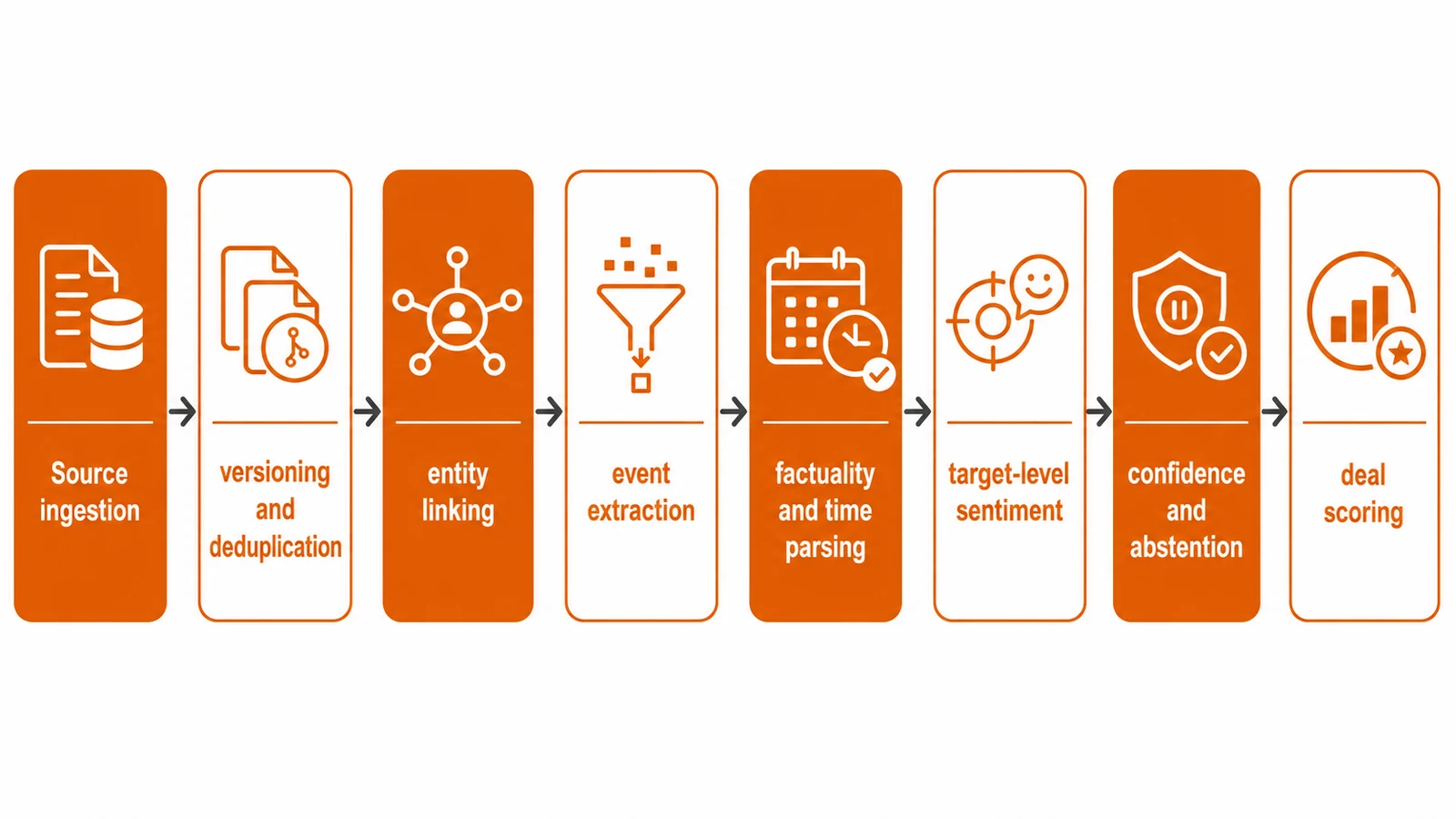 Figure 1. Funding-news NLP pipeline from source ingestion and entity linking to sentiment classification, confidence controls, and deal scoring.
Preserve the source
Funding stories may arrive through RSS feeds, licensed news APIs, company announcements, investor portfolio pages, regulatory filings, or archived websites.
The system should store the publisher, canonical URL, publication time, update time, retrieval time, language, source type, article hash, and original text version.
This record matters because stories change. A publisher may replace “closed” with “expects to close,” revise the amount, or clarify that a transaction involved debt rather than equity. Without source versioning, the original model decision cannot be reproduced.
Extract the parties and transaction
Named entity recognition can locate company names, investors, currencies, amounts, dates, and round labels. Nevertheless, entity detection is only the beginning.
The pipeline must also establish relationships. It needs to distinguish the investee from the lead investor, participating funds, lenders, founders, sellers, and acquiring companies.
A useful event record may contain:
Field | Extracted Value |
Company | Nova Labs |
Investor | Apex Ventures |
Round type | Series C |
Reported amount | $50 million |
Event status | Planned or rumored |
Event date | Not confirmed |
Sentiment target | Nova Labs |
Sentiment label | Positive |
Confidence | 0.71 |
Review required | Yes |
This output is safer than recording a single positive score because it preserves the claim, target, uncertainty, and supporting evidence.
Separate event status from sentiment
Event status should use explicit labels such as completed, announced, planned, rumored, conditional, denied, cancelled, disputed, or insufficient evidence.
Meanwhile, sentiment should attach to a specific company, transaction, investor, or asset. This approach is often described as entity-level or aspect-based sentiment analysis in finance.
The FinEntity dataset illustrates why that distinction matters. It contains 979 financial-news paragraphs and 2,131 annotated entities. Moreover, 60.16% of the paragraphs contain multiple entities, meaning one document-wide sentiment label could easily be assigned to the wrong organisation.
Match each model to a defined job
Model family | Best pipeline role | Main weakness in funding news |
Rules and financial dictionaries | Amounts, currencies, and explicit round phrases | Miss paraphrases and complex clauses |
BERT, RoBERTa and FinBERT | Sentence-level and target-level classification | Limited document context and domain-transfer risk |
Token classifiers with CRF layers | Financial named entity recognition | Cannot establish transaction relationships alone |
Generative LLMs | Schema extraction and multi-step interpretation | May return unsupported fields or inconsistent labels |
Hybrid systems | Combining rules, classifiers, and LLM review | Require more testing and orchestration |
FinEntity reported a micro-average F1 score of 0.84 for FinBERT-CRF on its benchmark, compared with 0.59 for zero-shot and 0.67 for few-shot GPT-3.5. These figures do not prove that one model is universally better. Instead, they show that a task-specific dataset and architecture can outperform generic prompting on a narrowly defined financial classification task.
More recent work has explored two-stage correction. The 2025 SILC-EFSA research first generated task-specific pseudo-labels and then trained a separate correction model using retrieved examples. This reflects an important production principle. The first model output does not have to be the final answer.
Where Funding News Models Fail Systematically
The most dangerous errors are often predictable.
Funding rumors are a common example. Phrases such as “exploring a raise,” “reportedly in talks,” “seeking up to $100 million,” and “expected to close” contain strong financing language without confirming that money changed hands.
The event-status classifier must run before the story enters a confirmed funding database.
Example of a False Positive
Consider the following funding statement:
Source: “Nova Labs is reportedly seeking up to $50 million.”
Incorrect extraction: Completed Series C worth $50 million.
Correct extraction: Planned or rumored financing of up to $50 million, with no confirmed completion.
The source describes a possible future transaction rather than a completed funding round. The phrase “up to” indicates a maximum proposed amount, while “reportedly seeking” shows that the event remains unverified. Without event-status classification, the model could incorrectly add $50 million to the company’s confirmed funding history.
Negation is harder because the cue and the claim may sit far apart. Consider the sentence:
“The company denied that it had failed to secure additional financing.”
A weak model may focus on “failed” and “financing” and return a negative label. A stronger system identifies the denied proposition, the scope of the negation, and the party making the statement.
Entity roles also break in complex syndicates. A paragraph may mention the startup, lead fund, co-investors, lender, founder, seller, and parent company. If the system recognises the organisations but fails to resolve their roles, it can assign the funding amount or sentiment to the wrong entity.
Temporal ambiguity creates another problem. The publication date is not necessarily the closing date. A round announced in March may have closed in January, while an article updated in April may introduce terms that were unavailable during the original screening date.
To prevent look-ahead errors, the pipeline should preserve the publication date, update date, reported closing date, announcement date, and expected future date as separate fields.
Repeated coverage can also turn one transaction into several signals. A company release may be copied by a syndication service, rewritten by news outlets, and repeated in investor newsletters. Deduplication should combine canonical URLs, text similarity, source tracing, and an event fingerprint built from the company, amount, round, and date.
Language drift creates a longer-term risk. Terms such as SAFE extension, token warrant, strategic treasury round, rescue financing, secondary tender, and structured equity may be rare in older training samples. As a result, historical model accuracy can decline even when the code remains unchanged.
Multilingual coverage adds another layer. The 2025 EFSA-CLC study tested cross-lingual financial sentiment methods across seven languages from three language families. Its findings support separate multilingual evaluation rather than assuming that an English classifier will transfer reliably to translated funding news.
How to Benchmark and Govern the Pipeline
A useful benchmark should test the complete funding record, not only whether a headline sounds positive.
Annotations should cover the company, investor, financing type, amount, currency, event status, dates, sentiment target, sentiment label, and supporting evidence span.
The EFSA benchmark moved financial sentiment analysis toward event-level outputs. Its dataset contains 12,160 financial-news articles and 13,725 structured records covering a company, industry, coarse event, fine event, and sentiment. Although the dataset is Chinese and not designed specifically for venture rounds, its structure demonstrates why event context matters.
Evaluation should also use chronological data splits to measure how model performance changes over time. Use older stories for training and a later period for model selection. Reserve the newest sufficiently labelled period for final testing.
Company-level holdouts prevent the model from memorising descriptions of frequently covered businesses. Publisher-level holdouts test whether they can handle unfamiliar writing styles. Duplicate families must also remain within one split so that syndicated versions of the same article do not appear in both training and testing.
Each stage requires a suitable metric. Entity extraction needs precision, recall, and F1. Investor-investee relationships need relation F1. Event status should report macro-F1 and recall for rare labels such as cancelled or denied.
Probability outputs also require calibration testing. A model that assigns 80% confidence should be correct approximately 80% of the time across a sufficiently large comparable sample. Meanwhile, production teams should track false-confirmed events, missed completed rounds, abstention rates, and precision within daily review capacity.
The 2025 FLaME framework evaluated 23 foundation models across 20 financial NLP tasks. Its broad design reinforces why no single sentiment benchmark can establish readiness for entity recognition, event extraction, temporal reasoning, and other downstream uses.
Before deployment, institutional teams should require point-in-time source records, disclosed training periods, model and prompt versioning, confidence calibration, an abstention rule, correction logs, human-review thresholds, and drift triggers.
How Human Review Should Work
High-confidence funding events supported by reliable and consistent sources may enter the database automatically. However, automation should be restricted to records that meet predefined thresholds for entity matching, event status, transaction details, and source credibility.
A record should be escalated for human review when event-status confidence is low, sources conflict, a report has been denied or disputed, multiple possible investees are mentioned, funding dates remain unclear, or amounts and currencies do not match.
Reviewers should compare the extracted record with its supporting evidence, confirm the investor and investee roles, verify whether the transaction was announced or completed, and record any correction. These decisions should feed back into evaluation datasets and future model updates.
Production Monitoring Checklist
After deployment, teams should continuously:
- Track funding rounds that were falsely classified as confirmed
- Review completed transactions that the system missed
- Monitor publisher-specific and source-specific error patterns
- Test confidence calibration on a regular schedule
- Audit duplicate-event clusters and syndicated coverage
- Retrain or update models when funding terminology changes
- Version prompts, models, datasets, extraction rules, and source records
These controls help teams identify performance decline before incorrect funding signals affect company rankings, research workflows, or investment screening decisions.
The interface should also distinguish verified facts from source-reported claims, model inferences, estimates, legal interpretations, and projections.
Funding-news NLP is most useful when it organises evidence and exposes uncertainty. It should never convert an incomplete report into false certainty.
FAQs
Is FinBERT enough for funding news sentiment analysis?
No. FinBERT provides a strong financial-language baseline, but not a production pipeline. Also needs entity linking, investor-investee relation extraction, event-status classification, temporal normalisation, deduplication, calibration, and human review.
How should funding rumors be classified?
Rumors should receive a separate event-status label. They should not enter a confirmed funding history unless a later, traceable source verifies that the round was formally announced or completed.
Which metrics matter most?
Track entity and relation F1, event-status macro-F1, target-level sentiment F1, probability calibration, false-event rate, abstention rate, and precision within the number of stories analysts can review.
Research methodology
This article uses published financial NLP research and original benchmark documentation. Reported performance figures apply only to the cited datasets and experimental settings. They should not be interpreted as expected production accuracy or investment performance.