
A startup may be valued at $20 billion in its latest funding round, yet its illiquid common shares could be worth far less. That difference surprises many investors because a headline valuation rarely reflects the fair value of shares that cannot be freely bought or sold.
Liquidity restrictions, shareholder rights, capital structure, and marketability all affect the actual value of those shares. As private companies stay private for longer, estimating the value of illiquid equity has become one of the biggest challenges in pre-IPO investing.
According to Nasdaq Private Market's 2025 report, secondary share-sale proceeds exceeded VC-backed IPO volume in 2024, highlighting the growing role of private transactions in valuing pre-IPO shares.
This guide explains how professionals model the value of illiquid equity using comparable company multiples, discount rates, DLOM, capital structure adjustments, and secondary-market pricing to estimate the pre-IPO valuation gap.
What Is Illiquid Equity in Pre-IPO Markets?
Illiquid equity is the shares in a private company that cannot be easily bought or sold because they are not listed on a public stock exchange. These shares are commonly held by founders, employees, early investors, and venture capital firms before the company goes public.
Unlike publicly listed stocks, illiquid equity has no daily market price. Its value must be estimated using valuation methods such as comparable companies, discount rates, and recent private-market transactions.
Pre-IPO shares are considered illiquid for many reasons. Private companies often restrict who can buy or sell shares, and many transactions require company approval before they can close. The buyer base is also much smaller than in public markets. In most cases, investors must wait for an IPO, tender offer, or secondary sale before they can exit their position.
Limited liquidity directly affects valuation. Public stocks can usually be sold within seconds during market hours, while private shares may take weeks or months to trade. Because selling is slower and less predictable, investors often apply liquidity discounts when valuing pre-IPO shares.
It is also important to separate enterprise value, equity value, and per-share value.
- Enterprise value reflects the total value of the business, including debt.
- Equity value represents the portion owned by shareholders after liabilities are considered.
- Per-share value depends on the company’s capital structure, including preferred shares, common shares, options, and dilution.
As a result, a company’s valuation does not always reflect the realistic value of common shares held by employees or secondary investors.
Why Pre-IPO Valuation Is Different From Public Stock Valuation
Public stocks work in active markets where prices update continuously throughout the day. Investors can track real-time prices, volume, and market sentiment on exchanges such as Nasdaq or the New York Stock Exchange (NYSE).
This continuous pricing process helps public markets respond quickly to new information. Pre-IPO shares work differently. Their valuation depends on periodic funding rounds, secondary transactions, and financial models rather than live market activity.
Private-market investors usually rely on several valuation inputs:
- Latest funding round: Often used as the starting point because it reflects the price institutional investors recently paid for shares.
- Secondary sales and tender offers: Help show where buyers and sellers currently agree on pricing.
- Public comparable multiples: Investors compare private companies with similar public firms using metrics such as EV/Revenue or EV/EBITDA.
- 409A valuations: Companies use these valuations to estimate common-share value for employee stock-option purposes.
These valuation methods do not always produce the same result. Funding rounds may involve preferred shares with additional protections, while secondary transactions often involve common shares with lower protections. Market conditions can also shift between financing rounds, changing how investors price growth and risk.
This difference creates the pre-IPO valuation gap. It refers to the gap between a company’s headline valuation and the realistic market value of its common shares today.
Nasdaq Private Market’s 2025 report says private secondary pricing recovered during 2024. However, the market still showed wide pricing differences across companies and transaction types.
What Is the Pre-IPO Valuation Gap?
The pre-IPO valuation gap is the difference between a company’s headline private valuation and the current value of its common shares. A company may raise capital at a multibillion-dollar valuation, but common shares in the secondary market can still sell at lower prices.
This gap appears for many reasons:
- Preferred vs common share rights: Funding rounds often involve preferred shares with additional protections and economic benefits that common shareholders do not receive.
- Stale funding rounds: A valuation from an older financing round may no longer reflect current market conditions.
- Illiquidity: Private shares cannot be sold as easily as public stocks, so investors often apply discounts to reflect lower liquidity.
- Time-to-IPO uncertainty: Companies expected to remain private for several more years may receive lower pricing than firms closer to a public listing.
- Changes in public-market multiples: Lower valuation multiples in public markets can reduce how investors price similar private companies.
- Secondary-market demand: Investor interest and available share supply can push secondary pricing higher or lower.
The valuation gap is not always a discount. Strong late-stage companies with high investor demand can sometimes maintain pricing close to, or even above, previous funding-round levels.
Gunderson and Goodwin tender-offer data also says that tender prices do not always match the last preferred funding round. This difference highlights how the valuation gap appears in real private-market transactions.
What Inputs Are Used to Value Pre-IPO Shares?
Private companies do not have a live market price, so investors combine multiple valuation inputs to calculate current value. Each method shows a different part of the company’s financial and market position.
Last Funding Round Valuation
The latest funding round usually acts as the starting point for valuation. It shows the price institutional investors recently paid for shares and gives the market a useful reference point. However, investors cannot rely on this number alone.
An older funding round may no longer match current market conditions. In many cases, preferred shares also come with additional investor protections that common shareholders do not have.
Secondary Market Pricing
Secondary transactions provide another important valuation signal. These transactions include tender offers, employee liquidity programs, and brokered share sales. Investors closely watch these deals because they show current demand and liquidity conditions.
Strong buyer demand can support higher pricing, while weak demand can push valuations lower than the last funding round.
Public Comparable Multiples
Investors also compare private companies with similar public firms. They often use valuation metrics such as EV/Revenue or EV/EBITDA to calculate value. Public peers help investors understand how the market prices similar businesses.
However, investors usually reduce these multiples before applying them to private companies because private firms have lower liquidity, less disclosure, and higher risk.
409A and Common-Share Value
Companies use 409A valuations to calculate the fair value of common shares for employee stock-option purposes. These valuations help companies follow tax and compensation rules.
However, a 409A valuation does not represent a live market price because valuation firms calculate it using financial inputs rather than active buyer demand.
How Comparable Multiples Work in Pre-IPO Valuation
Investors use comparable multiples to estimate the value of pre-IPO companies. This method compares a private company with similar public businesses.
How to Choose the Right Public Comps
Choosing the right comparable companies is one of the most important steps. Investors usually compare companies operating in the same sector and business model. They also look at growth rates, profit margins, company maturity, and overall scale.
For example, investors would not compare an early-stage AI software company with a mature industrial manufacturer because their growth profiles and risk levels are very different.
Which Valuation Multiples Matter Most
Different valuation multiples work better for different businesses. Investors often use EV/Revenue for high-growth companies that are still focusing on revenue growth. This multiple is common in SaaS and AI sectors where growth matters more than short-term earnings.
More developed companies with stable profits often use EV/EBITDA because it focuses more on operating performance. Investors usually use the P/E ratio only when a company makes consistent net income.
How to Adjust Public Multiples for Private Companies
Investors do not usually apply public-market multiples directly to private companies. Private firms often have lower liquidity, less public financial information, smaller business size, and higher business risk.
Investors also consider how long the company may stay private before reaching an IPO. Because of these factors, investors often reduce public-market multiples before applying them to a pre-IPO valuation.
How to Turn Comps Into an Implied Valuation Range
Investors first select a valuation multiple range from comparable public companies. They then apply that range to the private company’s projected revenue or EBITDA (Earnings Before Interest, Taxes, Depreciation, and Amortization). This process helps calculate an estimated value range.
After that, investors adjust for capital structure, dilution, and liquidity factors to calculate a more accurate common-share value.
Example of a Comparable-Multiple Valuation
Scenario | Public Peer EV/Revenue Multiple | Private-Market Adjustment | Adjusted Multiple | Forward Revenue (NTM) | Implied Enterprise Value | Explanation |
1. Strong AI Growth Leader | 18x (top public AI/SaaS comparables with 30%+ growth) | -25% (standard illiquidity + size/risk discount) | 13.5x | $500M | $6.75B | High-growth AI gets multiples. Discount applied for being private. |
2. Solid Mid-Tier AI SaaS | 12x (good growth 20–30% YoY peers) | -30% (higher risk, longer time to IPO) | 8.4x | $300M | $2.52B | Good growth peers, larger private discount due to risk. |
3. Conservative / Mature SaaS | 6x (median public SaaS in 2026) | -20% (lower risk, closer to IPO) | 4.8x | $800M | $3.84B | Mature company: lower multiple but bigger revenue base. |
4. High-Growth Emerging AI | 22x (premium AI-focused public/VC comps) | -35% (early-stage, higher illiquidity) | 14.3x | $150M | $2.145B | Hype drives high public multiple; bigger discount for early risk. |
5. Average Market Case | 9x (mixed AI/SaaS peers) | -25% (typical pre-IPO) | 6.75x | $400M | $2.7B | Typical market case for many pre-IPO companies. |
How Discount Rates Affect Illiquid Equity Value
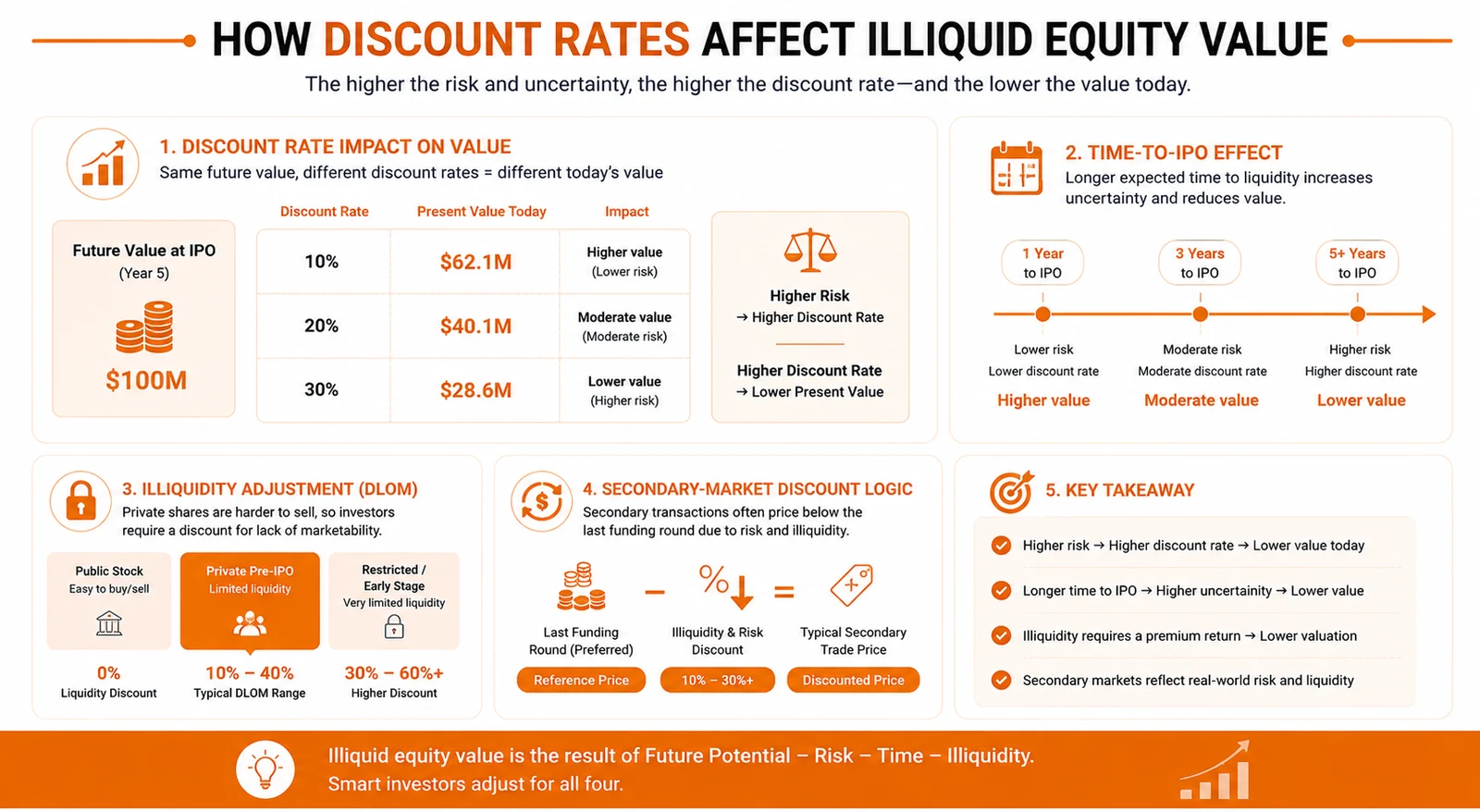
Investors use discount rates to calculate what a future investment may be worth today. In pre-IPO valuation, this matters because investors may wait years before they can sell shares through an IPO.
A discount rate is the return investors expect before investing in a company. Lower-risk investments usually require lower returns, while higher-risk investments require higher returns. In pre-IPO valuation, investors use discount rates to convert future value into today’s value.
Higher risk → higher required return → lower present value.
When investors apply a higher discount rate, the current value of future cash flows or future share value usually falls.
Why Private Companies Need Higher Discount Rates
Private companies usually carry more risk than public firms. Investors cannot easily sell shares because liquidity is limited. Companies may also stay private for many years, which creates uncertainty around IPO timing.
Investors also consider financing risk, business volatility, limited public financial reporting, and the difficulty of adjusting positions quickly. These risks increase the return investors expect from private investments.
What Goes Into a Pre-IPO Discount Rate
Investors usually make discount rates using multiple factors. These mostly include the risk-free rate, equity risk premium, size factor, and company-specific risk factor.
Investors may also add an illiquidity or marketability factor when shares cannot be sold easily. Some models also include financing or business risk factors.
Why Time to IPO Changes Value
Time-to-liquidity can affect valuation. A company expected to reach an IPO within 12 months may receive stronger pricing than a company that could remain private for another three to five years. Longer holding periods increase uncertainty and usually lead investors to apply larger valuation discounts.
Valuation expert Aswath Damodaran also says to use higher discount rates for illiquid private companies. His research explains that investors usually demand additional return for holding assets that cannot be sold easily or quickly.
What Is a Discount for Lack of Marketability (DLOM)?
A Discount for Lack of Marketability (DLOM) is a valuation discount investors apply because private shares cannot be sold as easily as public stocks. Public shares can usually be sold quickly on exchanges such as Nasdaq or the New York Stock Exchange (NYSE). Private shares often require approvals, negotiations, and waiting periods before investors can find buyers.
Several factors can increase or reduce DLOM levels:
- Time to liquidity: Companies expected to remain private for longer periods usually receive larger discounts.
- Transfer restrictions: Private companies often limit who can buy or sell shares.
- Buyer depth in secondary markets: Strong demand and active secondary markets can reduce discounts.
- Company quality and investor demand: Well-known late-stage companies with strong growth may receive smaller discounts.
- Position size: Large share positions are often harder to sell than smaller positions.
Investors must also avoid double-counting liquidity risk. Some valuation models already include illiquidity through higher discount rates. If investors apply a large DLOM on top of a heavily adjusted discount rate, they may reduce valuation too much.
Because of this, investors usually decide whether to include liquidity risk inside the discount rate, through DLOM, or through both methods.
Research from valuation expert Aswath Damodaran and marketability studies also supports this approach. Many private-company studies show DLOM levels often range between 10% and 40%, depending on liquidity conditions and expected holding periods.
How Capital Structure Changes Common-Share Value
Enterprise value is the total value of a company’s business. It includes the value of the company before dividing ownership among different shareholders.
Common-share value is the value common shareholders may actually receive after considering investor rights, dilution, and the company’s ownership structure. Because of this difference, a company can report a high headline valuation while common shares may still have a lower value.
Several parts of the capital structure affect common-share value:
- Preferred vs common shares: Preferred shareholders often receive extra benefits that common shareholders do not receive.
- Liquidation preferences: Preferred investors may receive payouts first during an IPO, company sale, or liquidation.
- Option pool dilution: Companies often reserve shares for employee stock options. As more shares enter the market, each existing share may represent a smaller ownership percentage.
- Convertibles and SAFEs (Simple Agreements for Future Equity): These can later convert into shares and increase the total share count.
Because of these factors, the last preferred funding-round price can sometimes show a higher value than actual common shares worth.
How to Use DCF and Comparable Multiples Together
DCF and comparable multiples answer different questions. Strong pre-IPO analysis uses both because each fills a gap in the other.
DCF is useful when a company has clearer revenue visibility, improving margins, and more stable long-term assumptions. It helps estimate value through future cash flows, making it a strong long-term valuation method.
Comparable multiples are more useful for fast-scaling companies with low profitability, where revenue growth matters more than current earnings. Investors use metrics like EV/Revenue or price-to-sales to compare how similar companies are valued in the market.
Strong pre-IPO valuation uses both. DCF gives an intrinsic value lens, comps give a market-based lens, and secondaries reflect real private-market pricing based on actual transactions.
Together, they combine financial models, market pricing, and real transaction data to create a more realistic valuation view.
DCF vs Comparable Multiples in Pre-IPO Valuation
Method | Best For | Main Problem | Key Facts (2025–2026) |
DCF | Growing or stable companies | Highly dependent on assumptions | Used as a check; value can change 20–50% easily |
Public Comps | Fast-growing (AI/SaaS) | Needs 20–35% discount for private | SaaS multiples 3.4–7x; AI up to 10–25x+ |
Secondary Pricing | Real buyer/seller deals | Not many trades | Discounts 8–29% vs last funding round |
409A Valuation | Employee stock options | Usually low and safe | Common shares 30–60% below preferred |
How to Build a Pre-IPO Valuation Model
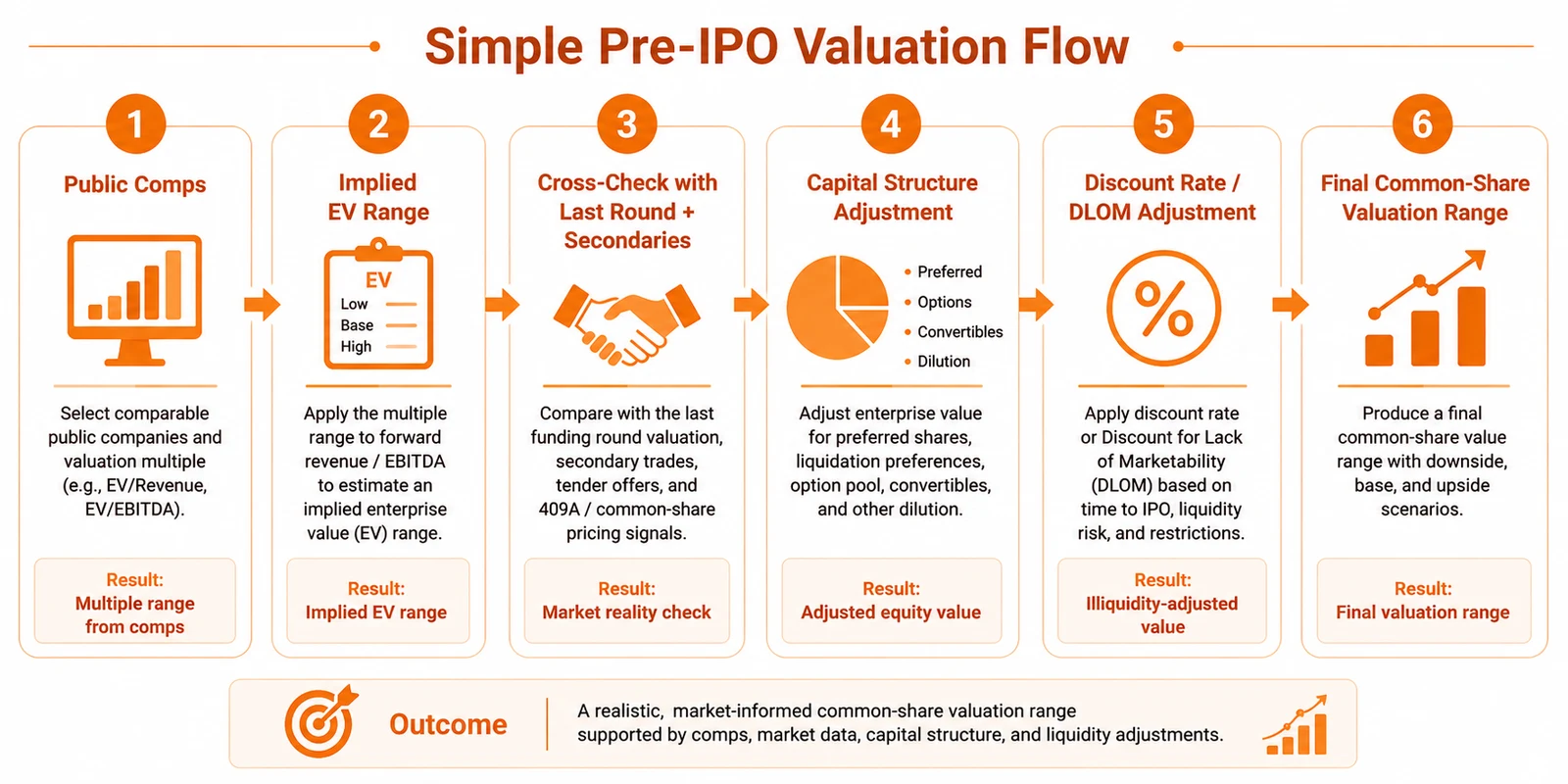
Pre-IPO valuation models usually follow a step-by-step process rather than using one fixed formula. Each step helps investors build a more realistic common-share value range.
Step 1: Build a Comp-Based Valuation Range
Start by selecting public companies with similar business models, growth rates, margins, and market focus. Next, choose the most relevant valuation multiple, such as EV/Revenue for high-growth companies or EV/EBITDA. Apply the selected multiple to the company’s forward revenue or EBITDA forecast to estimate an implied enterprise value (EV) range.
Step 2: Cross-Check With Last Round and Secondary Trades
Next, compare the comp-based valuation with the company’s latest funding round. Then review tender offers, secondary trades, and available 409A or common-share pricing signals. This helps determine whether real private-market transactions support or challenge the model-based valuation range.
Step 3: Adjust for Capital Structure
After calculating enterprise value, adjust it towards the common-share value based on the company’s capital structure. Include preferred shares, employee stock options, future dilution, and convertible securities if they exist. This helps show a more realistic value for common shareholders.
Step 4: Apply Discount Rate / DLOM Logic
Pre-IPO shares are illiquid, so valuation models usually apply an additional adjustment. This may come through a higher discount rate or a separate Discount for Lack of Marketability (DLOM). The adjustment should reflect expected time to IPO, liquidity risk, and transfer restrictions.
Step 5: Produce a Valuation Range
The final step is building a realistic valuation range instead of one fixed number. Most models include a downside case, base case, and upside case to reflect different growth, margin, and market assumptions. This produces a more balanced common-share valuation framework.
What Current Secondary-Market Trends Mean for Pre-IPO Valuation
Private companies are staying private longer, which makes secondary markets more important than before. Investors now depend more on secondary transactions and share-sale activity to understand real private-market pricing.
In mid-2026, secondary markets were still active, with many private-company shares selling at 8–29% discounts. However, strong companies like Anthropic and Stripe continue to see strong investor demand in private markets.
Tender offers are also becoming a larger part of employee and investor liquidity. More late-stage companies now allow structured share sales before public listings, creating more pricing visibility in private markets.
The market is also separating strong late-stage companies from weaker ones more clearly. Companies with stronger growth and better IPO prospects are listing closer to their last funding rounds, while weaker names are facing larger secondary discounts.
As a result, the valuation gap appears directly in actual transaction pricing across private markets.
The Hiive 2025 State of the Private Market report showed stronger secondary-market activity during 2024–2025. It also told more shareholder liquidity events across late-stage private companies.
Final Takeaway: How to Think About Illiquid Equity Value
Pre-IPO valuation is not as simple as using the latest funding round number. Private shares do not trade in active public markets, so investors usually combine multiple valuation methods to estimate a realistic common-share value.
This often includes public comparable multiples, DCF analysis where relevant, secondary-market pricing, capital structure adjustments, and discount-rate or DLOM assumptions. Each method explains a different part of the valuation picture.
Market conditions, liquidity timing, investor demand, and dilution can all affect pricing. Because of this, illiquid equity is usually best viewed as a valuation range supported by multiple data points, not a single headline valuation figure.
Disclaimer: This article is for educational purposes only and is not financial, legal, investment, or tax advice. Tokenized and private-market assets carry risks, including loss, limited liquidity, custody issues, and regulatory changes. Review all documents and seek professional advice before investing.