
Choosing the right SEC exemption is one of the first decisions a company makes when raising private capital. For most private offerings, that decision comes down to Rule 506(b) or Rule 506(c) under Regulation D.
Both exemptions allow businesses to raise an unlimited amount of capital without registering securities with the SEC, but they follow different fundraising rules. The biggest difference is how companies find investors and how they confirm that investors qualify as accredited.
Selecting the wrong exemption can increase compliance costs, limit fundraising options, or create unnecessary regulatory risk. This guide explains how Rule 506(b) and Rule 506(c) work, the investor verification rules for each, and the key differences you should know before raising private capital.
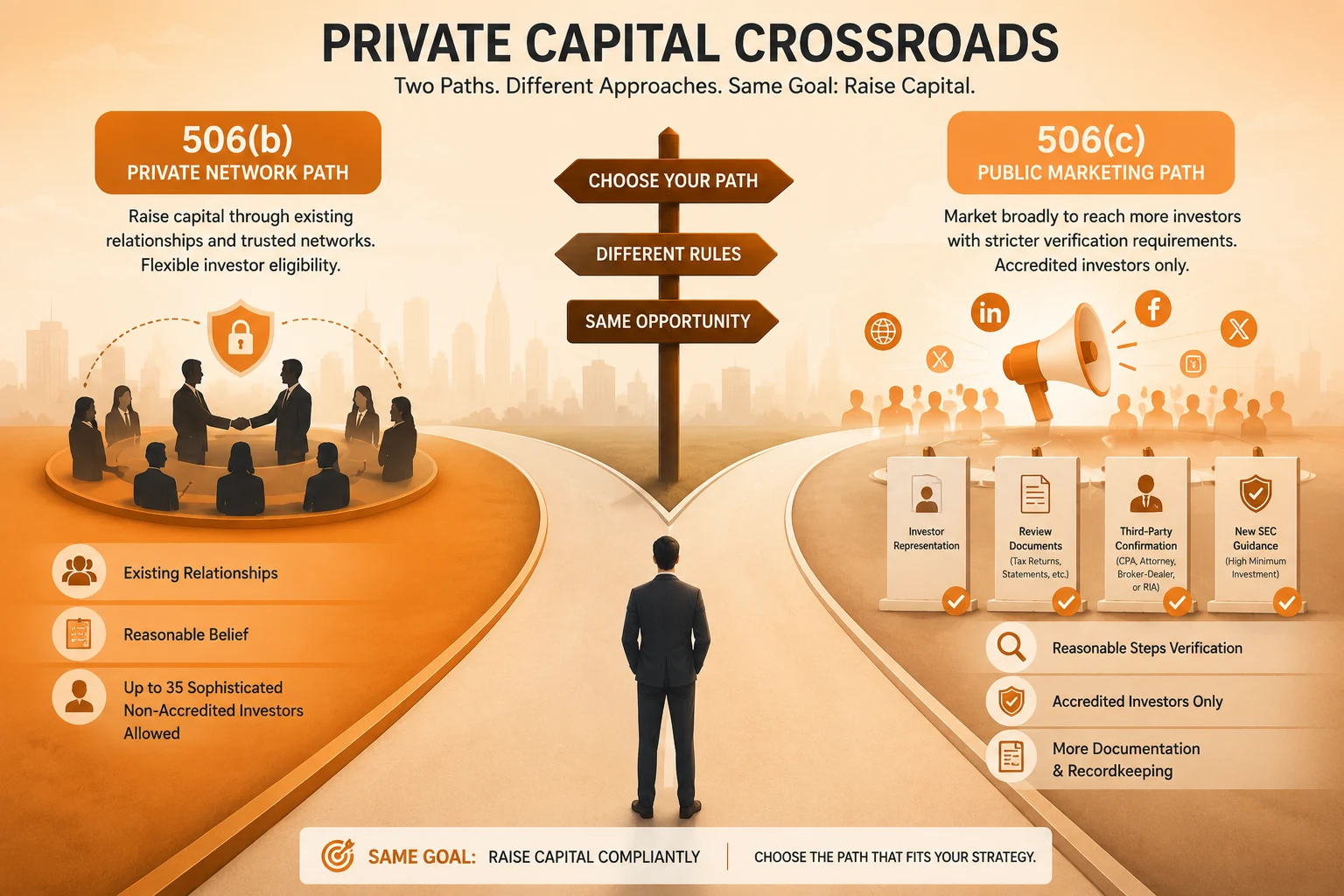
What Is Regulation D?
Regulation D (Reg D) is a set of SEC exemptions that allows companies to raise private capital without registering securities through a public offering. Instead of registering securities with the SEC, businesses can sell them directly to eligible investors under specific conditions. This makes fundraising faster, less expensive, and more flexible than a registered offering.
Among these exemptions, Rule 506 is the most widely used because it allows companies to raise an unlimited amount of capital while avoiding most state registration requirements. Companies relying on Rule 506 usually choose between Rule 506(b) and Rule 506(c).
Both provide the same exemption from SEC registration, but they differ in how companies market an offering, who can invest, and how accredited investor status is established.
What Is Rule 506(b)?
Rule 506(b) allows companies to raise an unlimited amount of capital without publicly advertising their offering. Instead, issuers typically raise money through existing business relationships, referrals, venture capital firms, family offices, or other established investor networks.
The rule permits an unlimited number of accredited investors and up to 35 sophisticated non-accredited investors who have enough financial knowledge and experience to evaluate the investment. If non-accredited investors participate, the issuer must provide additional disclosure documents.
A key feature of Rule 506(b) is its reasonable belief standard. Companies do not have to formally verify an accredited investor's financial status in every case. Instead, they may rely on information already available, such as investor questionnaires, subscription agreements, previous investments, or an existing relationship with the investor.
What Is Rule 506(c)?
Rule 506(c) was introduced through the JOBS Act of 2012 to give companies greater flexibility when raising private capital. Unlike Rule 506(b), it allows issuers to publicly advertise and generally solicit their offerings through websites, social media, webinars, conferences, and other public channels. This makes it easier to reach investors beyond an existing network.
In exchange for this flexibility, Rule 506(c) applies stricter investor requirements. Every purchaser must qualify as an accredited investor, and the issuer must take reasonable steps to verify that status before accepting an investment.
A simple investor declaration is generally not enough. Companies usually verify investors by reviewing financial documents or obtaining written confirmation from a CPA, attorney, registered broker-dealer, or registered investment adviser.
Rule 506(b) vs. Rule 506(c): Technical Comparison
Rule 506(b) and Rule 506(c) both allow companies to raise an unlimited amount of private capital under Regulation D without registering securities with the SEC. However, they follow different rules for marketing an offering, investor eligibility, accredited investor verification, and compliance.
The table below highlights the key differences before we examine each requirement in more detail.
Aspect | Rule 506(b) | Rule 506(c) |
General Solicitation / Marketing | Prohibited (no public advertising, social media blasts, or broad outreach; limited to pre-existing relationships) | Permitted (broad advertising allowed via internet, social media, TV, etc.) |
Eligible Investors | Unlimited accredited investors + up to 35 non-accredited but sophisticated investors | Accredited investors only (no non-accredited investors permitted) |
Accredited Investor Verification | Reasonable belief; self-certification via questionnaire generally sufficient (unless red flags) | Reasonable steps required to verify status (e.g., review of tax returns, bank statements, CPA/attorney letters, or other documentation) |
Disclosure Requirements | Detailed disclosures required if non-accredited investors participate; must be provided to all | No specific disclosure requirements beyond anti-fraud rules |
Best For | Trusted networks, existing relationships, flexibility with sophisticated investors | Public marketing and broader reach when all investors are verified accredited |
The following sections explain how these differences affect fundraising and compliance.
General Solicitation
One of the biggest differences between Rule 506(b) and Rule 506(c) is how companies reach investors.
Rule 506(b) works best when issuers already have access to investors through existing relationships or trusted networks. Rule 506(c) allows companies to advertise publicly through websites, social media, webinars, and other marketing channels to reach a much larger audience.
The trade-off is simple: greater marketing freedom comes with stricter accredited investor verification.
Investor Eligibility
Both rules allow an unlimited number of accredited investors, but they treat non-accredited investors differently.
Rule 506(b) allows up to 35 sophisticated non-accredited investors, which can expand the investor pool but also increases disclosure obligations. Rule 506(c) limits participation to accredited investors only, making the fundraising process simpler but more restrictive.
The right choice depends on who you plan to raise capital from.
Accredited Investor Verification Requirements
The most important difference between Rule 506(b) and Rule 506(c) is how companies establish that an investor qualifies as accredited.
- Under Rule 506(b), issuers may rely on a reasonable belief that an investor meets the SEC's accredited investor requirements. This is a facts-and-circumstances standard. Companies often establish this belief through existing relationships, investor questionnaires, subscription agreements, previous investments, or other available information. In many cases, formal financial documents are not required.
- Rule 506(c) applies a higher standard. Instead of relying on an investor's representations alone, issuers must take reasonable steps to verify accredited investor status. The SEC does not prescribe a single mandatory method, but companies must use an objective verification process appropriate for each investor.
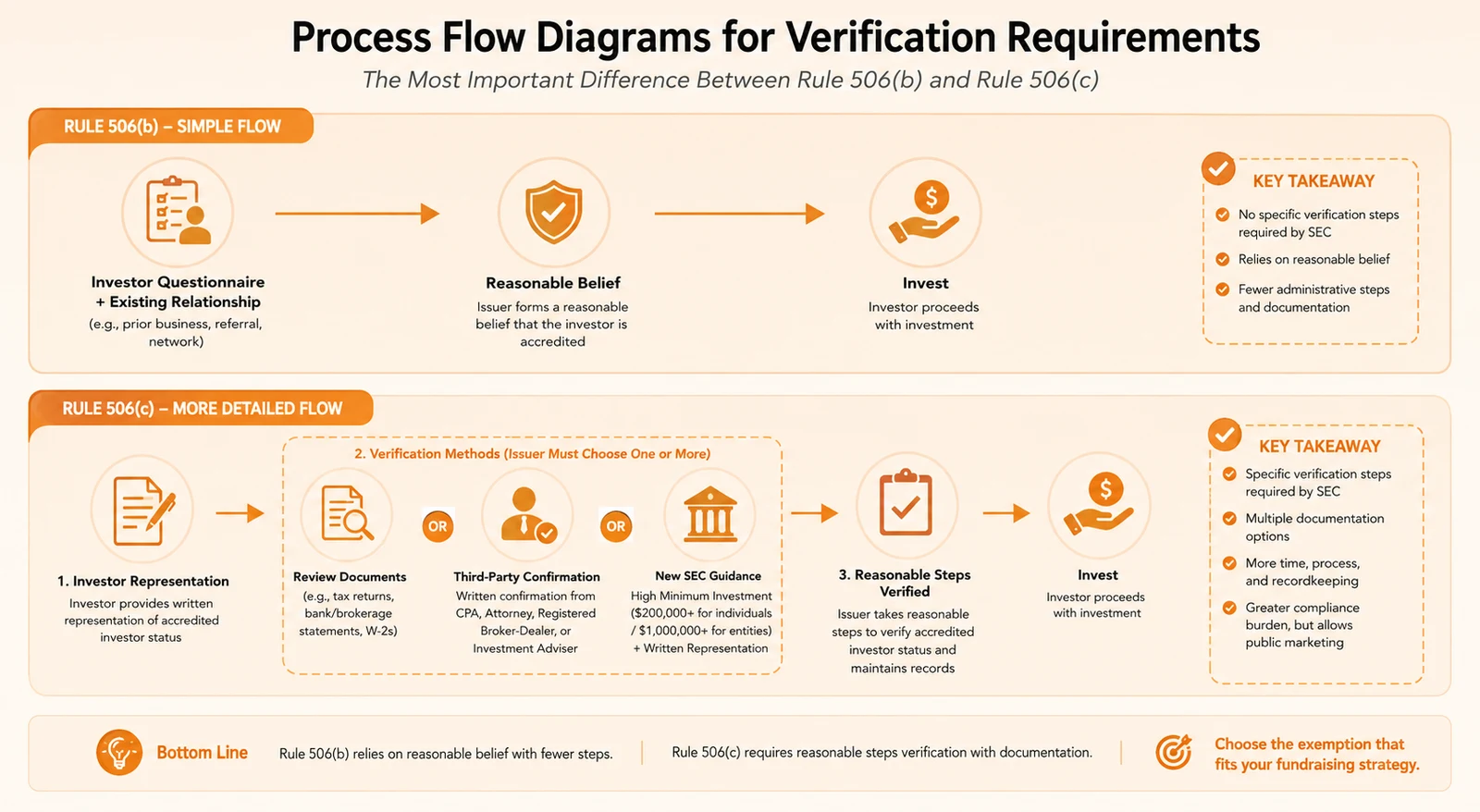
According to the SEC, issuers must take reasonable steps to verify that every investor is accredited. This may include reviewing tax returns, bank or brokerage statements, or obtaining written confirmation from a CPA, attorney, registered broker-dealer, or registered investment adviser.
Because this process requires extra time and documentation, many issuers still choose Rule 506(b). Companies that want to publicly advertise their offering often use Rule 506(c) instead.
In March 2025, the SEC clarified that, in certain cases, issuers may meet the verification requirement by combining a high minimum investment with written investor representations. This guidance can reduce the verification burden while still protecting investors.
Documentation and Recordkeeping Requirements
Choosing the right exemption is only part of the process. Companies must also keep records that demonstrate compliance with SEC requirements. The documentation differs between Rule 506(b) and Rule 506(c).
Rule 506(b):
- Subscription agreements
- Investor questionnaires
Records supporting the issuer's reasonable belief that accredited investors qualify
- Disclosure documents provided to sophisticated non-accredited investors (if applicable)
Rule 506(c):
- Records showing the issuer took reasonable steps to verify accredited investor status
- Supporting financial documents, where applicable
- Written confirmation from a CPA, attorney, registered broker-dealer, or registered investment adviser
- Records from third-party verification services, if used
Keeping complete and organized records helps companies demonstrate compliance if regulators or investors later review the offering.
Disclosure Requirements
Although both exemptions fall under Rule 506, their disclosure obligations differ.
Under Rule 506(b), issuers may need to provide investors with additional material information about the offering. The scope of disclosure generally depends on the circumstances of the offering.
Rule 506(c) does not impose the same specific disclosure requirements. However, issuers must still comply with the federal anti-fraud provisions, which prohibit misleading statements or the omission of material facts.
In practice, many companies provide similar offering materials under both exemptions to improve transparency, support investor due diligence, and reduce legal risk.
Form D Filing Requirements
Whether a company relies on Rule 506(b) or Rule 506(c), it must generally file Form D with the SEC after the first sale of securities. Form D is a short notice filing that informs regulators about the exempt offering. It does not register the securities or require SEC approval before fundraising begins.
A typical Form D includes basic information such as the issuer's name, executives, exemption claimed, offering size, investor type, and the amount of capital raised. The filing becomes publicly available through the SEC's EDGAR database, making it a valuable resource for tracking private offerings.
Companies may also need to file state notices, known as Blue Sky filings, depending on where their investors are located. While Rule 506 generally exempts offerings from state registration, these filings and fees may still apply.
Common Compliance Risks
Most compliance issues do not arise because companies misunderstand Rule 506. They happen because issuers fail to follow the requirements of the exemption they selected.
- Using General Solicitation Under Rule 506(b)
Public advertising through social media, public websites, or mass email campaigns may be considered general solicitation and could jeopardize a Rule 506(b) exemption.
- Failing to Verify Investors Under Rule 506(c)
Relying only on an investor's statement is not enough. Issuers must keep evidence showing they took reasonable steps to verify accredited investor status before accepting an investment.
- Missing Required Filings
Companies should file Form D on time and complete any required state notice filings to remain compliant.
- Poor Recordkeeping
Incomplete or disorganized records can create problems during regulatory reviews, investor due diligence, or future fundraising rounds. Maintaining clear documentation helps demonstrate compliance throughout the offering.
Which Exemption Should You Choose?
The right exemption depends on your fundraising strategy, investor base, and compliance resources. Neither Rule 506(b) nor Rule 506(c) is inherently better. The best choice depends on how you plan to raise capital.
Scenario / Priority | Recommended Exemption | Rationale |
Existing network / pre-existing relationships | 506(b) | Leverages trusted contacts without marketing restrictions |
Broad marketing / public advertising needed | 506(c) | Allows general solicitation across digital and traditional channels |
Desire to include sophisticated non-accredited investors | 506(b) | Up to 35 non-accredited permitted |
All investors are accredited | Either (506(b) simpler) | 506(b) offers easier verification |
Minimize compliance burden | 506(b) | No mandatory verification steps |
Maximize fundraising reach | 506(c) | Public promotion to wider accredited investor pool |
Complex or high-profile offering | 506(c) | Greater visibility with proper verification processes |
Recent SEC Guidance on Rule 506(c)
In March 2025, the SEC Division of Corporation Finance issued a no-action letter and updated its Compliance and Disclosure Interpretations (C&DIs) on Rule 506(c) accredited investor verification. (Source)
Under this guidance, issuers may satisfy the "reasonable steps" requirement by relying on a minimum investment of $200,000 for natural persons or $1,000,000 for entities, together with written investor representations. The issuer must have no actual knowledge that the investor is not accredited, and the investment cannot be financed by a third party for the offering.
This guidance gives issuers greater flexibility and may reduce the need for extensive verification documents in some offerings. As a result, Rule 506(c) may become a more practical option for companies that want to publicly market their offerings while maintaining investor protections.
Bottom Line
Rule 506(b) and Rule 506(c) both provide an effective way to raise private capital without registering securities with the SEC. The key difference is not how much money a company can raise, but how it finds investors and verifies accredited investor status.
Rule 506(b) is generally better suited for relationship-based fundraising with fewer verification requirements, while Rule 506(c) supports public fundraising but requires a more structured verification process.
By understanding these differences, companies can choose the exemption that best fits their fundraising strategy and compliance needs. Selecting the right exemption from the start helps support a smoother and more compliant capital raise.