
A 2025 NBER working paper tracked 8,815 startup opportunities considered by one early-stage venture investor. Only 366 received intensive analysis, and 114 were funded. Among those investments, 32% later raised more than $10 million, and 13% raised more than $25 million.
The investor demonstrated selection ability, yet the researchers still described the process as noisy. Moreover, subsequent financing was not the same as an exit or realized investment return.
That tension defines human vs algorithmic due diligence. An investment committee may spend weeks advancing the wrong company, while a model may reject the right company in seconds.
When that happens, was the error caused by human judgment, model design, or the workflow connecting them?
Neither method has a universal advantage. A fair comparison gives analysts and models the same deals, decision-date evidence, outcome definition, and review capacity.
In this article, algorithmic due diligence refers primarily to the use of models during investment screening and preliminary evidence assessment. A model may prioritize opportunities and identify risk signals. But it cannot independently verify legal ownership, financial statements, contractual rights, cybersecurity controls, or regulatory compliance.
A Structured Comparison of Due Diligence Error Types
Due diligence errors fall into four practical categories. The first two concern the final decision. The third concerns systematic bias. The fourth appears when human and machine judgments influence each other.
Decision: The action taken by the fund, such as advancing, rejecting, or investing.
Target outcome: The measurable event used to evaluate that decision, such as a later funding round, investment return, exit, or survival after a fixed period.
False positive: The process advanced a deal that did not reach the defined target outcome.
False negative: The process rejected a deal that later reached the defined target outcome.
A structured comparison requires every error to be evaluated through the same five questions:
- What decision was made?
- What outcome later occurred?
- What caused the error?
- What financial or operational cost followed?
- Which control could have detected it?
Error type | Human cause | Algorithm cause | Likely consequence | Main control |
False positive | Founder charisma, FOMO, confirmation bias and narrative conviction | Data leakage, overfitting, proxy anomalies and duplicated evidence | Wasted diligence, weak investment or capital loss | Point-in-time data and independent verification |
False negative | Limited review capacity, unfamiliar sectors and network dependence | Sparse precedents, missing data and rigid thresholds | Missed investment opportunity | Rejection audits and model abstention |
Bias-driven error | Herd behaviour, recency bias and sunk-cost escalation | Historical bias, survivorship bias and proxy-variable bias | Unequal or systematically distorted selection | Subgroup error testing |
Interaction error | Analyst anchors on a machine score | Model output becomes accepted without challenge | Human and machine errors reinforce each other | Independent scoring before comparison |
This framework makes an important distinction. False positives and false negatives are outcome errors. Bias-driven errors describe a repeated pattern across groups or deal types. Interaction errors occur inside the workflow, even when the analyst and model perform reasonably well on their own.
False Positives and False Negatives Fail Differently
Human false positives often begin with a persuasive founder or an attractive market story. An ambitious forecast can feel more credible when it is delivered confidently, even when the supporting evidence is weak.
Competitive rounds add urgency. Meanwhile, confirmation bias encourages analysts to defend their early view rather than search for disconfirming evidence.
For example, an investment committee may advance a company because the founder has a strong reputation and several respected investors are showing interest. However, independent analysis may later reveal weak customer retention, high revenue concentration, and unit economics that deteriorate as the company grows.
Algorithmic false positives appear more objective, but their causes can be harder to see.
Look-ahead leakage may place later hiring, funding or product-traction data into an earlier screening record. Several articles may also repeat the same company announcement, making one claim look like several independent confirmations.
Crypto and tokenized opportunities create further risks. A model may treat wallet growth as genuine adoption, reported trading volume as usable liquidity, or contract activity as proof of enforceable ownership.
For instance, a protocol may receive a high score because its active-wallet count and token volume are rising. Human verification may later show that rewards attracted short-term wallets, related parties generated a significant portion of the activity, and the available market depth could not support the proposed investment size.
The calculation may be precise while the economic interpretation is wrong.
A team that can investigate only 20 deals should therefore measure precision at 20.
Precision@20 = Qualifying deals in the top 20 ÷ 20
This metric shows how many qualifying opportunities appeared among the 20 recommendations the team could realistically review.
Suppose six of the model’s top 20 deals later meet the predetermined target. Precision@20 would be 30%. Reporting precision across an unlimited ranking would be less useful when the fund could never review all those opportunities.
A practical false-positive cost can be expressed as:
False-positive cost = wasted review cost + probability-weighted capital loss + cost of displacing a stronger opportunity
This is a decision framework rather than a formal accounting identity. Each component should be estimated using the fund’s actual review hours, ticket sizes, historical loss rates, and pipeline constraints.
High Accuracy Can Still Hide Bias
Human bias comes from attention, incentives, memory, and social influence. Model bias comes from training data, labels, missing values, proxy variables, and the chosen optimization target.
However, the two forms of bias can reinforce each other.
A committee may treat a numerical score as more objective than the evidence supporting it. At the same time, a model may use geography, education, former employers, or media visibility as indirect proxies for characteristics that were never intended to influence selection.
The Jang and Kaplan working paper demonstrates why this distinction matters.
Team scores helped explain whether companies obtained at least $1 million in financing. However, market and product factors had greater explanatory power for larger financings and longer-term outcomes. The authors viewed this result as consistent with venture investors placing too much weight on team characteristics during initial selection.
Therefore, automated due diligence model bias should not be assessed through one aggregate accuracy score.
Error rates should be compared across:
- Investment stage
- Sector
- Geography
- Deal vintage
- Data availability
- Sourcing channel
- Company maturity
- Business-model novelty
- Availability of independently verified evidence
A system could achieve acceptable overall performance while producing materially higher false-negative rates for new sectors, smaller markets, first-time founders, or companies with limited media coverage.
Calibration also matters. When deals assigned a 70% probability reach the target only 40% of the time, the probabilities are poorly calibrated, even when the ranking appears useful.
Calibration asks whether the predicted probability corresponds to the observed outcome rate. Ranking asks whether stronger opportunities generally appear above weaker ones. A system can rank deals reasonably well while producing unreliable probability estimates.
Human and Model Error Rates Need the Same Test
Consider a fund that receives 500 opportunities each month but can investigate only 20.
The human-only, model-only, and hybrid processes should each produce a 20-deal shortlist from the same 500 companies. Every process must use only the information available on the original decision date.
The comparison should measure:
- False-positive and false-negative rates
- Precision and recall at 20
- Probability calibration
- Abstention frequency
- Human-model disagreement
- Error gaps between sectors and vintages
Abstention means the model declines to score a company because its evidence is incomplete, contradictory or outside the validated population.
PR-AUC summarizes precision and recall across several thresholds when positive outcomes are uncommon. However, it must be compared with the underlying positive-class rate.
Bootstrap confidence intervals can show how much the result changes across resampled datasets. When analysts and models assess the same deals, McNemar’s test can examine whether their classification errors differ beyond sampling noise.
DIALECTIC provides a recent example. The multi-agent startup-screening system was evaluated in the 2026 EACL industry track using 259 opportunities from five venture-fund watchlists. 25% met the researchers’ success definition by raising a Series A or later round by September 1, 2025.
The researchers divided the dataset through random stratified sampling into 129 validation and 130 test companies. DIALECTIC achieved a test PR-AUC of 0.2422. The human comparison covered six investments, two of which met the defined target.
After eligibility, entity-matching, temporal, and historical-data controls were applied, the DIALECTIC dataset fell from 3,441 records to 259 companies, meaning more than 90% of the original records were excluded. That shows how difficult it is to build a clean point-in-time private-market dataset.
The research demonstrates a structured screening process. However, the small human benchmark and non-chronological split do not establish lower machine learning due diligence error rates across later market vintages.
Disagreement Should Control the Workflow
A hybrid process should not simply average an analyst score and a model score. Disagreement is more useful because it reveals where an additional review is needed.
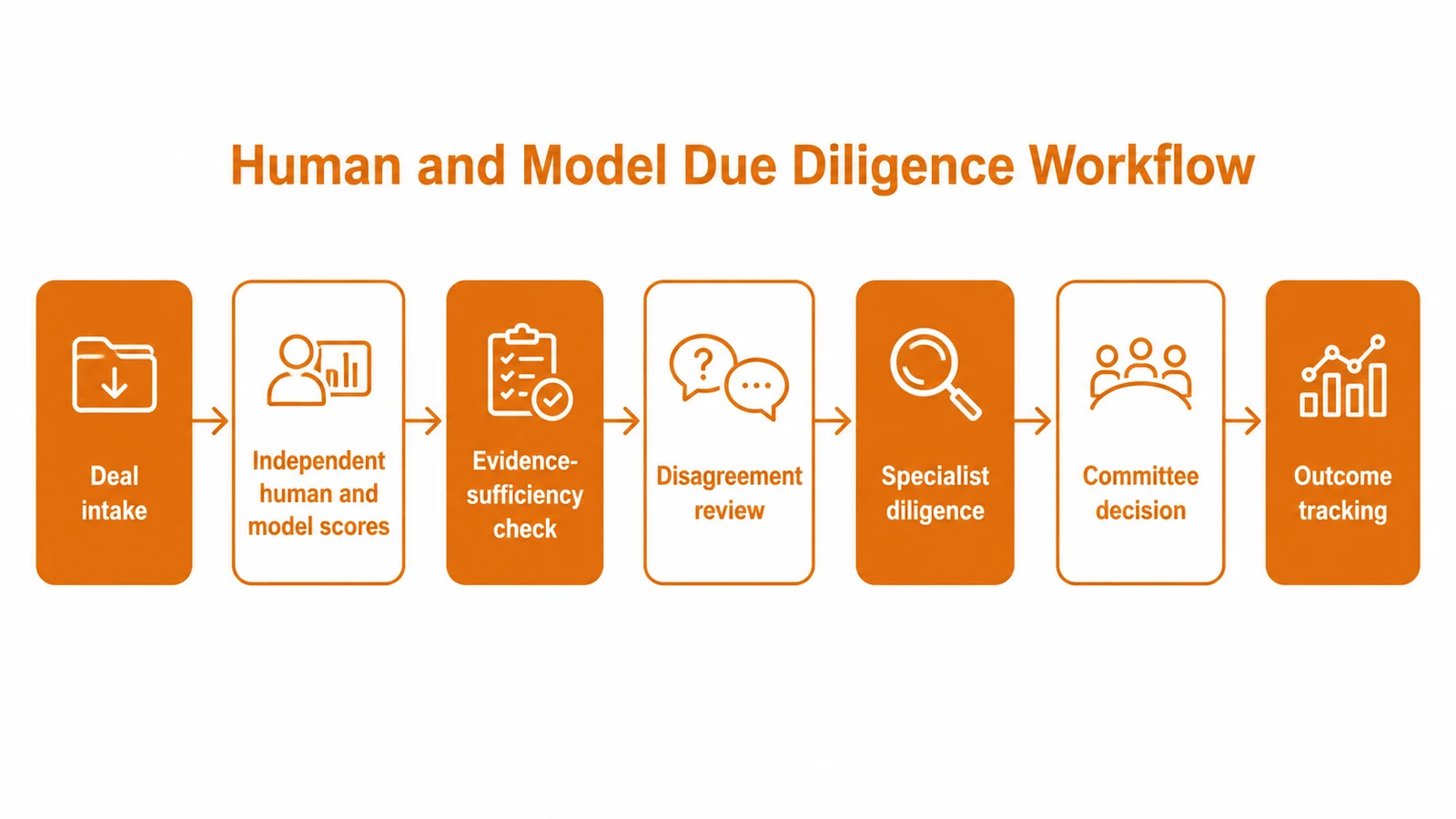
When both sides reject a deal, record the reasons and audit some cases later. This helps estimate hidden false negatives.
When the model accepts and the analyst rejects, examine whether the system found genuine novelty or relied on a weak proxy.
When the analyst accepts and the model rejects, test whether conviction is overriding thin evidence or whether the deal lies outside the training distribution.
When both accept, commercial, legal, technical, ownership, and liquidity checks must continue. Agreement does not verify a claim or create enforceable investor rights.
Governance should reflect the financial consequences of error.
On April 17, 2026, the federal banking agencies issued revised model-risk guidance, published by the Federal Reserve as SR 26-2. It replaced SR 11-7 and emphasized a risk-based approach tied to model purpose, exposure, and operational complexity.
Its direct scope is banking. The guidance excludes generative and agentic AI while covering traditional quantitative models and non-generative, non-agentic AI systems.
Private-market managers can use their development, validation, documentation, and independent-challenge principles as a governance benchmark rather than claim formal compliance.
NIST’s voluntary AI Risk Management Framework provides broader lifecycle guidance for designing, using and evaluating AI systems. NIST currently states that AI RMF 1.0 is being revised.
The adoption rule is clear. Use a hybrid workflow only when it lowers cost-weighted errors against human-only and model-only processes on a later, untouched deal vintage.
The calculation should include analyst time, missed-opportunity cost, capital loss, model maintenance, abstentions, and overrides.
Algorithms are strongest at organizing evidence, ranking large pipelines, and applying rules consistently. People remain essential for interpreting novelty, challenging assumptions, and verifying rights that structured data cannot establish.
The wider technical design is explained in AI-Driven Deal Screening Model Architecture, Validation, and Known Limitations.
FAQs
Which method produces more false positives?
There is no universal winner. Results depend on the deal population, outcome definition, evidence cutoff, review capacity, and operating threshold.
Why is accuracy weak for deal screening?
A system can appear accurate by rejecting almost every opportunity while missing the few deals the fund needs to identify.
Can algorithms remove cognitive bias?
Algorithms can improve consistency, but they may reproduce historical, proxy, and selection biases. Their scores can also create automation bias among human reviewers.
How should false negatives be measured?
Track rejected deals through a fixed outcome period, audit a random rejection sample, and report recall by stage, sector and vintage.
Research Methodology
This article uses primary research from NBER and the Association for Computational Linguistics, together with current Federal Reserve and NIST guidance. Research findings are distinguished from editorial interpretation.
Investment Risk Notice
Due diligence scores are research tools. They do not guarantee investment performance or replace legal, financial, tax, technical, or regulatory review.