
Private companies are raising larger funding rounds while staying private longer, making accurate ownership modelling more important than ever. According to Cooley’s venture financing reports, billions of dollars continue flowing into private companies through institutional financing rounds, where ownership percentages can change significantly after every transaction. At the same time, Carta’s startup equity research shows that founder ownership commonly declines as companies progress from early-stage financing into later venture rounds because new investors, employee equity plans, and convertible securities reshape the capitalization table.
The challenge is that many founders and investors focus on valuation growth while underestimating ownership erosion. A company can increase from a $20 million valuation to a $500 million valuation, yet the original shareholders may control a much smaller percentage of the business.
This is why professional investors use a multi-round dilution model cap table.
The model answers critical questions:
- How much ownership will founders retain after several funding rounds?
- How does a Seed investor’s stake change through Series A, B, and C?
- How does an option pool refresh affect existing shareholders?
- How can investors estimate future ownership before committing capital?
A proper dilution model not only calculates today's ownership. It forecasts how financing decisions change ownership over the entire growth cycle.
How a Multi-Round Dilution Model Calculates Ownership Decay
A multi-round dilution model cap table is a structured financial model that tracks ownership changes after multiple financing events.
Unlike a simple dilution calculation, which only evaluates one investment round, a multi-round model follows the complete ownership journey:
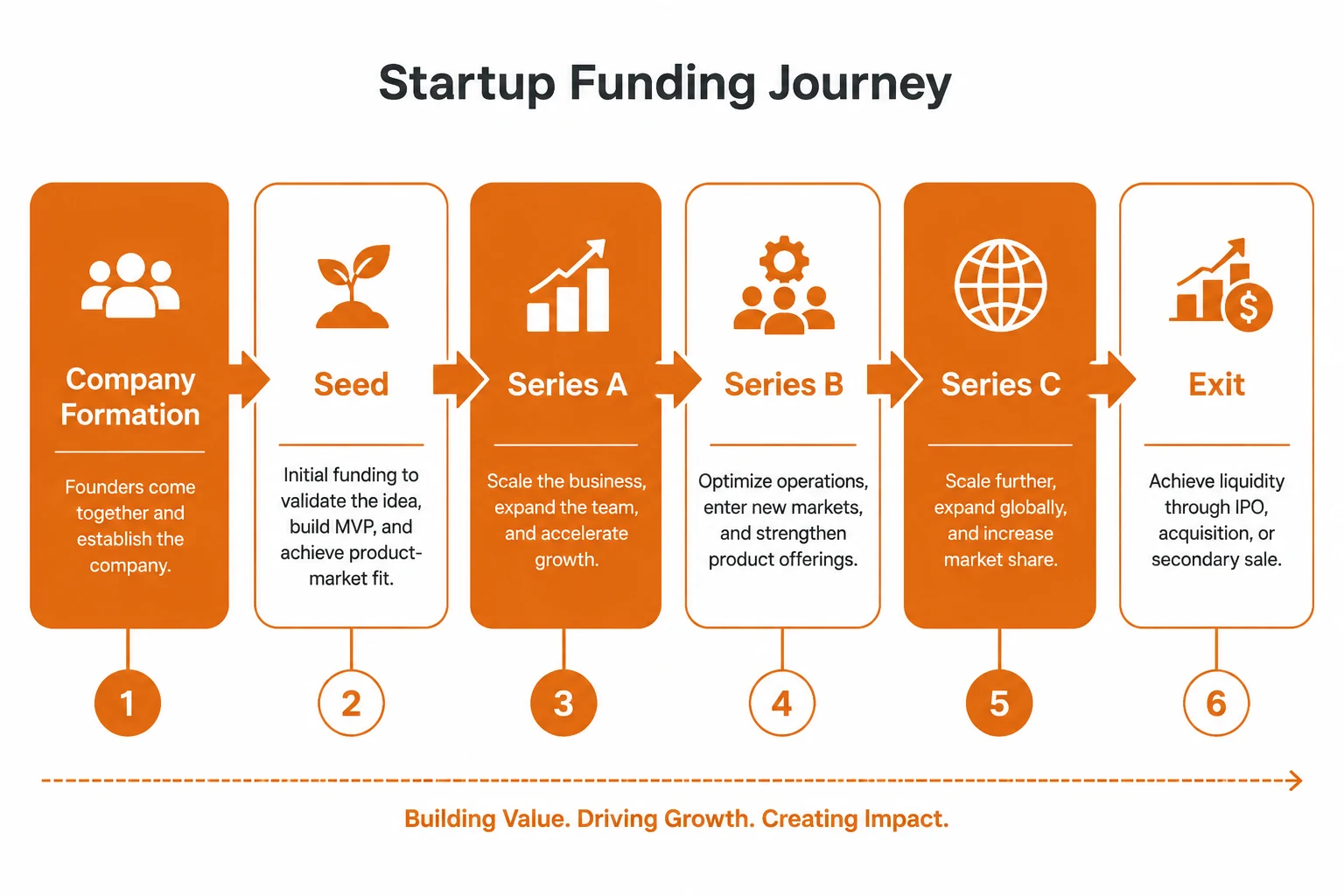
Company formation → Seed → Series A → Series B → Series C → Exit
The fundamental formula is:
Ownership Percentage = Shares Owned ÷ Fully Diluted Share Count
The fully diluted share count includes:
- Issued and outstanding common stock
- Preferred shares
- Employee stock option pool (ESOP)
- Convertible securities
- SAFE conversions
- Warrants and other equity instruments
The key concept is that shareholders usually do not lose shares during dilution. Instead, companies issue additional shares, increasing the total ownership pool.
For example:
A founder owns 8 million shares.
Before financing:
- Total shares: 10 million
- Founder ownership: 80%
After a financing round:
- Total shares: 20 million
- Founder ownership: 40%
The founder still owns 8 million shares, but the ownership percentage has declined.
This ownership percentage change is called dilution.
However, professional investors do not evaluate dilution in isolation. They analyse:
- Current ownership
- Future fundraising needs
- Option pool requirements
- Investor rights
- Expected exit ownership
This is why cap table modelling is a forward-looking exercise rather than a simple mathematical calculation.
Building the Initial Capitalization Table Before Funding
Before external investors enter, a startup usually begins with founders owning all issued common stock.
The initial capitalization table may look like this:
Shareholder | Ownership |
Founders | 100% |
Investors | 0% |
Employee Option Pool | 0% |
At this stage, founders control the company. However, venture investors rarely negotiate using only issued shares.
They usually evaluate the fully diluted capitalization table, which considers future equity commitments.
This distinction becomes important because a company may have:
- 10 million issued shares
- 1 million reserved employee options
- 500,000 convertible securities
The investor ownership calculation must include these future obligations.
Seed Round Dilution Calculation
Assume a company raises its first institutional financing round:
- Pre-money valuation: $15 million
- New investment: $5 million
- Post-money valuation: $20 million
The investor ownership formula is:
Investor Ownership = Investment Amount ÷ Post-Money Valuation
$5 million ÷ $20 million = 25%
After the Seed round:
Shareholder | Ownership |
Founders | 75% |
Seed Investor | 25% |
The founder did not sell equity. The dilution occurred because the company issued new preferred shares to the investor.
This same process repeats during every future financing round.
Seed to Series C Ownership Progression Model
To understand cumulative ownership decay, consider a company raising capital through four financing stages.
Assumptions:
Seed Round
- Investment: $5 million
- Post-money valuation: $20 million
Series A
- Investment: $15 million
- Post-money valuation: $75 million
Series B
- Investment: $40 million
- Post-money valuation: $200 million
Series C
- Investment: $80 million
- Post-money valuation: $500 million
The ownership progression:
Funding Stage | Founder | Seed Investor | Series A Investor | Series B Investor | Series C Investor |
Formation | 100% | — | — | — | — |
Seed Close | 75% | 25% | — | — | — |
Series A Close | 56% | 19% | 25% | — | — |
Series B Close | 44% | 15% | 20% | 21% | — |
Series C Close | 36% | 12% | 16% | 17% | 19% |
As the model demonstrates, by the time the company reaches its Series C close, the founders' combined equity has decayed from 100% to 21.0%. Although the paper value of their remaining stake is highly attractive, their voting power and governance control have been severely compromised.
Furthermore, Carta’s 2026 research highlights an even more dramatic reality. At Series C, the median employee equity pool actually reaches 16.8%, which officially outstrips the median founder ownership of 16.1%. Consequently, founders who do not actively manage their dilution risks early on may find themselves holding a smaller share of the company than their collective employee pool.
Likewise, the Seed investor in our model, who did not negotiate or exercise pro-rata, watched their initial 20.0% stakes deteriorate to just 5.25%. This progression highlights why institutional investors treat pro0rata rights as non-negotiable clauses in early-stage term sheets.
The founder's ownership falls from 100% to approximately 36%.
However, ownership percentage alone does not determine financial outcome.
At Series C:
Founder ownership value:
36% × $500 million valuation = approximately $180 million theoretical ownership value
The company became significantly more valuable even though the ownership percentage declined.
This is why investors separate:
- Ownership percentage
- Enterprise valuation
- Liquidation economics
- Exit proceeds
How Option Pool Refreshes Change Dilution Outcomes
One of the most important variables in venture dilution modelling is the Employee Stock Option Plan expansion.
Growing companies need equity incentives to hire executives and employees. Therefore, investors often require additional option pool allocation before financing closes.
According to venture financing practices documented by firms such as Cooley and Wilson Sonsini, option pool negotiations are one of the most frequently discussed ownership issues during preferred equity financings.
The timing of the option pool creation determines who absorbs the dilution.
Scenario A Pre-Money Option Pool Expansion
Assume:
Before Series A:
- Founder ownership: 56%
- Seed investor ownership: 19%
- New investor enters: 25%
The Series A investor requires a 10% option pool before closing.
The new pool is created from existing shareholders.
After adjustment:
Shareholder | Before Refresh | After 10% Pool Refresh |
Founder | 56% | 50.40% |
Seed Investor | 19% | 17% |
Employee Pool | 0% | 10% |
Series A Investor | 25% | 25% |
The founder loses approximately 5.6% before the new investor even receives shares.
This is known as the option pool shuffle.
Scenario B Post-Money Option Pool Planning
A different approach is creating an option pool based on actual hiring requirements after considering the financing structure.
For example:
Instead of automatically creating a 10% pool, the company analyses:
- Number of planned hires
- Executive compensation requirements
- Existing employee grants
- Expected hiring timeline
This can reduce unnecessary dilution.
Variable | Pre-Money Refresh | Post-Money Planning |
Existing shareholder impact | Higher dilution | Lower dilution |
Founder ownership | Larger reduction | Better protection |
Investor outcome | Stronger protection | More balanced structure |
Hiring flexibility | Fixed allocation | Needs-based allocation |
Option pool decisions are therefore not only HR decisions. They are capital structure decisions that affect founder and investor returns.
How Early Investors Manage Ownership Decay
Early investors face a similar challenge to founders.
A Seed investor may begin with 20% ownership.
After multiple financing rounds:
- Series A: 15%
- Series B: 10%
- Series C: 7%
The investor's ownership declines because additional shares are issued.
However, venture investors often negotiate pro-rata rights.
These rights allow investors to participate in future rounds and purchase enough shares to maintain their ownership percentage.
Without participation:
20% → 15% → 10% → 7%
With pro-rata participation:
20% → approximately maintained ownership
Some investors negotiate super pro-rata rights, allowing them to increase their ownership in future rounds.
Therefore, ownership modelling must consider not only current equity but also future capital commitments.
Building an Equity Dilution Sensitivity Analysis Model
Professional investors rarely analyse one dilution outcome.
Instead, they test multiple scenarios.
Important variables include:
- Funding size
- Pre-money valuation
- Option pool percentage
- Financing timing
- Investor participation
- Down-round probability
A basic sensitivity framework:
Model Change | Expected Ownership Impact |
Larger option pool | Higher founder dilution |
Lower valuation round | Greater investor ownership |
Additional financing rounds | More ownership erosion |
Pro-rata participation | Reduced dilution impact |
A professional cap table spreadsheet usually contains:
- Ownership calculation sheet
- Funding round assumptions
- Option pool scenarios
- Share conversion analysis
- Exit the waterfall model
The objective is not to predict the exact future. It involves understanding how different financing decisions affect ownership outcomes.
Advanced Dilution Events Investors Must Model
Equity dilution does not only happen through priced financing rounds.
Several other mechanisms can change ownership.
SAFE and Convertible Security Conversion
SAFE agreements and convertible notes delay dilution because they convert into equity during future financing events.
The investor may not appear on the cap table initially but receives shares after conversion.
Anti-Dilution Protection
Preferred investors may receive protection during down rounds.
Common structures include:
- Broad-based weighted average anti-dilution
- Full-ratchet anti-dilution
These provisions protect earlier investors but may increase dilution pressure on founders and later shareholders.
Secondary Transactions
Secondary liquidity transactions involve existing shareholders selling shares.
Unlike primary financing:
- No new shares are created
- Company ownership transfers between holders
- Capital does not enter the company's balance sheet
Treasury Stock Method
For public-company fully diluted calculations, analysts may use the treasury stock method to estimate the impact of options and warrants by assuming proceeds from exercise are used to repurchase shares.
Although private companies use different modelling approaches, the underlying principle remains the same:
Future equity obligations affect ownership calculations.
How Investors Use Dilution Models Before Allocating Capital
Before investing, professional investors typically evaluate:
Current Ownership Structure
Who owns the company today?
Future Financing Requirements
How much additional capital will be required?
Option Pool Requirements
How much employee equity will be created?
Investor Rights
Do shareholders have:
- Pro-rata rights?
- Anti-dilution protection?
- Liquidation preferences?
Exit Ownership
What percentage will investors own after future rounds?
A company with an attractive valuation and growth may still produce weak investment outcomes if future dilution is underestimated.
The strongest investors analyse ownership progression before investing, not after dilution has already occurred.
Key Takeaways
A multi-round dilution model cap table provides a realistic view of how ownership changes across Seed, Series A, Series B, and Series C financing.
The biggest drivers of ownership decay are:
- New equity issuance
- Option pool expansion
- Convertible security conversion
- Multiple financing rounds
Valuation growth matters, but ownership structure determines who captures that growth.
Founders and investors who model dilution early can make better financing decisions and understand the true economics behind private-market investments.
FAQs
What is a multi-round dilution model cap table?
A multi-round dilution model cap table tracks ownership changes across several financing rounds by calculating how new share issuance affects founders, investors, and employees.
How do you calculate dilution across multiple funding rounds?
Dilution is calculated by dividing existing shares by the new fully diluted share count after additional equity is issued.
How does an option pool refresh affect founder ownership?
A pre-money option pool refresh usually reduces founder ownership because the dilution occurs before new investors purchase shares.
Can investors avoid dilution?
Investors can reduce dilution through pro-rata rights, which allow them to purchase additional shares during future financing rounds.
What is typical venture capital dilution per round?
Dilution varies based on company stage, valuation, and negotiation. Early rounds often create larger ownership changes because startups are still building their long-term capitalization structure.
Summary
A multi-round dilution model calculates ownership changes after repeated fundraising events. The main inputs are funding amount, valuation, option pool size, investor rights, and future financing needs. Founders should model ownership from Seed through exit, while investors should evaluate fully diluted ownership, pro-rata rights, and dilution risk before investing.