A $500,000 SAFE (Simple Agreement for Future Equity) investment can appear straightforward when the agreement is signed. An investor provides capital, the startup receives funding, and both sides wait for a future financing event.
The uncertainty begins when the company raises its next round.
A startup completes a Series A financing at a $30 million valuation. The SAFE investor knows the valuation cap, but that alone does not answer the most important ownership question:
How many shares will the SAFE investor actually receive after conversion?
The final outcome depends on several variables. It includes the valuation cap, discount rate, company capitalization, existing SAFE agreements, option pool expansion, and new investor ownership.
This safe note conversion math worked example explains how SAFE agreements convert into equity, how valuation caps and discounts affect conversion prices, and why investors must evaluate the complete capitalization table before committing capital.
What a SAFE Represents Before Conversion
SAFE stands for Simple Agreement for Future Equity. It is a contractual agreement that gives an investor the right to receive equity in a company after a defined triggering event.
A SAFE (Simple Agreement for Future Equity) is basically a shortcut for startups to get money from investors without a lot of complicated paperwork. |
A standard SAFE is different from a convertible note. It is generally not debt, does not typically accrue interest, and usually does not have a maturity date. Instead, it converts into equity according to the terms written in the agreement.
The most common triggering events include:
- A priced equity financing round
- A liquidity event such as an acquisition
- An IPO
- A dissolution event
The basic process is:
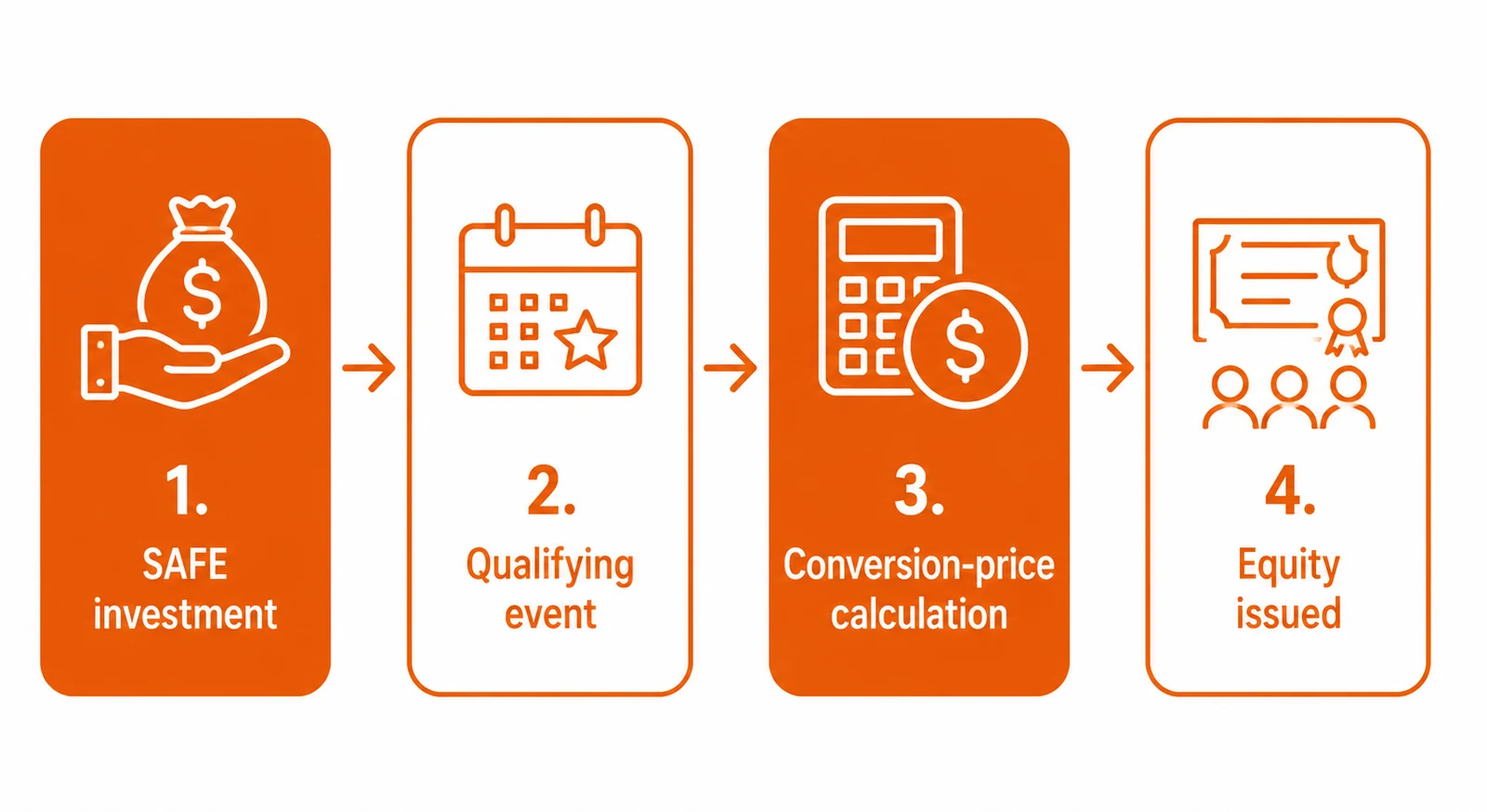
Figure Caption: SAFE Conversion Workflow From Investment to Equity
Illustration of how a SAFE investment progresses through a qualifying event, conversion-price calculation, and final equity issuance.
SAFE investment → qualifying event → conversion-price calculation → equity issued
The SAFE framework was introduced by Y Combinator's SAFE documents and has become a common early-stage financing structure.
However, not every SAFE works the same way. The signed agreement controls the calculation.
A SAFE may include:
- A valuation cap
- A discount rate
- Both a valuation cap and a discount
- A most-favored-nation (MFN) clause
- Pro-rata rights
The difference between pre-money SAFE and post-money SAFE structures is especially important.
A pre-money SAFE calculates ownership before considering some later financing changes. Because multiple SAFEs and other convertible instruments can exist before the priced round, ownership calculations may become difficult.
A post-money SAFE was created to make the ownership sold through the SAFE easier to estimate before the next equity financing. However, later SAFEs, option pool increases, and new investors can still change the final ownership structure.
A SAFE investor does not own company shares immediately after signing. The investor owns a future equity right that converts later.
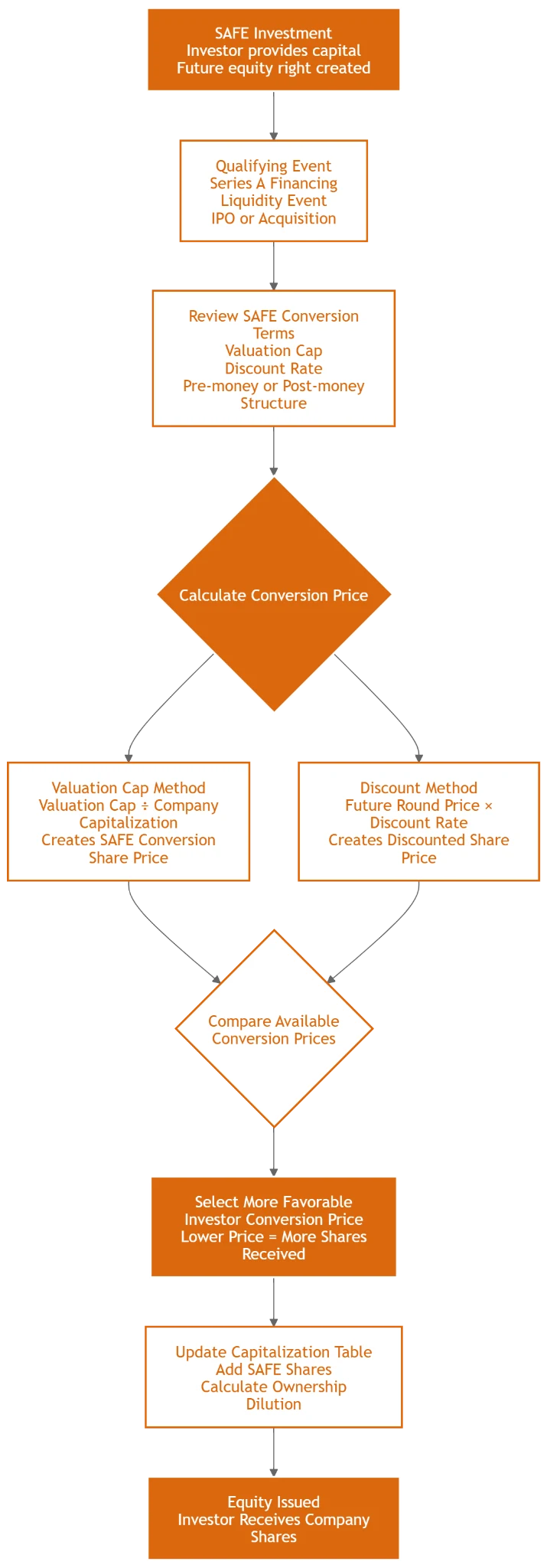
Figure 1. SAFE conversion workflow from investment agreement to equity issuance.
How Valuation Caps and Discounts Set the SAFE Conversion Price
The valuation cap is one of the most important terms in SAFE agreements.
A valuation cap does not mean the startup is currently worth that amount. Instead, it represents the maximum valuation used when calculating the investor’s conversion price.
When the company grows significantly before a priced round, the cap protects early investors from converting at the higher future valuation.
A simplified illustration is:
Cap-based conversion price = valuation cap ÷ company capitalization used in the SAFE calculation
The exact capitalization definition depends on the agreement. Real transactions may require additional modeling because fully diluted capitalization can include options, warrants and other securities.
SAFE conversion example using a valuation cap
Assume:
- SAFE investment = $500,000
- Valuation cap = $10 million
- Series A pre-money valuation = $30 million
- Fully diluted capitalization before conversion = 10 million shares
The Series A investor price is:
$30 million ÷ 10 million shares = $3.00 per share
The SAFE cap price is:
$10 million ÷ 10 million shares = $1.00 per share
The SAFE investor receives:
$500,000 ÷ $1.00 = 500,000 shares
If the SAFE converted at the Series A price instead:
$500,000 ÷ $3.00 = approximately 166,667 shares
The valuation cap creates a significantly larger share allocation because the investor converts at a lower price.
A discount works differently.
The discount gives the SAFE investor a percentage reduction from the price paid by investors in the future priced round.
The formula is:
Discount conversion price = new round price × (1 − discount rate)
Using the same Series A example:
- Series A price = $3.00
- Discount = 20%
The discounted conversion price becomes:
$3.00 × 0.80 = $2.40
The SAFE investor receives:
$500,000 ÷ $2.40 = approximately 208,333 shares
In this example, the valuation cap provides better economics because the $1.00 conversion price is lower than the $2.40 discounted price.
When a SAFE contains both mechanisms, investors generally receive the calculation that provides the lower conversion price or greater share allocation, although the exact treatment depends on the contract language.
SAFE Note Valuation Cap Vs Discount Depends on the Future Financing Valuation
Investors evaluating SAFE note conversion scenarios should not assume that a valuation cap always creates the best outcome.
The value of each mechanism changes depending on the company’s future financing valuation.
Assumptions:
- SAFE investment = $500,000
- Valuation cap = $10 million
- Discount = 20%
- Fully diluted capitalization = 10 million shares
Scenario | New round price | Discount price | Cap price | Applied price |
Series A valuation $15M | $1.50 | $1.20 | $1.00 | $1.00 cap |
Series A valuation $9M | $0.90 | $0.72 | $1.00 | $0.72 discount |
In the first scenario, the company grows beyond the valuation cap. The cap becomes more valuable because it limits the conversion valuation.
In the second scenario, the company raises at a lower valuation. The discount produces a cheaper conversion price.
This is why investors should model both outcomes before evaluating a SAFE-based investment.
The key question is not:
“Does this SAFE have a valuation cap?”
The better question is:
“What conversion price will this agreement create under different financing outcomes?”
How Stacked SAFEs Create Ownership Dilution Before a Liquidity Event
A single SAFE can be relatively simple to model. Multiple SAFEs create a more complex ownership structure.
Stacked SAFE notes dilution modeling requires investors to analyze:
- Different valuation caps
- Different discounts
- Multiple investment dates
- Existing preferred shares
- Employee option pools
- Future financing rounds
Consider this simplified illustration:
Company raises:
SAFE 1
- Investment: $500,000
- Valuation cap: $8 million
SAFE 2
- Investment: $1 million
- Valuation cap: $12 million
SAFE 3
- Investment: $750,000
- Discount: 20%
Additional assumptions:
- Series A pre-money valuation = $24 million
- Starting capitalization = 10 million shares
This example simplifies capitalization assumptions. Actual SAFE conversions depend on the company’s legal capitalization definition.
Series A reference price:
$24 million ÷ 10 million shares = $2.40
SAFE 1 conversion:
$8 million ÷ 10 million shares = $0.80
$500,000 ÷ $0.80 = 625,000 shares
SAFE 2 conversion:
$12 million ÷ 10 million shares = $1.20
$1 million ÷ $1.20 = approximately 833,333 shares
SAFE 3 conversion:
$2.40 × 80% = $1.92
$750,000 ÷ $1.92 = approximately 390,625 shares
Total SAFE shares issued:
625,000 + 833,333 + 390,625 = approximately 1,848,958 shares
The company now has:
10,000,000 original shares
+ 1,848,958 SAFE shares = approximately 11,848,958 shares before issuing Series A shares
SAFE ownership after conversion:
1,848,958 ÷ 11,848,958 = approximately 15.6%
This means SAFE investors collectively own about 15.6% of the company before the new Series A investors receive their shares.
This example demonstrates why the SAFE conversion price is only one part of the investment decision. The capitalization table determines the final ownership outcome.
A complete SAFE post-money dilution calculator guide should include:
- Existing common and preferred shares
- Outstanding SAFEs
- Convertible instruments
- Warrants
- Option pool expansion
- New-money investor shares
- Pro-rata rights
Investors moving from SAFE mechanics into ownership analysis should also review the related frameworks on Cap Table Analysis Framework and Quantifying Dilution Through Funding Rounds.
How Investors Evaluate SAFE Deals Before Committing Capital
A SAFE should be reviewed as a future ownership position rather than only as a discounted entry opportunity.
Before investing, investors should examine the agreement terms.
Important SAFE terms include:
- Valuation cap
- Discount rate
- Pre-money or post-money structure
- MFN clause
- Pro-rata rights
- Financing conversion trigger
- Liquidity event treatment
- Dissolution provisions
The company capitalization also matters.
Investors should review:
- Existing shareholders
- Preferred stock rights
- Previous SAFE rounds
- Convertible securities
- Employee equity pool
- Planned option pool expansion
- Founder ownership
A lower conversion price can increase the number of shares received, but it does not guarantee a stronger return.
Returns depend on:
- Future company valuation
- Ownership dilution
- Exit timing
- Liquidation preferences
- Available liquidity
Professional investors typically model multiple outcomes:
- Downside scenario
Lower financing valuation and increased dilution.
- Base scenario
Expected financing conditions and ownership outcome.
- Growth scenario
Higher valuation with stronger exit potential.
Each scenario should calculate:
- Conversion share price
- Shares received
- Fully diluted ownership
- Founder dilution
- New-money investor ownership
SAFE agreements differ from direct preferred equity because direct equity provides immediate ownership at an agreed valuation. A SAFE delays ownership issuance until a future event determines the conversion terms.
SAFE Conversion Math Determines Real Ownership
SAFE investing is not only about finding a low valuation cap.
The real ownership outcome depends on the conversion formula, capitalization structure and future financing decisions.
Valuation caps, discounts, stacked SAFEs and option pool changes can materially influence how much of the company investors ultimately own.
Before participating in a SAFE-based opportunity, investors should calculate conversion prices, model multiple financing outcomes and review the complete fully diluted capitalization table.
Do not evaluate a SAFE from its valuation cap alone. Calculate the conversion price, resulting shares and ownership percentage before making an investment decision.
FAQs
How does a SAFE convert into equity?
A SAFE converts into company shares during a qualifying event, usually a priced equity financing round. The number of shares depends on the conversion terms defined in the agreement, including valuation caps, discounts and capitalization calculations.
Does a SAFE convert using the valuation cap or discount?
If a SAFE includes both terms, the investor generally receives the mechanism that produces the more favorable conversion price. However, the signed agreement determines the exact calculation method.
How do stacked SAFEs affect dilution?
Stacked SAFEs increase the number of shares issued during conversion. This reduces the ownership percentage of founders and existing investors unless the company value grows enough to offset the dilution.
What is the difference between pre-money and post-money SAFEs?
A post-money SAFE makes the ownership sold through that SAFE easier to estimate before the next financing round. A pre-money SAFE can create more uncertainty because later securities may affect final ownership calculations.
Sources
- Y Combinator SAFE documents
- Carta private market resources
- Clerky startup legal resources