
A successful pre-IPO investment is not only about buying shares in a fast-growing company. Investors also need to understand how money moves through the SPV structure after an exit occurs. Fees, carry, dilution, and payout rules can affect how much capital investors finally receive.
As private companies stay private longer and liquidity events get delayed, investors increasingly use SPVs to access late-stage private shares. These vehicles combine investor capital into a single structure that invests in startup equity, but the final return depends heavily on how managers structure and manage the SPV waterfall.
According to Nasdaq Private Market, secondary tender offer proceeds exceeded VC-backed IPO volume in 2024 as companies remained private for longer periods. The company also reported 83% year-over-year growth in private company auction programs, reflecting stronger demand for structured private-market liquidity.
This guide breaks down how SPV waterfall structures work in practice, how carry and fees shape net investor returns, and why dilution and pro-rata rights play a critical role in determining real outcomes in pre-IPO investing.
What Is an SPV?
A Special Purpose Vehicle (SPV) is a separate legal structure created for one investment. In pre-IPO investing, SPVs combine money from multiple investors into a single vehicle before investing in a private company. Instead of adding many individual investors directly to a startup’s ownership table, startups work with the SPV as one investor.
- SPVs simplify startup ownership structures by grouping investors together
- SPVs allow smaller investors to participate in private-market deals
- SPVs help investor groups organize and manage deals more efficiently
In a typical SPV structure, investors contribute capital into the vehicle, and the SPV purchases shares in a private company. The SPV then holds those shares until a liquidity event occurs, such as an IPO, tender offer, or secondary share sale.
How a Pre-IPO SPV Works
Step 1: Investors Contribute Capital
A pre-IPO SPV starts when investors commit capital into the structure. Investors usually complete investment paperwork and transfer funds before the SPV closes the deal. Some SPVs accept smaller investments, while institutional vehicles often require larger minimum check sizes.
Step 2: SPV Purchases Startup Shares
The SPV then purchases shares in a private company. The vehicle may buy primary shares directly from the startup or secondary shares from existing shareholders. Some SPVs invest in preferred shares that include investor protections, while others purchase common shares with higher risk exposure.
Step 3: Shares Are Held Until a Liquidity Event
After the transaction closes, the SPV holds the shares until a liquidity event occurs. Common liquidity events include IPOs, company sales, tender offers, and secondary share sales. Investors usually cannot freely trade these shares during the holding period.
Step 4: Cash Flows Back Through the Waterfall
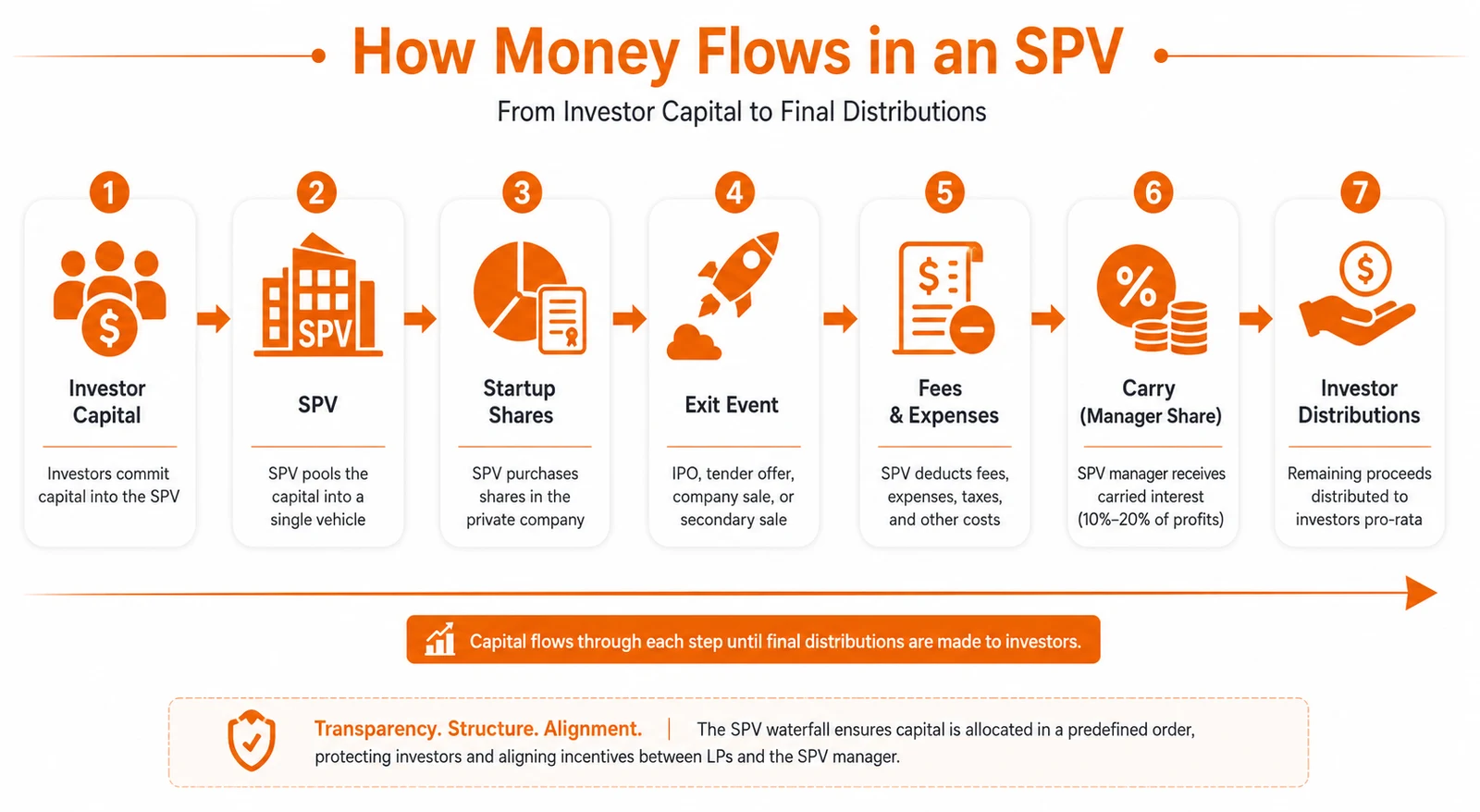
When liquidity occurs, cash flows back into the SPV waterfall structure. The SPV deducts fees and expenses first, allocates carried interest to the SPV manager, and then distributes remaining proceeds to investors based on ownership percentages.
SPV Waterfall Explained
A waterfall structure controls how investment proceeds move through an SPV after a liquidity event. It determines who gets paid first, when fees get deducted, how carry gets applied, and how much investors finally receive. Most waterfall structures first return investor capital before dividing profits between investors and the SPV manager.
Gross returns can often mislead investors because headline startup valuations do not reflect final investor payouts.
Fees and expenses reduce total proceeds
Carry lowers investor profits
Long holding periods reduce annualized returns
Different share classes create different outcomes
Net returns may differ from paper valuations
For example, an SPV investment may grow from $1 million to $5 million on paper. After fees, expenses, and 20% carry deductions, investors may receive materially lower net distributions.
Institutional investors closely analyze waterfall structures because realized cash returns matter more than paper gains. Most firms focus on net MOIC (measures how many times an investment grows) and IRR (measures the annualized return over time) instead of headline valuations alone.
Institutions also model different exit scenarios to understand how fees, carry, and timing affect investor returns.
How Money Flows in an SPV
Cash does not move directly from a startup exit to investors. SPV waterfalls follow a defined payout order that determines how capital, fees, carry, and profits are distributed.
Step 1: Return Investor Capital
Most SPV waterfall structures first return the original investor capital before distributing profits. This structure helps protect investors because the SPV repays invested money before allocating gains.
Step 2: Deduct SPV Expenses
The SPV then deducts expenses from total proceeds. These costs may include legal fees, administration costs, tax filings, audit expenses, banking fees, and fund operations. These deductions reduce final investor distributions.
Step 3: Apply Preferred Return or Hurdle
Some SPVs apply a preferred return, also called a hurdle rate. This structure requires investors to receive a minimum return before the SPV manager receives carry. Institutional structures commonly use hurdle rates between 6% and 8%.
Step 4: Allocate Carry
After returning investor capital and meeting hurdle requirements, the SPV allocates carried interest. Carry gives the SPV manager a percentage of the profits, often around 10%–20% in venture SPVs.
Step 5: Distribute Remaining Profit
The SPV distributes the remaining profits to investors based on ownership percentages.
For example, a $1 million SPV investment may exit at $5 million. After deducting fees and applying 20% carry, investors receive the remaining net proceeds.
Forge Global reported growing institutional participation in private secondary markets as liquidity activity expanded. The company also reported billions of dollars in private-market transaction volume flowing through structured secondary programs.
What Is Carry in an SPV?
Carry, also called carried interest, is a performance-based share of investment profits. The SPV manager receives carry when the investment generates profits above the original invested capital.
Carry exists because SPV managers source deals, structure investments, manage operations, and oversee the investment until an exit occurs.
- Carry incentivizes managers to source stronger deals.
- Carry rewards managers for managing the investment process.
- Carry aligns investor and manager incentives because both benefit from stronger exits.
Carry differs from management fees. Carry depends on investment profits and performance, while management fees apply regardless of investment performance. SPVs use management fees to cover legal, administration, compliance, and operational costs.
Most SPV waterfall structures apply after returning investor capital. Some institutional SPVs also require investors to receive a preferred return or hurdle rate before the SPV manager receives carry. This structure ensures investors receive a minimum return before profits get shared.
Common Carry Structures in Pre-IPO SPVs
Different SPVs use different carry structures depending on deal size, investor type, and investment strategy. Smaller investor groups often use lower carry structures, while institutional private-market vehicles commonly use higher carry percentages.
10% Carry Structures
Many smaller SPVs use 10% carry structures. These structures are common in smaller investor groups and lower-fee private-market deals. Investors often prefer lower carry because it allows them to keep more of the investment profits.
15% Carry Structures
Some SPVs use 15% carry as a middle-ground structure. This model balances investor returns and manager compensation. Mid-sized private-market vehicles commonly use this approach.
20% Carry Structures
Many institutional pre-IPO and private-market structures use 20% carry. This model became standard across much of venture capital and private equity because it strongly aligns manager incentives with investment performance.
Tiered Carry Structures
Some SPVs use tiered carry models where the carry percentage increases after certain return milestones. For example, the SPV manager may receive higher carry after investors achieve a target return.
Preferred Return Structures
Institutional SPVs sometimes use preferred returns. These structures require investors to first receive a minimum annual return, often around 6%–8%, before the SPV manager receives carry.
What Is Carry Modeling in a Pre-IPO SPV?
Carry modeling helps investors calculate how profits move through an SPV waterfall structure. Investors use these models to estimate manager carry payouts, final LP distributions, and net investment returns under different exit scenarios.
Carry models usually require several key inputs:
- Initial investment amount
- Exit valuation
- Carry percentage
- Holding period
- SPV fees and expenses
Step 1: Calculate Gross Exit Proceeds
The model first calculates the total value generated at exit. For example, a $1 million SPV investment may grow to a $5 million exit value after an IPO or secondary sale.
Step 2: Return Investor Capital
The SPV then returns the original investor capital before distributing profits. In this example, the first $1 million goes back to investors.
Step 3: Calculate Total Profit
After returning investor capital, the structure calculates total profits. A $5 million exit minus the original $1 million investment produces $4 million in profits.
Step 4: Apply Carry Percentage
The SPV manager then receives a percentage of the profits based on the agreed carry structure. With a 20% carry, the SPV manager receives $800,000 from the $4 million profit amount.
Step 5: Determine Final LP Distribution
The SPV distributes the remaining profits to investors. In this scenario, investors receive the remaining $3.2 million in net profits after carry deductions.
Carry matters more in larger exits because higher valuations increase sponsor payouts. Smaller exits generate lower carry, while large IPO exits can produce much higher sponsor compensation.
Nasdaq Private Market reported stronger late-stage secondary pricing during Q4 2024. The firm reported more transactions pricing above the last preferred funding round, increasing investor focus on how carry structures affect realized profits in large exits.
Example Carry Table
Item | Amount | Notes / Assumptions |
Initial Investment | $1,000,000 | Total LP capital committed to the SPV |
Exit Value | $5,000,000 | Pre-IPO secondary sale or IPO valuation realization |
Profit | $4,000,000 | Exit Value minus returned capital |
Carry Rate | 20% | Standard sponsor promote/carry in many VC SPVs |
Carry Paid | $800,00 | 20% of $4M profit |
Net LP Profit | $3,200,000 | Remaining 80% distributed to investors |
What Is an SPV Fee?
SPVs charge fees to cover the costs of creating, managing, and operating the investment structure. These fees pay for legal work, compliance, administration, accounting, and investor reporting. Unlike carry, SPV fees usually apply even if the investment does not generate profits.
SPVs commonly charge several types of fees:
- Management fees cover ongoing operations and deal management.
- Organizational costs include SPV setup and formation expenses.
- Legal expenses cover contracts, filings, and regulatory work.
- Audit and tax costs support financial reporting and tax filings.
- Banking and wire fees cover transaction processing and fund transfers.
Some SPVs also charge fund administration fees for investor reporting and recordkeeping.
Fees can materially reduce investor returns over long holding periods. For example, a pre-IPO investment may take several years before reaching an IPO or secondary sale. During that period, annual fees continue reducing net returns even if the investment value increases.
SPV fees differ from carry. Fees represent fixed operating costs that apply regardless of performance, while carry represents a percentage of investment profits earned after a successful exit.
What are Pro-Rata Rights
Pro-rata rights give existing investors the right to participate in future funding rounds. These rights help investors maintain their ownership percentage as startups raise additional capital over time.
Pro-rata rights matter because they help investors maintain exposure to successful companies.
- Pro-rata rights help reduce dilution.
- Investors can maintain ownership percentages.
- Investors can increase exposure to fast-growing startups.
- Follow-on participation can improve long-term returns.
Dilution has become a growing focus in late-stage private markets as startups continue raising larger funding rounds before IPOs. According to Carta, ownership percentages can decline materially across multiple financing rounds when existing investors do not participate through pro-rata investing.
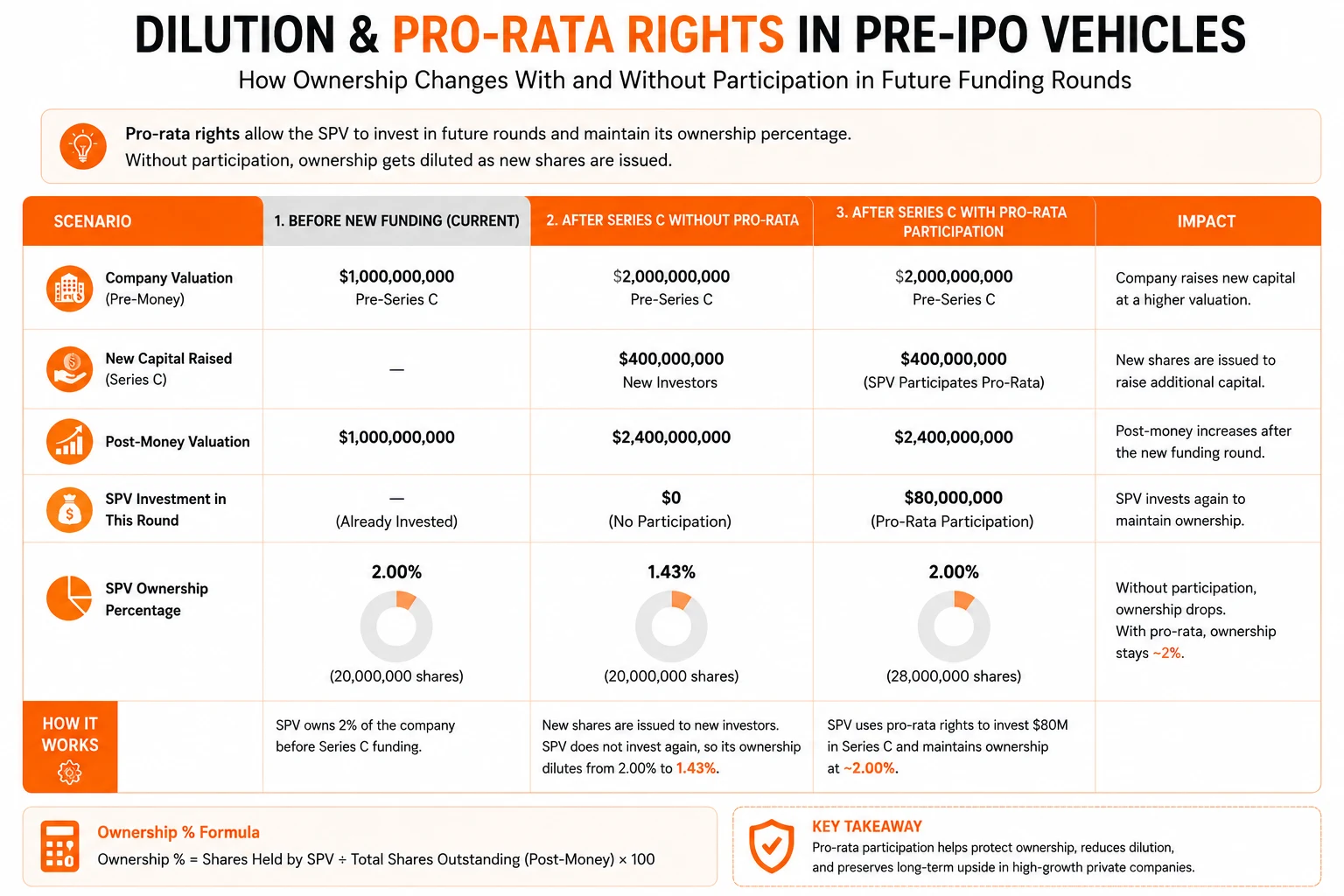
For example, an SPV that owns 2% of a startup may see its ownership decline after a Series C or Series D funding round if it does not participate again. Series C and Series D rounds are later-stage fundraising rounds where startups raise additional capital to scale operations, expand markets, or prepare for an IPO.
In many pre-IPO SPVs, pro-rata rights exist at the SPV level instead of the individual investor level. This means the SPV manager usually controls follow-on participation decisions, allocation rules, and access to future investment rounds.
Modeling Pro-Rata Rights in Pre-IPO Vehicles
Pro-rata modeling helps investors estimate how future funding rounds may affect ownership percentages. These models also show how follow-on investing can reduce dilution over time.
Ownership Before New Funding
Pro-rata modeling starts with the SPV’s ownership percentage before a new funding round. For example, an SPV may initially own 2% of a startup before the company raises additional capital.
Dilution Without Participation
Dilution happens when the company issues new shares to incoming investors. If the SPV does not participate in the next round, its ownership percentage usually declines because the total number of outstanding shares increases.
Maintaining Ownership Through Follow-On Investing
Pro-rata rights allow the SPV to invest additional capital during future rounds. This process helps the SPV maintain its original ownership percentage and continue participating in the company’s growth.
Capital Required for Pro-Rata Participation
Investors must also model how much additional capital they may need for follow-on investing. Larger funding rounds can require significant additional investment to maintain ownership levels.
Oversubscribed Round Limitations
High-demand private companies may limit investor allocations during later funding rounds. In oversubscribed rounds, SPVs may not receive their full pro-rata allocation even if investors want to invest more capital.
Preferred Shares vs Common Shares in SPV Structures
Feature | Preferred Shares | Common Shares | Key Stats/Insights |
Payout Priority | Paid first | Paid last | Preferred paid first in 90%+ of VC exits |
Liquidation Preference | Yes (1x–2x+, often participating) | None | 1x standard; participating in 20-40% early deals |
Downside Protection | Strong (anti-dilution, priority) | Limited | Preferred recovers 1.5–2x+ more in down exits |
Dividend Rights | Preferential/fixed | Discretionary, subordinate | Preferred often 6-8%+ cumulative |
Voting/Control Rights | Limited/protective | Full | Preferred hold veto on key decisions |
Risk/Volatility | Lower | Higher | Common 2–3x higher volatility |
Liquidity/Valuation | Moderate, premium | Lower, discounted | Common: often 30-60% discount to preferred |
Building a Complete SPV Waterfall Model
An SPV waterfall model shows how capital flows from investors to final distributions at exit. It defines the exact order in which money is returned after fees, costs, and profit-sharing are applied. The structure ensures transparency between LPs and managers and avoids ambiguity in return calculations.
Main inputs required: capital raised, carry percentage, management and setup fees, expected exit value, and holding period assumptions.
Step 1: Raise Capital
Investors commit capital into the SPV. Ownership percentages are assigned based on contribution size.
Step 2: Deduct Setup Costs
Legal, structuring, and formation costs are deducted upfront. These reduce the initial deployable capital.
Step 3: Apply Annual Fees
Management fees are charged over the holding period. These reduce net asset value over time.
Step 4: Model Follow-On Rounds
Ownership is adjusted if additional funding rounds occur. This captures dilution effects before exit.
Step 5: Calculate Exit Proceeds
Total exit value is allocated based on final ownership after dilution adjustments.
Step 6: Apply Carry
Carry is calculated on profits after returning the original invested capital to LPs.
Step 7: Calculate LP Distributions
Remaining proceeds are distributed to LPs after fees and carry deductions. This represents the final cash return.
This step-by-step structure ensures the waterfall reflects real capital priority, from gross exit value to net investor returns.
According to Forge Global, institutional activity in private secondary markets continued growing during 2024. Investors also increased focus on liquidity, secondary pricing, and net returns as companies stayed private longer.
What Risks Should Investors Understand?
Pre-IPO SPVs can generate strong returns, but they also carry several important risks.
- Long liquidity timelines can lock investor capital for years before an IPO or exit occurs.
- High fee drag can reduce net returns during long holding periods.
- Dilution risk can lower ownership percentages in future funding rounds.
- Weak governance rights may limit investor control and transparency.
- Unclear waterfall terms can create confusion around distributions and carry calculations.
- Valuation risk can cause private shares to trade below headline funding-round prices.
- Delayed IPO risk can extend holding periods and reduce annualized returns.
Investors should carefully review SPV documents, fee structures, carry terms, and liquidity rights before participating in private-market deals.
What Investors Should Review Before Joining an SPV
Before joining an SPV, investors should check how returns are structured and what costs apply. These factors directly affect net performance and exit outcomes.
- Carry structure: how profits are split between sponsor and LPs.
- Total fees: setup, management, and ongoing costs.
- Waterfall mechanics: payout order from exit proceeds.
- Governance rights: level of investor control or voting.
- Liquidity restrictions: lock-up periods and exit limits.
- Pro-rata rights: ability to follow on in future rounds.
- Sponsor track record: past execution and deal performance.
Reviewing these areas helps investors understand risk, control, and expected returns before committing capital.
Bottom Line
SPV waterfalls determine how much capital investors actually receive after an exit. While headline valuations often look strong, real outcomes depend on how carry, fees, and dilution are structured.
Institutional investors focus on these mechanics because they directly affect net MOIC and IRR, not just paper gains. Understanding waterfall design, payout order, and investor protections helps explain why two SPVs with the same exit valuation can produce very different returns.
In pre-IPO investing, the structure matters as much as the deal itself.
Disclaimer: This article is for educational purposes only and is not financial, legal, investment, or tax advice. Tokenized and private-market assets carry risks, including loss, limited liquidity, custody issues, and regulatory changes. Review all documents and seek professional advice before investing.