
Many private-market assets are expensive for a single investor to buy alone. Fractionalization solves this by dividing ownership into smaller interests that multiple investors can hold. This model is widely used in venture capital, pre-IPO investing, private equity, commercial real estate, and tokenized real-world assets (RWAs).
According to Boston Consulting Group (BCG), tokenized illiquid assets could grow into a $16 trillion market by 2030, reflecting growing institutional interest in digital ownership infrastructure and secondary-market liquidity systems.
Today, two major structures dominate fractional ownership: traditional SPV-based structures and blockchain-based tokenized structures. SPVs rely on legal agreements and centralized administration, while tokenized systems use blockchain networks, smart contracts, and digital transfer systems.
Both structures aim to give investors shared economic exposure while maintaining ownership controls and compliance systems. This guide explains how these ownership models work, how transfers and investor rights are managed, and why hybrid SPV-token structures are becoming increasingly important in private markets.
What Is Fractionalization Mechanics?
Fractionalization is the process of dividing ownership of an asset into smaller interests that multiple investors can hold. Fractionalization mechanics is the system used to divide and manage ownership. The system determines how ownership is recorded, how investor rights are enforced, and how transfers are controlled over time.
Fractionalization is not only about splitting economics. It also requires systems for:
- ownership tracking
- governance
- compliance
- transfer restrictions
- distributions
- investor rights
A major distinction exists between economic exposure and legal ownership. Economic exposure gives investors participation in an asset’s performance, appreciation, or exit proceeds. Legal ownership refers to the officially recognized ownership rights enforceable under law.
Different structures solve this ownership problem differently.
SPV-based structures rely on legal structures, contracts, operating agreements, and centralized administration. Tokenized systems rely on blockchain infrastructure, smart contracts, wallets, and programmable transfer rules.
At its core, fractionalization is an ownership-management system designed to coordinate multiple investors around one underlying asset.
How Fractionalization Works
Fractionalization follows a structured ownership process. The asset is divided into smaller interests, investor rights are assigned, and ownership records are maintained through legal or blockchain-based systems.
Dividing an Asset Into Ownership Units
Fractionalization works by dividing one asset into smaller ownership interests that multiple investors can hold. Instead of purchasing the full asset, each investor owns only a percentage of it. This structure makes large private-market investments more accessible to smaller investors.
Assigning Economic Rights
Once ownership is divided, investors receive economic rights connected to their ownership percentage. These rights may include profit participation, distributions, appreciation exposure, and a share of exit proceeds. The value an investor receives depends on the structure of the investment and the performance of the underlying asset.
Recording Ownership Interests
Ownership interests must be recorded and tracked properly. Traditional SPV structures use cap tables, membership records, and legal ownership records. Tokenized systems use blockchain wallets and token records to track ownership digitally.
Managing Governance Rights
Governance rights also need to be managed. Some structures give investors voting or approval rights, while others place decision-making authority under a manager or administrator. These rights become important during financings, exits, ownership changes, or secondary sales.
Handling Transfers and Liquidity
Fractionalized ownership systems also require transfer controls. Investors may want to sell their interests through secondary transactions, but many private-market structures include restrictions, approvals, or compliance checks before transfers can occur.
What Is an SPV Structure?
A Special Purpose Vehicle (SPV) is a separate legal structure created to hold one investment or a specific group of assets.
SPVs are commonly used because they help:
- reduce large startup cap tables
- combine multiple investors into one structure
- simplify reporting and administration
- centralize governance and compliance
- organize group investments efficiently
In an SPV structure, investors contribute capital into the vehicle, and the SPV combines those funds into one investment structure. The SPV then purchases shares or assets on behalf of participating investors. The startup recognizes the SPV as the official shareholder, while investors own membership interests inside the SPV itself.
Platforms like AngelList helped popularize venture SPVs by making startup group investing easier to manage at scale. The platform has supported thousands of SPV formations for private-market investments.
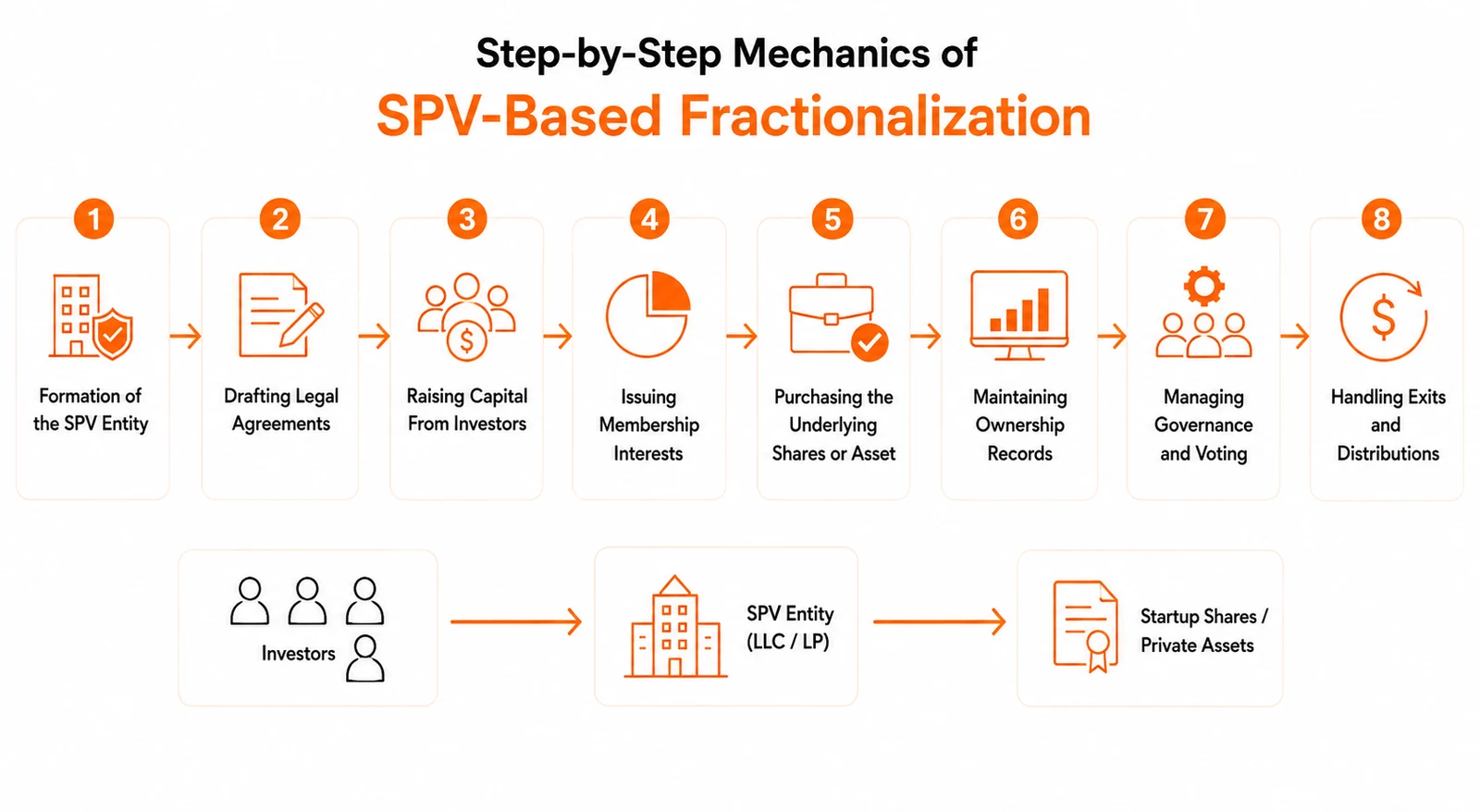
Step-by-Step Mechanics of SPV-Based Fractionalization
SPV-based fractionalization follows a structured legal and operational process.
Step 1: Formation of the SPV Structure
The process starts with the creation of an LLC (a business structure that protects investors from personal liability) or limited partnership. This legal structure becomes the official investment vehicle that will hold the underlying shares or assets.
Step 2: Drafting Legal Agreements
The SPV manager prepares legal documents such as operating agreements, subscription agreements, and investor-rights provisions. These documents define ownership terms, voting rights, fees, transfer restrictions, and distribution rules.
Step 3: Raising Capital From Investors
Investors complete onboarding, compliance checks, and capital commitments. Once funds are collected, the SPV combines investor capital into one structured investment.
Step 4: Issuing Membership Interests
Each investor receives membership interests inside the SPV based on their contribution amount. Ownership percentages are recorded internally through cap tables and membership ledgers.
Step 5: Purchasing the Underlying Shares or Asset
The SPV then invests capital into the target asset, such as startup shares, private equity positions, or real estate holdings. The underlying company recognizes the SPV as the legal shareholder.
Step 6: Maintaining Ownership Records
SPV administrators maintain investor records, reporting systems, capital accounts, and distribution schedules throughout the investment lifecycle.
Step 7: Managing Governance and Voting
Most SPVs operate under manager-controlled governance structures. The SPV manager typically handles voting decisions and communication with the underlying company.
Step 8: Handling Exits and Distributions
If the asset is sold, acquired, or reaches an IPO, proceeds flow back into the SPV. Returns are then distributed to investors based on their ownership percentages and waterfall distribution terms.
What Is Token-Based Fractionalization?
A real-world asset is divided into digital units called tokens. Each token represents a verified share of ownership in that asset. These tokens are stored and transferred on blockchain networks, making ownership digital, traceable, and easier to manage.
Blockchain records ownership through
- Distributed ledgers store transaction records across many nodes.
- Wallet-based systems allow investors to hold and transfer tokens directly.
- Immutable records ensure ownership data cannot be changed once confirmed.
Not all tokens represent ownership rights. Utility tokens provide access to a product or service, such as platform features or usage rights. Security tokens represent financial ownership in assets like equity, real estate, or funds. Only security tokens carry legal and investment rights.
- Real-world assets are structured legally first, then divided into smaller fractional units. These units are issued as digital tokens on a blockchain, where each token reflects a share of the underlying asset.
- Smart contracts automate how tokens are issued, transferred, and managed. They also enforce rules like compliance checks and profit distribution without manual intervention.
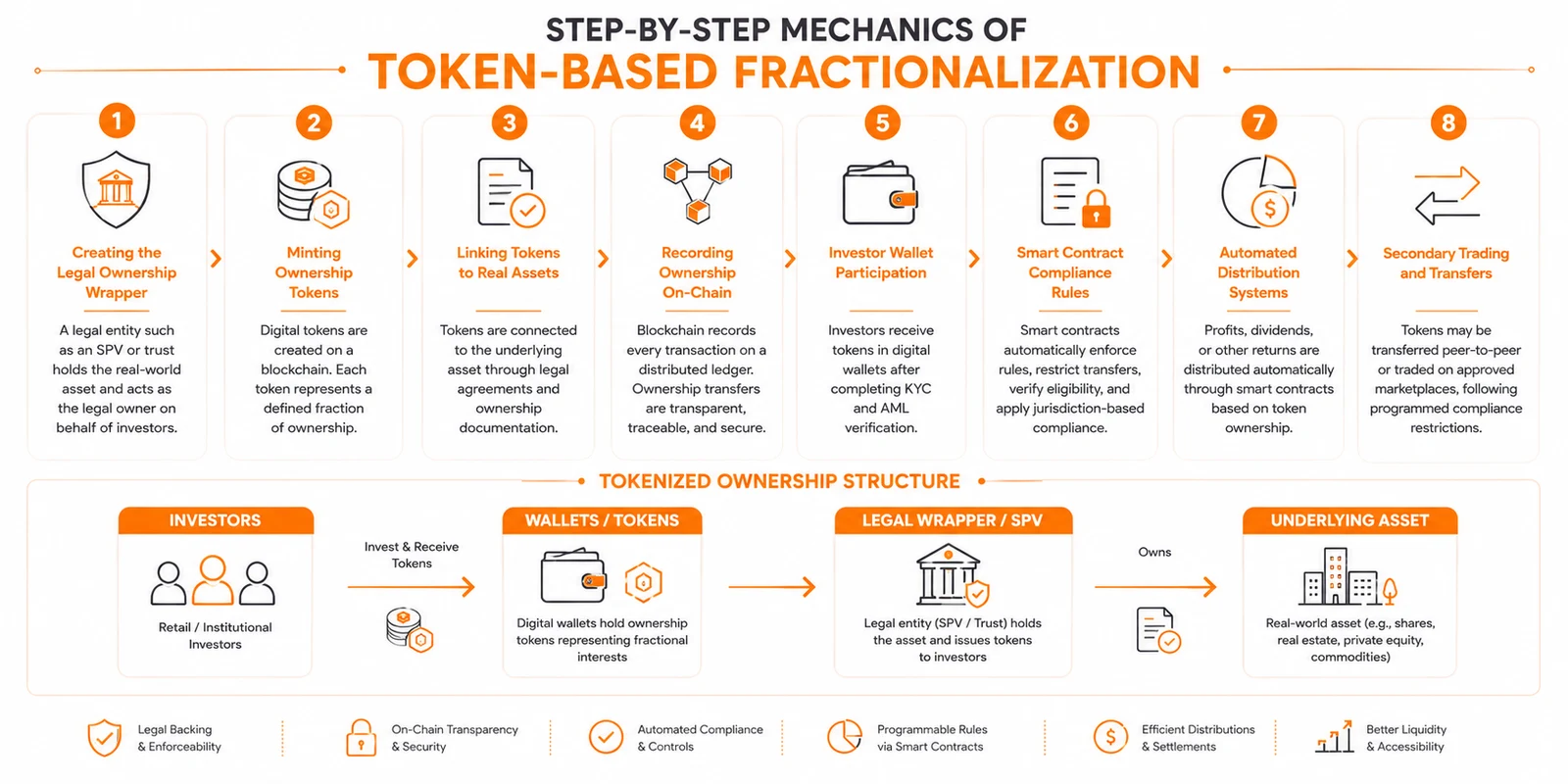
Step-by-Step Mechanics of Token-Based Fractionalization
Token-based fractionalization works by combining legal structures with blockchain systems. It links real-world ownership with digital tokens in a controlled process.
Step 1: Creating the Legal Ownership Wrapper
Most token systems still rely on a legal entity such as an SPV or trust. This structure holds the real-world asset and acts as the legal owner on behalf of investors.
Step 2: Minting Ownership Tokens
After the asset is structured, digital tokens are created on a blockchain. Each token represents a defined fraction of ownership. This issuance process is known as minting.
Step 3: Linking Tokens to Real Assets
The tokens are connected to the underlying asset through legal agreements and ownership documentation. This gives the tokens a legal right linked to the asset.
Step 4: Recording Ownership On-Chain
Blockchain systems record every transaction on a distributed ledger. Ownership transfers become transparent, verifiable, and difficult to change after confirmation.
Step 5: Investor Wallet Participation
Investors receive tokens in digital wallets after completing identity verification checks such as KYC and AML procedures. Wallets function as digital ownership accounts.
Step 6: Smart Contract Compliance Rules
Smart contracts implement rules. They can restrict transfers, check investor eligibility, and apply legal requirements based on location.
Step 7: Automated Distribution Systems
Profits, dividends, or other returns can be distributed automatically through smart contracts based on token ownership percentages.
Step 8: Secondary Trading and Transfers
Tokens may be transferred directly between users or traded on approved marketplaces. All transfers still follow the programmed compliance restrictions.
Token Standards and Legal Structure Behind Tokenized Ownership
Blockchain can record ownership transfers, but tokens alone do not create legal ownership rights. In many systems, blockchain records token holders, while legal contracts define investor rights.
Different token standards are used based on the level of compliance required.
- ERC-20 supports basic identical token transfers but does not include compliance controls.
- ERC-1400 was designed for security tokens and includes transfer restrictions, investor verification, and regulatory controls.
- ERC-3643 focuses on permissioned ownership systems where only approved wallets can hold or transfer tokens. This structure is commonly discussed in regulated tokenization infrastructure.
Compliance remains central to tokenized ownership systems. Investors usually complete KYC and AML checks before receiving tokens. Wallet approval lists are also used to limit transfers to approved participants only.
Tokenized ownership still faces challenges around securities-law uncertainty, wallet security, and cross-border regulation. Different jurisdictions apply different rules to digital assets, increasing legal complexity for global offerings.
Institutional adoption continues growing. According to the official ERC-3643 Association, the ERC-3643 ecosystem supports over $32 billion in tokenized assets across regulated real-world asset infrastructure.
SPV-Based vs Token-Based Ownership Mechanics
Comparison Area | SPV-Based Structure | Token-Based Structure |
Legal ownership | Clear ownership through the SPV company. | Tokens give economic rights; SPV holds legal title. |
Ownership recording | Manual records and paperwork. | Digital records on blockchain (easy to check). |
Transfer process | Slow; needs documents (often 7–30 days). | Near-instant blockchain transfers. |
Settlement speed | Takes 2–5+ days. | T+0 to T+1 (up to 99% faster). |
Liquidity potential | Low; limited secondary markets. | Much higher (5–10x liquidity premium in secondary markets). |
Compliance enforcement | Done manually by staff. | Automatic via smart contracts (cuts costs by 40–70%). |
Hybrid Structures Combining SPVs and Tokenization
Hybrid ownership structures combine traditional SPVs with blockchain-based token systems. In these models, the SPV legally owns the underlying asset, while blockchain tokens represent investor interests linked to that SPV. This combines legal ownership frameworks with digital transfer infrastructure.
One of the most common institutional models today is the tokenized SPV membership structure. Investors usually do not directly own the asset on-chain. Instead, they hold tokens tied to SPV membership interests or economic rights, while legal agreements continue governing ownership and investor protections.
Institutions prefer hybrid models because they combine legal protection with blockchain efficiency through:
- Recognized legal protection using SPV structures and legally binding agreements.
- Faster reporting and settlement systems through blockchain infrastructure.
- Improved ownership tracking and transfer efficiency using digital token systems.
Many hybrid systems also use permissioned token infrastructure where only verified investors can participate through identity checks and transfer restrictions.
In 2024, Hamilton Lane’s tokenized Secondary Fund VI raised $5.6 billion through the Securitize platform on Polygon blockchain infrastructure. KKR has also explored regulated tokenized fund structures.
Risks and Limitations Tokenized structures still face legal, technical, and operational risks. These include regulatory uncertainty, smart contract vulnerabilities, wallet security issues, compliance fragmentation, and limits on institutional adoption. |
Final Outlook
Fractionalization is about managing shared ownership. SPV-based structures rely on legal agreements, centralized administration, and compliance systems. Tokenized structures use blockchain infrastructure, smart contracts, and digital transfer systems to improve efficiency and ownership tracking.
However, tokenization alone does not replace legal ownership frameworks. Legal protection, compliance, and investor security still remain critical in private markets.
This is why many institutions are exploring hybrid SPV-token models that combine legal structures with blockchain infrastructure. These systems improve speed, transfer efficiency, and digital ownership management while maintaining regulatory control.
The future of private-market ownership will combine traditional legal systems with digital infrastructure.
Disclaimer: This article is for educational purposes only and is not financial, legal, investment, or tax advice. Tokenized and private-market assets carry risks, including loss, limited liquidity, custody issues, and regulatory changes. Review all documents and seek professional advice before investing.